
How to Choose LED Lighting for Growing: Watts, PPFD and Tent Size
Choose the right LED lighting based on the area it needs to illuminate, not just the wattage on the box. In this article, you’ll learn what PPF, PPFD, µmol/J and DLI mean, how much light tomatoes, chillies and lettuce need, what input power is suitable for your tent, and how to assess the spectrum, hanging height and dimming. At the end, you’ll find a comparison table of specific LED lights by tent size.
Start with your tent size
Grow LED manufacturers state a recommended area for each light, such as 80 × 80 cm or 1.2 × 1.2 m. The area is the first thing to consider:
- Measure the inside dimensions of your tent or the area you want to illuminate.
- Choose a light that the manufacturer recommends for this area. A light that is too small may not illuminate the edges sufficiently; a more powerful model can be dimmed as needed. PPFD distribution and the required DLI are what matter.
- Only then compare efficiency, spectrum and features (dimming, control, protection rating).
For the lights in our comparison table below, input power at full output is generally 280–420 W per m² of growing area. It is higher for the smallest tent size, 60 × 60 cm: for example, the SANlight EVO LED Set 60 has an input power of 200 W for 0.36 m². The manufacturer recommends dimming this small set because full output may be too high, particularly for young plants. However, watts are only a rough guide. The light’s efficiency determines how much light it produces from its wattage.
PPF, PPFD, µmol/J and DLI: what they mean
The traditional photosynthetically active radiation (PAR) range is 400–700 nm. Longer wavelengths can also be useful for photosynthesis when combined with light in this range; see the section on far-red. So, for grow lights, look for these figures rather than lumens or lux:
| Measurement | What it means |
|---|---|
| PPF (µmol/s) | The amount of photons in the PAR range emitted by a light per second. It is expressed in micromoles per second, not watts. |
| PPFD (µmol/m²/s) | The number of micromoles of these photons that fall on 1 m² per second at plant level. It is measured with a PAR metre and depends on the hanging height. |
| Efficiency (µmol/J) | The number of micromoles of photons in the stated spectral range emitted by a light per 1 joule of electricity consumed. Compare the complete light, including its power supply, and make sure the spectral range is the same. |
| DLI (mol/m²/day) | The total amount of light received per 1 m² each day. It combines light intensity (PPFD) and lighting duration. |
For constant or time-averaged PPFD during the lighting period, the conversion is: DLI = PPFD × number of lighting hours × 3,600 / 1,000,000. To calculate the average PPFD you need, use the reverse formula: PPFD = DLI × 1,000,000 / (hours × 3,600).
How much light do plants need?
University recommendations are usually given as DLI. We calculated the average PPFD in the table from these figures, based on 16 hours of lighting per day. Treat the values as a guide; they vary depending on the variety, temperature and other conditions.
| Crop and stage | DLI (mol/m²/day) | PPFD at 16 h (µmol/m²/s) | Source |
|---|---|---|---|
| Lettuce and cucumber seedlings | 10–15 | 174–260 | Purdue University |
| Tomato and pepper seedlings | 15–20 | 260–347 | Purdue University |
| Hydroponic lettuce with good air circulation | 17 | 295 | Cornell University |
| Fruiting tomatoes, peppers and cucumbers | at least 15, preferably over 20 | at least 260, preferably over 347 | Michigan State University |
For lettuce, Cornell recommends a DLI of 17 only when there is good air circulation around the growing leaves. Without it, the recommendation is a lower DLI of 13–14, as rapid growth can lead to tipburn, or marginal necrosis of young leaves, when the growing point does not receive enough calcium. More light is not always better. Fruiting vegetables such as tomatoes and chillies, on the other hand, can tolerate and make use of more light. We cover growing chillies under a lamp in detail in the article How to grow chilli peppers under artificial lighting.
How many watts of LED lighting for a tent: comparison table
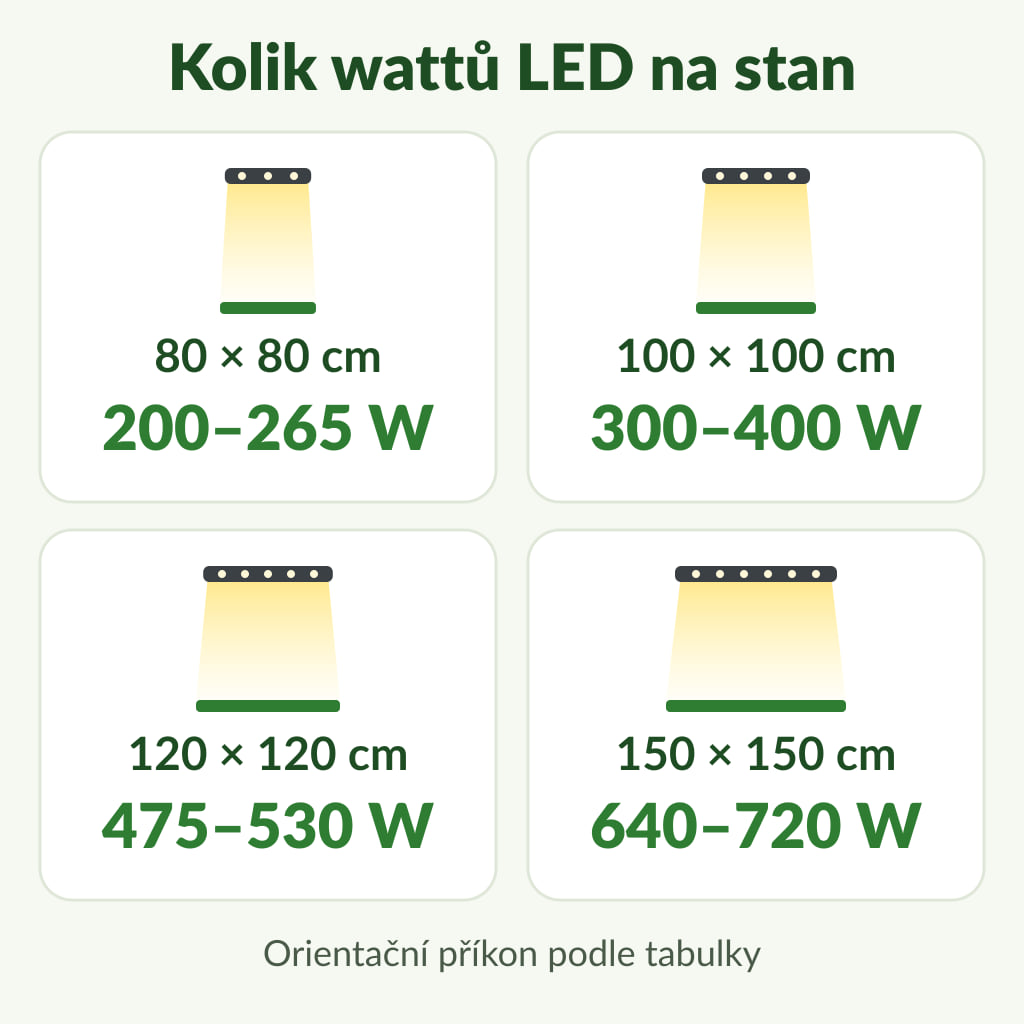
The table lists LED lights from our range, ordered by their indicative recommended area. Input power, photon flux and efficiency are taken from catalogue information; for the Varidrive range, the figures have only been verified against the Higarden listing. The recommended area alone does not determine whether a light is suitable for a specific crop: also compare PPFD, lighting duration and DLI. For SANlight, the asterisk indicates photon flux in the wider 400–780 nm range and efficiency calculated by dividing photon flux by the input power of the complete light. The manufacturer’s stated module efficiency of over 3 µmol/J applies to LED modules, not the complete light. These figures therefore cannot be directly compared with PPF and efficiency for PAR at 400–700 nm.
Indicative input power based on the table:
The “Photon flux per m²” column shows the light’s declared photon flux divided by the tent area. It is not a PPFD measurement: it does not account for the light’s geometry, losses or reflections from the walls. For the Lumatek ATS 200W PRO, this calculation gives 794 µmol/m²/s, while the manufacturer’s catalogue gives an average PPFD of approximately 511 µmol/m²/s at a height of 40 cm, with no wall reflections and at full output. For the ATS 300W PRO, the calculation gives 816, while the catalogue average is approximately 572 µmol/m²/s under the same conditions. In these two examples, the measured figure is roughly 64–70% of the simple calculated value; this is not a universal conversion factor for other installations.
| Tent (area) | LED light | Input power | Photon flux (µmol/s) | Efficiency (µmol/J) | Photon flux per m² |
|---|---|---|---|---|---|
| 60 × 60 cm (0.36 m²) | SANlight EVO LED Set 60 | 200 W | 545* | 2.73* | 1514 |
| 60 × 120 cm (0.72 m²) | Lumatek Zeus 300W PRO 3.1 | 312 W | 965 | 3.1 | 1340 |
| 80 × 80 cm (0.64 m²) | Maxibright Daylight PRO 200W | 200 W | 500 | 2.5 | 781 |
| Lumatek ATS 200W PRO | 208 W | 508 | 2.5 | 794 | |
| SANlight EVO LED Set 80 | 265 W | 725* | 2.74* | 1133 | |
| 100 × 100 cm (1.00 m²) | Maxibright Daylight PRO 300W | 300 W | 750 | 2.5 | 750 |
| Lumatek ATS 300W PRO | 310 W | 816 | 2.7 | 816 | |
| Maxibright Varidrive 360W (0.8 × 0.8 to 1.2 × 1.2 m) | 360 W | 1040 | 2.89 | 1040 | |
| SANlight EVO LED Set 100 (2 lights) | 400 W | 1090* | 2.73* | 1090* | |
| 120 × 120 cm (1.44 m²) | Lumatek Zeus 465W PRO 3.1 | 475 W | 1450 | 3.1 | 1007 |
| SANlight EVO LED Set 120 (2 lights) | 530 W | 1450* | 2.74* | 1007 | |
| 150 × 150 cm (2.25 m²) | Lumatek Zeus 600W PRO 3.1 | 640 W | 1990 | 3.1 | 884 |
| SANlight EVO LED Set 150 (2 lights) | 680 W | 1830* | 2.69* | 813 | |
| Maxibright Varidrive 3.0 720W (1.2 × 1.2 to 1.5 × 1.5 m) | 720 W | 2160 | 3.0 | 960 |
For larger areas, you can use several smaller lights or a kilowatt model, such as the Lumatek Zeus 1000W PRO EVO 3.1 (1025 W, PPF 3125 µmol/s) for an area of 1.5 × 2.0 m. Find more models in the Lumatek LED, SANlight LED and Maxibright LED categories, as well as in the full LED grow lights category.
The SANlight EVO sets in the table for areas from 1 × 1 m use two lights. According to the manufacturer, their positioning and angling can provide more even lighting; the actual result depends on the installation.
Efficiency in µmol/J: why it matters
Efficiency determines how much you pay for electricity to get the same amount of light. For comparison:
- HID lamps: In Nelson and Bugbee’s 2014 study, the most efficient double-ended HPS lights achieved about 1.7 µmol/J. An older reference light with a large screw base and magnetic ballast had an efficiency of 1.02 µmol/J; this is not a figure for all HPS lights.
- Minimum for certification: Version 4.0 of the DesignLights Consortium (DLC) programme requires a declared efficiency of at least 2.5 µmol/J in the 400–700 nm range. Version 3.0 set the threshold at 2.3 µmol/J. This is a condition for inclusion on the DLC list, not a general requirement for lights sold in the Czech Republic.
- Catalogue LED efficiency: For Lumatek, Maxibright Daylight PRO and Varidrive, the table lists 2.5–3.1 µmol/J based on supplier information. Catalogue figures may not exactly match the stated PPF divided by input power; for example, for the ATS 200W PRO, 508 / 208 works out at approximately 2.44 µmol/J. For SANlight, the figure is calculated for a wider range and marked with an asterisk.
- Technology estimate from 2020: Kusuma, Pattison and Bugbee estimated that the technology available at the time could achieve an efficiency of around 3.4 µmol/J for lights with white and red diodes. According to the authors, protective optics against water and humidity reduce this by approximately 10%. This is not a universal physical limit for all LEDs.
For example, to produce the 1990 µmol/s output of the Lumatek Zeus 600W PRO 3.1, a light with an efficiency of 3.1 µmol/J needs about 642 W. At 2.5 µmol/J, it would need about 796 W, and at 1.7 µmol/J, about 1171 W. You pay the difference every day the lights are on, and higher input power also means more heat in the tent. Read our article Growing under artificial lighting: HPS vs. LED for a comparison of older HID lamps and LEDs.
Spectrum: full spectrum, red and far-red
The catalogue information for the lights in the table states that they provide a full spectrum for both growth and flowering. You therefore usually do not need to change the light source between these stages. For example, the Lumatek ATS PRO combines white, red and far-red diodes.
- Far-red (700–750 nm): This lies just beyond the PAR range. According to the study by Zhen, van Iersel and Bugbee (2021), when combined with standard light, far-red photons contribute to photosynthesis in a crop just like PAR photons, up to a share of about 30% of the photons. The authors therefore propose an extended 400–750 nm range (ePAR). Far-red is included in lights such as the Maxibright Daylight PRO and Lumatek ATS PRO.
- Supplementary bars: Lumatek offers separate far-red and UV bars for Zeus lights. According to the manufacturer, the far-red bar is used during vegetative growth and at the start of flowering, and the UV bar towards the end of flowering.
- Supplementary lighting for lower levels: Separate bars beneath the plant canopy address this; see the article How to choose LED lighting for under-canopy and inter-canopy use.
For small areas of seedlings, herbs and Microgreens, lower-output bars and panels may be sufficient if they provide the required PPFD and DLI. We cover them in more detail in the article Choosing lighting for growing Microgreens.
Hanging height and uniformity
The higher the light hangs, the larger the area it illuminates, but the lower the intensity at plant level. Choose the distance and dimming level according to the manufacturer’s recommendations and PPFD measurements; you do not necessarily have to address the higher intensity needed at a later stage simply by lowering the panel.
- Start with the manufacturer’s manual. Recommended distances vary by model and growth stage.
- Check with measurements. A PAR metre, such as the Apogee SQ-520 or Maxibright PAR Metre, measures the actual PPFD at leaf level. Take measurements in the centre and in the corners.
For specific distances, see the article How high to hang grow lights.
Dimming and control
Dimming lets you use the same light for seedlings and fully grown plants, and save electricity where plants do not need full output.
- Stepped dimming: Lumatek ATS and Zeus lights include a 0–10 V dimmer with off, 25, 50, 75 and 100% settings. Maxibright Daylight PRO has a remote dimmer with 25/50/75/100% settings, while Varidrive has an integrated dimmer from 25–100%.
- Controllers: Connect a controller through a compatible control interface, such as the Maxibright Universal Lighting Controller 0-10V. According to the product description, it schedules lighting, simulates sunrise and sunset, and can dim lights in the event of overheating. The RJ connector shape alone does not guarantee compatibility; the Daylight range uses the iLink system and the relevant Daylight controller. Find other models in the controllers category.
- Timer: For high-power LEDs with an integrated driver, we recommend controlling the lighting through a controller (see the descriptions of Lumatek Zeus lights). If you use a timer, its wiring and switching capacity must comply with the manual and the driver’s inrush current requirements. The inrush current must also be checked for lights below 600 W; the input power rating alone is not enough.
More powerful LEDs heat the tent. So, when choosing a light, also consider ventilation; see the article High temperatures when growing indoors.
Frequently asked questions
How many watts of LED lighting do I need for a 100 × 100 cm tent?
The lights that manufacturers recommend for an area of 1 × 1 m have an input power of 300–400 W in our table, for example the Maxibright Daylight PRO 300W (750 µmol/s) or the SANlight EVO LED Set 100 (1090 µmol/s). Focus on comparing PPF and efficiency, not just watts.
Is one powerful light better, or two smaller ones?
Both options work as long as the light covers the entire area. According to SANlight, two suitably positioned and angled lights can improve uniformity. One light usually makes hanging and cabling simpler.
Is full spectrum enough for both growth and flowering?
Yes. According to the catalogue information, the lights in the table are intended for both growth and flowering; adjust the intensity to suit the crop and its stage of development. Supplementary far-red or UV bars are optional.
How can I find out how much light the plants are actually receiving?
Measure PPFD with a PAR metre at the height of the upper leaves, both in the centre and in the corners of the tent. Use the average and the number of lighting hours to calculate DLI, then compare it with the recommendation for your crop.
Is it worth paying more for an LED with higher efficiency?
Higher efficiency reduces running costs, but the payback also depends on the purchase price, lighting duration and electricity price. With the same spectral range and the same amount of photons delivered, a light rated at 3.1 µmol/J needs about one-fifth less electricity than a light rated at 2.5 µmol/J and, in the same position, usually produces less heat.
Choose an LED for your tent
Measure the area, choose a light from the corresponding row in the table, and check its efficiency and dimming options. Browse the full range in the LED grow lights category, and the most powerful models in the Lumatek Zeus, SANlight EVO and Maxibright Varidrive categories. If you are unsure, contact us or visit one of our shops—we’ll be happy to advise you on your setup.