
CLOUDLINE A, S or T? How to set up a tent extraction system with AC Infinity
The AC Infinity CLOUDLINE inline fan range includes the A, S and T series. They differ in their specifications and the controls supplied with them. This article compares the series, gives performance figures from the manufacturer’s technical data sheets, recommends a diameter based on tent size, and explains how to assemble a quiet, effective extraction system from a filter, fan, ducting and silencer.
CLOUDLINE A, S and T: what are the differences?
All three series share the same fundamentals: a PWM-controlled EC motor, double ball bearings, IP-44 protection, a 100–240 V power supply, and horizontal or vertical mounting. According to current European package lists, the models compared here also include a UIS cable (male–male, 3.05 m) for connection to an AC Infinity controller; check the product description to confirm what is included in a specific delivery. No series includes a carbon filter. The differences lie in what else you get:
| Series | Control included | Hose clamps | Suitable for |
|---|---|---|---|
| CLOUDLINE A (A4, A6) | speed controller, 10 settings | no | lower-cost extraction with manual adjustment |
| CLOUDLINE S (S4, S6, S8, S10, S12) | speed controller, 10 settings | 2 pcs | higher flow rate, with the option to connect to AI+ later |
| CLOUDLINE T (T4, T6, T8) | Controller 69 PRO with probe, app via Wi-Fi | 2 pcs | automatic extraction based on temperature, humidity and VPD |
In Europe, the manufacturer refers to the S and T series as CLOUDLINE PRO S and CLOUDLINE PRO T. The T-series fan is the same as the S-series fan, but instead of a speed controller, you get a smart controller. It activates extraction according to temperature, humidity or VPD, and offers timers, cycles, schedules and minimum fan speeds. The app adds graphs and CSV data export. For a comparison of the controllers, see the article AC Infinity controllers: Controller AI+ or 69 PRO?
Performance according to the technical data sheets
The figures are taken from the manufacturer’s current European technical data sheets; the performance figures for the S4/T4, S6/T6 and S8/T8 sizes compared here are the same. The US website lists different flow rates and noise levels for some models, so we have not combined its figures with the European table. The CFM figures below are approximate conversions: 1 CFM = 1.699 m³/h. Connection diameters are nominal.
| Model | Diameter | Flow rate | Noise level | Static pressure | Average power consumption |
|---|---|---|---|---|---|
| A4 | 100 mm | 280 m³/h (~165 CFM) | 29 dBA | 324 Pa | 18 W |
| S4 / T4 | 100 mm | 348 m³/h (~205 CFM) | 28 dBA | 223 Pa | 21 W |
| A6 | 150 mm | 598 m³/h (~352 CFM) | 34 dBA | 394 Pa | 35 W |
| S6 / T6 | 150 mm | 683 m³/h (~402 CFM) | 32 dBA | 503 Pa | 38 W |
| S8 / T8 | 200 mm | 1,371 m³/h (~807 CFM) | 39 dBA | 746 Pa | 78 W |
| S10 | 250 mm | 2,042 m³/h (~1,202 CFM) | 48 dBA | 1,059 Pa | 136 W |
| S12 | 300 mm | 2,724 m³/h (~1,603 CFM) | 62 dBA | 818 Pa | 139 W |
The listed flow rate is the maximum figure from the technical data sheet. Static pressure is a separate limit; it does not mean that the fan delivers the maximum flow rate at that pressure. Noise levels are taken from the manufacturer’s data sheets and do not guarantee the noise level of the complete installation. Average power consumption should not be confused with maximum power: A4 35 W, S4/T4 28 W, A6 65 W, S6/T6 70 W, S8/T8 180 W, S10 255 W and S12 250 W. For reference, 1 inH2O ~ 249.09 Pa; in the same model order, the pressures in the table correspond to approximately 1.30 / 0.90 / 1.58 / 2.02 / 2.99 / 4.25 / 3.28 inH2O. With a filter and ducting, the actual flow rate in the tent is lower, so it is worth allowing for spare capacity and normally running the fan at a lower setting. For the 100 mm A4 model, the manufacturer lists a higher static pressure than for the S4, even though the A4 has a lower flow rate. We have reproduced the figures as given by the manufacturer. The article How powerful a fan do you need? explains how to calculate the required capacity for your tent. The article EC or AC fan explains the differences between motor types.
Which diameter for which tent?
The configurations listed by the manufacturer on its European website provide a useful guide: for the configurations compared, it uses 100 mm for 60 × 60 cm tents and 150 mm for tents from 60 × 120 to 120 × 120 cm. This is an example configuration, not a general limit on fan size. For a 150 × 150 cm tent, the manufacturer also uses 150 mm in its US configuration. For this size, we recommend considering 200 mm (CLOUDLINE S8 or T8) if using powerful lighting, longer ducting or a warm room; 150 mm is not a universal choice for every heat load. This is our recommendation, not a manufacturer’s specification.
| Tent | Extraction diameter |
|---|---|
| 60 × 60 cm | 100 mm (A4, S4, T4) |
| 60 × 120 and 90 × 90 cm | 150 mm (A6, S6, T6) |
| 120 × 120 cm | 150 mm (S6, T6), with 200 mm for extra capacity |
| 150 × 150 cm | 150–200 mm (S6, T6, S8, T8) |
| larger tents | based on calculations and duct ports; S10 250 mm or S12 300 mm may require external mounting and a reducer |
For specific configurations for each size, including a filter, air circulation and lighting, see the article AC Infinity setups by tent size.
Checking air exchange and spare capacity
To estimate one air exchange per minute, calculate Q = length × width × height in metres × 60 in m³/h. This is a starting design figure based on the manufacturer’s guide, not a guarantee of sufficient cooling. In its example, allowances are added for a carbon filter (multiplier of 1.6), ducting (1.2) and LED heat (up to 1.5), followed by a fan capacity reserve (1.25). The following model uses a product of 3.6; actual resistance varies.
| Tent | Volume | Base Q | Model Q × 3.6 |
|---|---|---|---|
| 60 × 60 × 120 cm | 0.432 m³ | 25.9 m³/h | 93 m³/h |
| 60 × 60 × 180 cm | 0.648 m³ | 38.9 m³/h | 140 m³/h |
| 60 × 120 × 180 cm | 1.296 m³ | 77.8 m³/h | 280 m³/h |
| 90 × 90 × 180 cm | 1.458 m³ | 87.5 m³/h | 315 m³/h |
| 120 × 120 × 200 cm | 2.880 m³ | 172.8 m³/h | 622 m³/h |
| 150 × 150 × 200 cm | 4.500 m³ | 270 m³/h | 972 m³/h |
The model shows why an S6/T6 (683 m³/h) may be sufficient for a 120 × 120 cm tent, but a 200 mm fan may be more suitable if there is additional resistance. For a 150 × 150 cm tent, this example gives 972 m³/h, which is above the S6/T6 maximum; a 200 mm fan is therefore indicated. In the manufacturer’s example, adding a silencer means applying a further multiplier of 1.2. This is an approximate calculation: check the temperature of the incoming air, lighting power consumption and actual flow rate after installation. Further details are available in the AC Infinity ventilation guide.
How to assemble an extraction system step by step
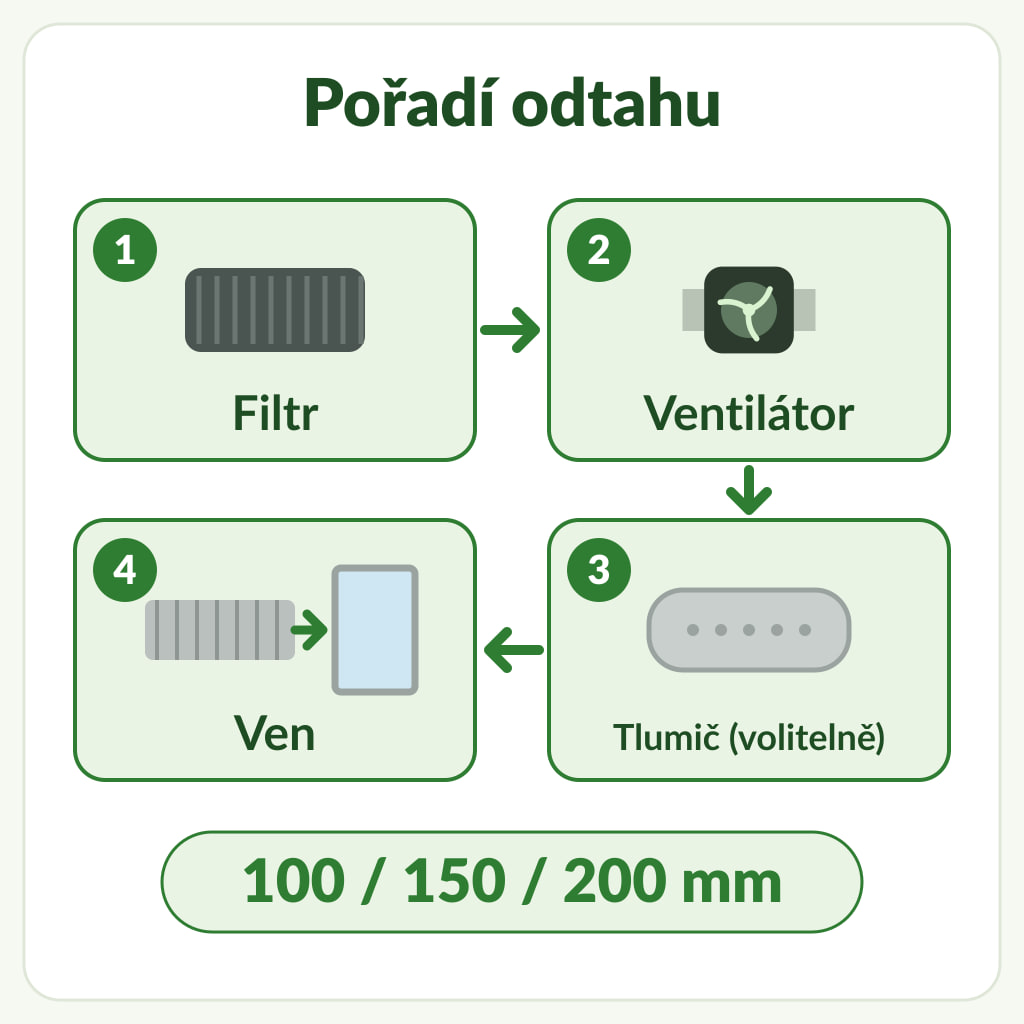
This example extraction system is assembled in the following order: filter -> fan -> silencer -> outside. For this example, choose the same nominal diameter for all components: 100 / 150 / 200 mm. The outlet to the outside is the direction of airflow; the silencer is optional.
AC Infinity components for each step:
- Filters: Duct Carbon Filter 100 mm (357 m³/h), 150 mm (697 m³/h) and 200 mm (1,308 m³/h) with Australian activated carbon. The refillable Refillable Carbon Filter Kit includes a filling that you can replace with new carbon. A pre-filter sleeve protects the filter.
- Matching the filter to the fan: choose the same nominal diameter and observe the filter’s permitted operating flow rate. Comparing only the two catalogue maximums is not enough: the filter adds resistance, reducing the flow rate of the complete system. For an S8 or T8 fan (1,371 m³/h), the XL 200 mm filter has a higher catalogue maximum flow rate (1,580 m³/h).
- Ducting: flexible 4-layer ducting in 100 mm, 150 mm (2.44 m) or 200 mm (7.62 m), and stainless steel clamps. The article How to choose ventilation ducting explains how to select and route ducting.
- Noise reduction: an Inline Duct Silencer 100 mm, 150 mm or 200 mm, and Noise Reduction Clamp noise-reducing couplers between the fan and ducting.
- Air intake: for a port used as a passive intake, the Duct Ventilation Attachment 150 mm is suitable; according to its description, it helps limit the entry of light and dust.
For general advice on where to position fans in a tent, see the articles How to choose and assemble tent ventilation and Where and how to position fans.
Ready-made ventilation kits
If you do not want to assemble the components yourself, choose a ready-made kit. AC Infinity offers two types:
- Air Filtration Kit (100 mm, 150 mm, 200 mm). See the description of the product you select for the exact contents and control method.
- Air Filter Set AI+ PRO (100 mm, 150 mm, 200 mm). See the description of the product you select for the exact contents and compatibility.
Air circulation: CLOUDRAY A or S
Extraction replaces the air, but it also needs to circulate inside the tent. CLOUDRAY clip-on fans with EC motors are designed for this purpose and attach to a tent pole:
- CLOUDRAY A6 (150 mm, 553 m³/h) and A9 (225 mm, 688 m³/h) do not have automatic oscillation,
- CLOUDRAY S6 (150 mm, 553 m³/h) and S9 (225 mm, 688 m³/h) have automatic oscillation.
All have 10 speeds and 10 dynamic airflow modes. They work independently and can be connected to a UIS controller later.
Frequently asked questions
Does the CLOUDLINE package include a carbon filter?
Standalone fans do not include a filter. It is sold separately; check the product description to confirm what is included with a ventilation kit.
Can I connect a CLOUDLINE A or S to a controller later?
Yes. According to current European package lists, the models compared here include a UIS cable. Connect it to a Controller AI+ or 69 PRO in place of the speed controller supplied, and you will gain automation and app control.
What is the difference between CLOUDLINE S and T?
The fan is the same. Instead of a speed controller, CLOUDLINE T includes a Controller 69 PRO with a probe, which controls extraction according to temperature, humidity and VPD and connects to the app. The probe measures temperature and humidity; the controller calculates VPD.
How can I make extraction quieter?
Choose a fan with spare capacity and run it at a lower setting, fit a silencer after the fan, and use a noise-reducing coupler between the fan and ducting. Suspend the fan using straps to prevent vibrations from being transmitted to the tent structure.
Can the fan be mounted vertically?
Yes. The manufacturer specifies both horizontal and vertical mounting for all CLOUDLINE series.
Where to shop
You can find fans in the AC Infinity fans category, ready-made kits in the AC Infinity ventilation kits category, and filters in the AC Infinity odour filters category. Ducting, clamps and silencers are available in AC Infinity accessories. The AC Infinity: what works with what and why guide explains how ventilation fits into the complete AC Infinity system.