
Living Soil: Organic Growing Without Fertilisers
Most of us take it for granted that, for plants in our gardens and grow boxes to thrive, we need to fertilise them regularly. But have you ever wondered who fertilises wild-growing plants? Although there is no mad gardener running across meadows and forests with a bottle of fertiliser in hand, plants in the wild usually do not lack nutrients. Their nutrition is taken care of by an army of soil microorganisms that constantly break down organic matter in the soil into plant nutrients. We will teach you how to create this natural symbiosis in your garden or growing room.
What does living soil mean? The literal translation into Czech is “živá půda”, and this term precisely captures the fact that living soil substrates are literally teeming with soil microorganisms. These beneficial bacteria, nematodes, fungi, protozoa and other microbes feed on organic matter in the soil, breaking it down into nutrients digestible by plants. As long as everything works as it should and there are enough microbes and organic matter in the soil, plants are part of the food chain and will always have enough nutrients.
How to create a living soil environment
 The living soil method is closely related to permaculture growing. This is based on working with nature and trying to interfere as little as possible with natural processes. The main mantra of every permaculture gardener is that fast-acting fertilisers made from mineral salts, as well as chemical pesticides and herbicides, have no place in the soil under any circumstances. All these products kill soil microorganisms, and their use leads to the breakdown of the natural food chain. Mineral fertilisers salinate the soil and create an unsuitable environment for microbes in the soil. In the case of chemical sprays, the main problem is that they do not act selectively and also kill beneficial organisms.
If you grow outdoors in beds, then switching to living soil will not be difficult for you. Start by removing synthetic fertilisers and sprays and replacing them with organic inputs. The basis is quality compost, worm humus, both rich in organic matter and microorganisms. Plants grown in living soil should be watered only with water, preferably rainwater that does not contain chlorine. It is also very important not to dig up the soil unnecessarily or disturb its structure. Instead, you can support natural soil processes by regular mulching, or by planting cover crops capable of fixing atmospheric nitrogen. Last but not least, keep an eye on the soil acidity, which should have a pH in the range of 6.0 to 7.0. You can lower soil acidity by liming and increase it by adding organic matter.
You may also be interested in: Series – Grow Three Plants Outdoors
Living soil indoors
Living soil indoors does not differ much from growing in other substrates. The main role is played by quality soil rich in organic matter and containing beneficial microbes. For this purpose, ordinary horticultural substrate is definitely not enough, as it does not contain enough nutrients and plants in it need to be fertilised regularly. It is also not a good idea to use soil from outside, which may be fertile but is likely to contain the germs of pests and pathogens that would multiply in an indoor environment.
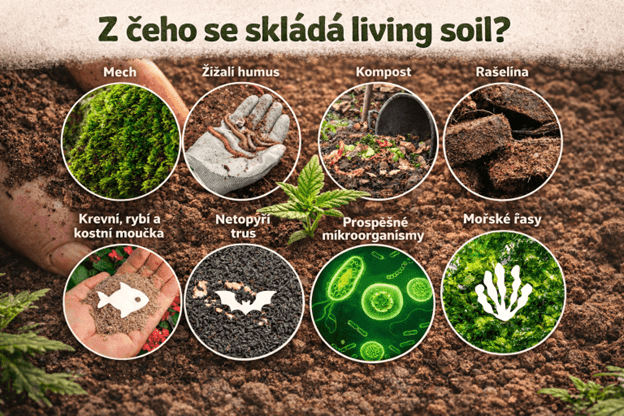
 Some experienced growers mix their own living soil, often according to very complex recipes proven over many years. Such home-prepared soil may contain dozens of ingredients, such as compost, peat, worm humus, blood and bone meal, ash, seaweed, guano, crustacean shells and dolomitic limestone. Fortunately for those who do not want to spend years experimenting, ready-made living soil substrates are now available on the market, allowing you to start growing immediately.
Bionova Living Soil: A mix for preparing 15 to 20 litres of living soil, enough for one plant for roughly 12 weeks, i.e. approximately one growing cycle. The contents of the pack are enough to mix with organic soil substrate, activate with water and you can start growing. The plants do not need to be fertilised, only watered with clean water.
Florganics Dope Soil: A pre-prepared living soil substrate already enriched with a universal mix of fertiliser and beneficial microorganisms, including earthworm germs. The growing substrate only needs to be watered with clean water without pH adjustment, and no fertilisers or other additives are required.
BioBizz Premix: A loose natural fertiliser that can be used to revive exhausted soil or when preparing your own living soil substrate. After mixing 10% BioBizz Premix with 60% organic substrate, 15% perlite and 15% worm humus, a fertile substrate suitable for indoor growing using the living soil method is created.
Monster Living Soil Concentrate: A base for preparing home-made living soil for permaculture growing. After mixing 1:1 with lightened soil substrate and allowing it to mature for 2 to 4 weeks, you will obtain 100 litres of highly fertile soil, ideal for permaculture gardens and indoor growing.
Monster Living Soil Homegrow Pot: A pre-mixed living soil substrate ready for immediate use in a practical bucket that serves as a pot. Simply plant the plant and water with clean water.
How to grow in living soil
Growing in living soil is not about frantic activity. On the contrary, living soil rewards long-term planning and a gentle approach. Once you manage to create a functioning soil ecosystem, your main role will be not to disturb it unnecessarily.
Remember that in permaculture growing you do not feed the plants, but the soil and the microorganisms in it. The plants take up nutrients indirectly through microbes that feed on organic matter. This means that instead of liquid fertilisers, you gradually add compost, mulch and other organic materials to the soil, which then decompose over time.
If you are growing indoors in pots, choose ready-made living soil substrates. Each plant should have at least 15 to 20 litres of substrate so that the nutrients last for the entire growing cycle. Water living soil substrates only with clean water, ideally dechlorinated or at least left to stand.
Some growers also use so-called cover crops in indoor living soil, such as clover or alfalfa, which help keep the root zone active and support microbial life. These are especially suitable for large raised beds, which simulate natural conditions and where the substrate is not replaced between growing cycles. These large beds can also be used indoors. If you have plants in smaller pots, cover crops are not necessary.
Switching to living soil does not have to be complicated. You only need to change your way of thinking a little, and once you learn to work with soil microbes, you will not want to do it any other way. Looking for more practical tips for indoor and outdoor growers? Visit our Higarden blog, where we regularly publish guides and articles about everything related to growing.