
Master Dry Back! Controlled substrate drying for beginners and advanced users
The key to success in indoor growing is balance between light, nutrients and humidity, and regular drying of the substrate is an important balancing factor. The so-called dry back is a technique based on controlled drying of the growing medium between individual waterings. In today’s article, you will learn why dry back is important and how to use this technique effectively in your grow room.
Not only beginner growers often ask themselves how often they should water their plants. Unfortunately, the answer is not as simple as it may seem at first glance. If you have been growing for some time, you have certainly noticed that the frequency and amount of watering significantly affect the way plants develop. If you water too often and the growing medium is constantly saturated with water, the plants are not forced to expand their root system and, in the end, their ability to absorb nutrients is reduced. On the other hand, every time the substrate dries out, the plants create new roots in an effort to obtain water, through which they can then take up even more water and nutrients after watering. Plants regularly exposed to drought are more resilient, show more vigorous growth and, according to some studies, also produce higher amounts of secondary metabolites (terpenes, flavonoids, active substances) than those grown in a constantly moist medium.
How to use dry back
Understanding why regular drying is important is certainly not difficult, but the practical use of the dry back technique can be a challenge even for experienced growers. Firstly, different growing media retain water differently, and secondly, the speed at which the substrate dries out is influenced by environmental factors such as temperature or air humidity. Last but not least, the stage of growth the plant is currently in is also important. A different dry back is suitable for clones, mature or ripening plants.
- Coconut substrates dry out relatively quickly while also holding a large amount of water. It is also important that the coconut fibres do not dry out completely during dry back, because then they lose their retention properties. When growing in coco, we usually water at most once a day, or less often.
- Soil and soil mixes dry out slowly and dry back can take longer than it does with coco or hydroponic media.
- Rockwool dries quickly and can hold a large amount of water, which allows frequent irrigation interrupted by short windows for dry back. In terms of irrigation control, mineral wool makes it possible to influence plant growth better than other growing media.
Would you like to learn more about how the choice of growing medium affects your plants? Read our Guide to Growing Substrates.
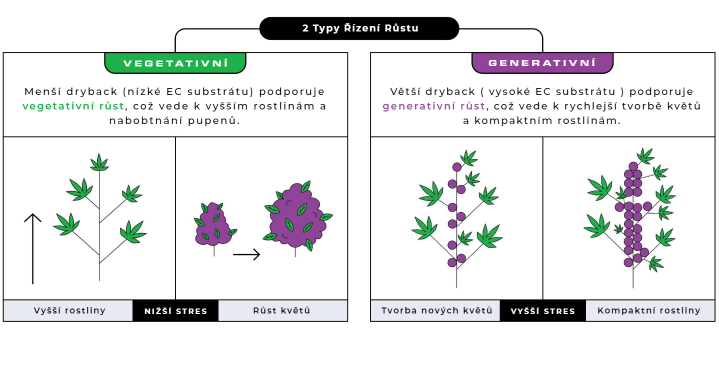 In addition to the growing medium, another important factor affecting dry back is the age of the plants. For vegetative growth, plants need more water than they do during flowering and ripening. Excessive drying during the growth phase stresses the plants and slows their growth. On the other hand, during flowering and ripening, a gradual increase in dry back is desirable. Mild stress encourages plants to flower and supports resin production. However, it is also necessary to take into account the fact that during flowering and ripening we usually maintain lower relative humidity in the growing space than during the growth phase. Air humidity and temperature also affect how quickly plants transpire and absorb water. When you start thinking about how to use dry back in your grow room, do not forget that it is mainly about the balance between overwatering and the stress caused by a lack of water.
Has today’s article caught your interest and would you like to learn more about indoor growing and the latest horticultural techniques for outdoor and urban growing? Do not hesitate to visit our Higarden blog!