
Stress Harms Plants Too: Abiotic Plant Stress
Plants are like people. Their health depends on living conditions, proper nutrition, and they are equally harmed by intense stress, also known as the “enemy of yields”. What kind of stress? In this article, we will focus on the specific stress factors that your plants should definitely not face if you want to achieve a beautiful harvest. Read on to find out how to prevent negative influences.
Just like humans, every plant has certain genetic predispositions and innate defences. Modern cultivation, much like medicine, offers effective means of strengthening the natural defence mechanisms of plants as well as practical devices for maintaining optimal conditions for their growth and vitality.
Once a plant is repeatedly or long-term exposed to excessive stress, a stress response occurs. The plant’s receptors, for example photosensors responding to the intensity of light radiation, first trigger a kind of internal alarm, which activates all available defence mechanisms, with the help of which the plant continues to survive. This period of resistance rarely passes without significant damage; it is usually harmed, or even completely destroyed by exhaustion, much like the flower in the picture. 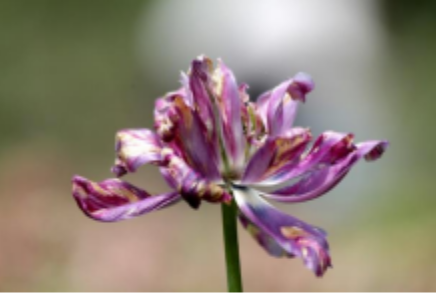
Unlike us humans, plants are sessile. They therefore cannot run away from stressors around the nearest corner or to a wellness centre. It is therefore the task of every grower to balance suitable conditions so that the plants they care for remain calm and full of life. Below we will discuss the most common abiotic stress factors. From the grower’s point of view, we can imagine under this term flooding, nutrient deficiency, excessively high radiation, low temperatures and the like. As the saying goes, too much of anything is harmful. And that applies in the plant kingdom too. Stress can therefore be caused by a deficiency as well as an excess. We also often encounter a combination of several factors at once. For example, wilting, caused mainly by a lack of water, can also be a response to excessive radiation. A plant’s ability to tolerate stress depends mainly on its intensity and duration. Heat stress can destroy a crop in a short time. Water deficiency within a few days...
Physical stress factors
- extremely high or low temperatures
- drought (water deficit), as well as overwatering or flooding
- mechanical damage
Among the most common abiotic stressors of plants is unsuitable climate. If you grow outdoors, it is necessary to pay increased attention to plants every year, especially during the hot summer. Individual species
have their own temperature optimum, which we can meet perfectly especially when growing indoors. The microclimate inside a grow box or grow room can be conveniently regulated thanks to fans and ventilators, or heating. Changes in outdoor temperatures often also require changes to the settings of indoor elements. In summer heat, your plants will appreciate the presence of CMH or LED lighting due to the lower amount of heat emitted into the growing environment.
Just as destructive as heat can be for plants cold or, when growing outdoors (or in a large outdoor greenhouse), frost. Under the influence of low temperatures, changes occur in the internal cell structures of plants, growth slows down and leaves lose their colour. During frosts and light frosts, tissues are damaged. Plants such as tomatoes or beans are very sensitive to cold.
Always protect the roots as well as the above-ground parts of plants from extreme temperatures.
In hydroponics, protect tanks with nutrient solution from direct light and maintain a temperature of 18-26 °C. Tank cooling can help you with this.
Maintaining optimal temperature and humidity with the use of humidifiers and digital measuring devices is relatively easy, but many beginners make mistakes in placing the probe from a combined thermometer – hygrometer, which should not be missing from the basic equipment of any grower. We recommend placing the probe in the upper third of the plant’s height, that is, somewhere just below the top. Circulation fans are an ideal helper that ensures continuous airflow around the plants. The higher humidity needed for seedlings is excellently maintained during pre-growing in small greenhouses and propagators.
Drought is related to reduced air humidity and is generally better tolerated by plants with a shorter life cycle. Dry substrate is, however, clearly bad, as it does not support the development of new roots. Nature has equipped plant leaves with microscopic stomata that open and close depending on air humidity. As soon as the plant feels drought, it closes the stomata to prevent water loss. The problem for the grower is that closed stomata do not exactly go hand in hand with effective photosynthesis. So watch out for dehydration throughout the entire growing cycle. The best prevention is regular watering.
The mentioned abiotic factors are also excellently prevented by the innovative perforated pots from the brand Hercules and other fabric pots, which help with proper watering and maintain optimal aeration of the root system.
Recommended temperature and humidity ranges for indoor growing:
For the growth stage, the ideal temperature is 21-28 °C in light, 18-23 °C at night, and humidity between 50 and 70 per cent. For the flowering and fruiting stage, lower air humidity of 35-50% is recommended, with daytime temperatures of 21-26 °C and night temperatures in the range of 18-23 °C. Seedlings benefit from higher air humidity of up to 80%.
