
I’m starting to grow, Page 2
- Series: Grow 3 Plants Yourself
- Discreet growing
- Equipment Selection for Beginners
- Very beginning
- Legal Cultivation
List of articles
Indoor plant cultivation and the savings associated with it
The financial demands of indoor growing are a common myth that unnecessarily discourages beginner growers from making full use of the advantages of grow tents and harvesting a luxurious crop several times a year, all in the comfort of home. This article aims to dispel the myth that indoor growing is financially demanding and, instead, highlight the savings and other benefits it brings to growers.

- Let us start straight away with the numbers. In our e-shop, you can buy a complete basic growing set including an odour filter for discreet operation in your home from just CZK 6,790.
- If you are concerned about the electricity bill, the real running costs of such a “magic cabinet”, as we like to call it, amount to only a few hundred crowns per month, which is a negligible sum, especially when compared with the value of the harvest, whether you are growing organic-quality vegetables and fruit or medicinal herbs.
- In addition, most households allow you to use the off-peak tariff hours for the lighting cycle.
- Once you start choosing your first grow box with accessories (lighting, ventilation, etc.), we will be happy to advise you on a solution tailored to your possibilities, so that you have a clear idea of the future costs.
“INVESTING IN QUALITY ALWAYS MEANS THE GREATEST SAVINGS IF YOU ARE SERIOUS ABOUT GROWING AT ANY SCALE.”
Beginner growers naturally tend to choose the cheapest products, but the technology used in only slightly more expensive equipment ultimately makes such a significant difference to operating efficiency that your initial investment will pay for itself within the first few growing cycles.
Here are some practical tips on how to reduce the running costs of an indoor growing room:
- Try to choose each piece of equipment and then use it as efficiently as possible, thereby reducing any potential energy losses to an absolute minimum.
- You can make use of every beam of light, for example thanks to high-quality reflectors or shades, if you choose discharge lamps as your source of artificial lighting.
- The same applies to reflective films. By carefully and regularly cleaning the reflective surfaces alone (both in the case of reflectors and reflective films), you will ensure not only maximum efficiency in the use of light radiation, but also give no chance to the action of pathogens or pests.
- In smaller grow boxes and propagators, you can use energy-saving lamps (CFL) for cultivating young plants.
- If you are serious about indoor growing, in the long term you will save considerable money by using LED grow lights, which significantly outperform classic discharge lamps in overall operating efficiency.
- Plants grown under discharge lamp light should be shaped evenly for maximum light absorption. With modern LED panels, even light distribution is already ensured. In the case of full-spectrum models, this is further developed into a perfect imitation of natural sunlight, so you only need a single light source for all development stages, and you also save on buying a shade, which is unavoidable when using a discharge lamp, while most discharge lamps are suitable only for one specific development stage (growth, flowering).
- Another advantage of LED lights is the possibility of hanging them very close to the tops of the plants thanks to their low heat emissions, without the risk of burning them. This again increases the overall efficiency of operation.
- To sufficiently highlight the savings achieved by using LED lights instead of HPS lamps, let us give a specific example. If we replace a 250W HPS lamp with full-spectrum LEDs of equivalent output, the investment will pay for itself by the sixth growing cycle at the latest, which, for example, in the case of autoflowering varieties lasts around 2 months, so within a year we have the investment back and at the same time enjoy higher-quality flowers or fruit and higher yields already in the first year.
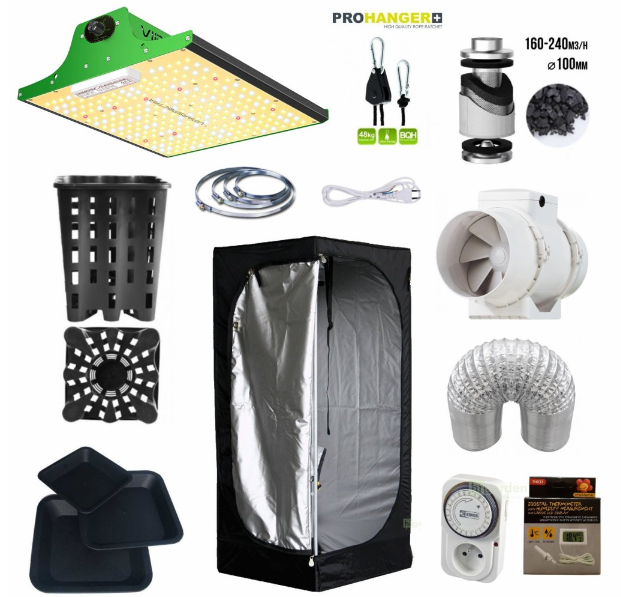
- And because we are well aware of this fact, precisely tuned LED grow box sets with complete accessories are among the most advantageous products you can buy, saving you additional money at the start of your indoor growing journey. The image below illustrates what such a set contains.
- Below we also provide a link to a separate article on the topic of HPS vs. LED.
- You can clean the blades of fans with compressed air after each growing cycle, which will result in lower noise during the following growing cycle and, last but not least, a longer service life.
- The fan speed can be regulated in quality devices according to the temperature inside the grow box, which naturally drops when the lights are switched off, and the fan’s electricity consumption also automatically decreases.
- When it comes to fans, if you want savings, choose fans with an EC motor without question, where the real electricity consumption will more closely correspond to the set output.
- EC motors also contribute to a significantly longer service life of the equipment.
- Ballasts and other accessories that emit heat into the space can be placed outside the growing area, which again reduces the required fan output.
How else can you save in indoor growing?
- Definitely on nutrition. But certainly not in terms of quality. We mean the advantage of larger packs. Our range also includes popular value fertiliser sets. For growing in soil, our customers most often choose BioNova Starter pack Soil Supermix.
- Large, more economical packs of individual products are characterised by a fairly long shelf life; they only need to be stored in a cool, dark place.
- In indoor growing, you also save thanks to the reduced risk of pests and plant diseases, as their elimination and the costs of prevention are, on average, considerable in the case of outdoor cultivation. When cultivating plants indoors, high-quality prevention such as Canna CURE is more than sufficient, and it is of course always cheaper than any solution to problems that have already arisen.
- Another way to save when growing indoors is to revitalise (recycle) exhausted substrate. You can read a separate article on this topic on our blog.
Below you can take inspiration from specific products from our range that are all about saving money, and if you are already beginning to suspect that a home growing room does not necessarily have to be an expensive hobby, we will be happy to advise you on selection, installation, and anything else needed. Do not hesitate to contact us at the well-known address info@higarden.eu.
For economical indoor growing, we recommend, among other things, these products:
- LED grow box sets with complete accessories (from CZK 8,990)
- Viparspectra PRO Series P600 (CZK 2,990)
- Value fertiliser and additive sets (from CZK 229)
What to read next?
Avoid the Most Common Mistakes When Growing Plants
Especially beginning growers often make fundamental mistakes that they could avoid by reading this article in time and enjoy a plentiful harvest right from the start. So let us introduce them!

EXCESS OF NUTRIENTS
- In a recent article, we looked closely at deficiencies, or shortages, of the most important nutrients in plant nutrition. However, plants do not thrive even when the cause of nutritional imbalance is, on the contrary, an excess of nutrients. In gardening too, the well-known saying applies that too much of a good thing is harmful. And also that less is sometimes more, because a lack of nutrients can be corrected more easily than an excess.
- And it is not only beginning growers who want the best for their herbs, and so give them more nutrients than is healthy for them. In cultivation practice, we refer to this mistake as burning plants due to over-fertilisation.
- The good news is that it can be easily avoided. Simply follow the instructions and values stated in the dosing tables.
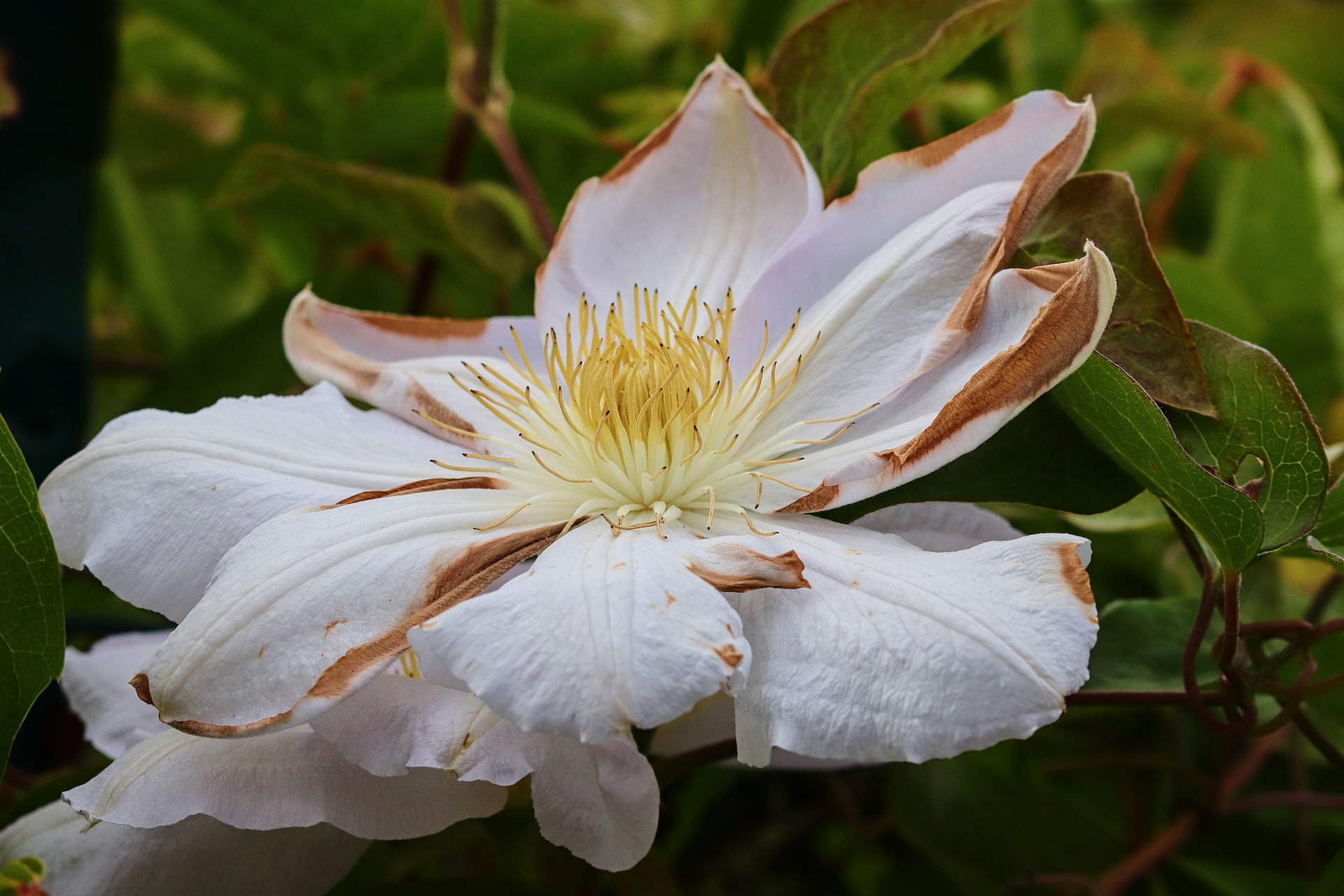
- Nutrient burn appears in a similar way to other types of burn caused by light or heat stress (see below).
- We observe random spots around the edges of the leaves and their curling.
- In hydroponic systems, the solution to this problem is easy! Simply replace the growing medium and dilute to the optimum amount of nutrients. Plants have considerable regenerative ability, but it takes some time before they recover sufficiently, which can be a problem, for example, with approaching frosts when growing outdoors.
LIGHT AND HEAT STRESS
- And we are back to plant burn, this time as a result of exposure to excessive light and heat.
- This mistake is most often encountered by beginning growers when cultivating herbs in a grow tent under a powerful source of artificial lighting. The mistake itself consists of placing a powerful discharge lamp too close to the tops of the plants, or above very young seedlings, whose cultivation in a propagator requires gentle TLED lamps, which can be safely placed very close to them.
- With an LED lamp, which compared with discharge lamps stands out for its even light distribution and incomparably lower heat emissions, you no longer need to worry about burning plants. We especially recommend the full-spectrum (and also best-selling) Lumatek LED luminaires.
- Visible signs of light and heat burn in the form of leaves with a yellow to brown coating will always be more pronounced closer to the source of artificial lighting.
- The solution is to increase the distance between the lamp and the tops of the plants. Alternatively, you can check the temperature in the tent. Room temperature will not harm plants, but if you keep your palm at leaf level for a minute and it feels distinctly hot, it means the seedlings must withstand an unhealthily high temperature.
IMPROPER WATERING
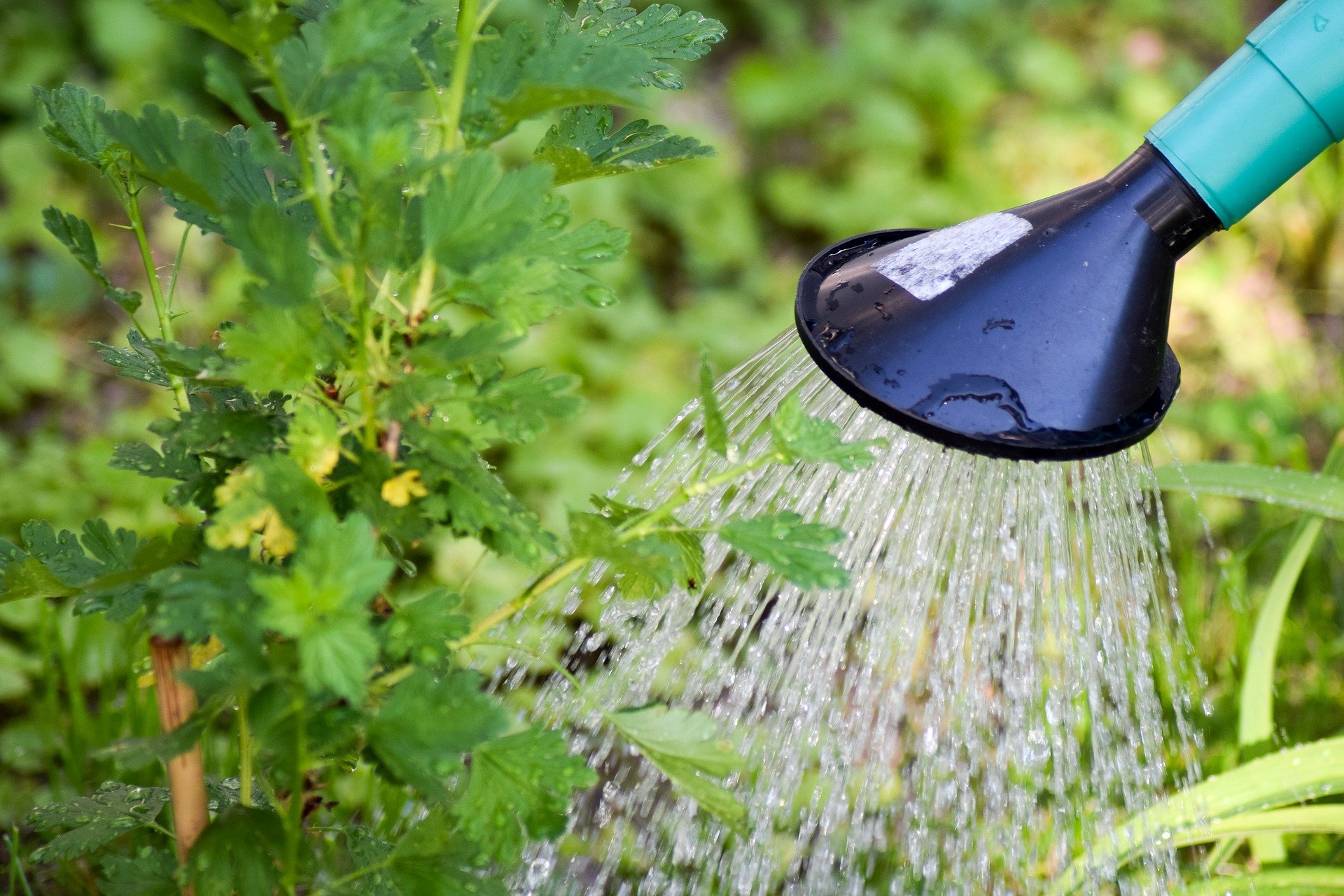
- When it comes to proper and improper watering, you need to avoid two extremes: insufficient watering and overwatering plants.
- Unfortunately, both of these extremes are difficult to distinguish from each other by sight alone, as overwatered plants also show drooping and curled leaves, as if they were suffering from a lack of moisture instead. Curling of the stem then reduces future yield.
OVERWATERING
- This is probably the most common mistake when growing plants. Overwatering plants again belongs to the category of mistakes most often encountered by enthusiastic growers during their first growing cycle, when they vigorously supply plants with water and nutrients.
- Leaving aside the risk of burning plants due to excess nutrients (see above), too much water and a wet substrate create a breeding ground for plant diseases or pest invasion.
- As we have already explained, overwatered plants initially look the same as those that need watering. In practice, this often unfortunately creates a “vicious circle”, when the beginning grower tries to revive wilting plants with more and more water.
- If you know that you are supplying plants with water regularly, and yet you observe wilting leaves, or even chlorosis (yellowing of the leaves) typical of more advanced stages of overwatering, there is nothing easier than to stop watering for a few days and watch whether the plants begin to improve. A proven way to indicate overwatering is also to press the surface of the substrate. Water should not appear on the surface at all after pressing with your fingers, and your fingers should remain only damp. Otherwise, you are overwatering.
- Simple loosening of the substrate can significantly speed up recovery. The root system of an overwatered plant is in fact “suffocating” due to a lack of oxygen, which can cause, among other things, root rot (see below).
- In general, plants benefit more from smaller amounts of water at regular intervals. The risk of overwatering, but also of burning plants with nutrients, is significantly reduced by self-watering systems or, for example, smart pots.
LACK OF MOISTURE
- How much water? Watering should equal the weight of the dry substrate.
- We also recommend misting the plants, especially during the vegetative phase, when higher humidity is important.
ROOT ROT
- Root rot is closely related to overwatering plants, because bacteria multiply in waterlogged substrate in close proximity to the roots and trouble is on the way.
- Once the root system is damaged as a result of rot, such root damage is irreversible. And that would be a great pity!
- So what is the prevention of root rot in plants?
- personal hygiene or the use of gloves
- clean, preferably sterile substrate and pot
- regular replacement of the growing medium in the case of hydroponics, as well as regular disinfection of the hydroponic system with peroxide
- oxygen enrichment of water (air stone)
- room temperature water (18-20 °C)
- water filtration (reverse osmosis)
We hope that today’s article will help you avoid mistakes in the future. It is said that personal experience is the most valuable, but we believe that in the case of these mistakes it is unnecessary, so why not avoid them altogether? After all, growing should be a pleasure! And if you have any questions, do not hesitate to contact us at the well-known address info@higarden.eu.
We recommend these products:
- HERCULES aerated pots (from 49 Kč)
- Lumatek full-spectrum LED luminaires (from 6 990 Kč)
- Cobble smart pot (219 Kč)
What to read next?
Grow box in an apartment block
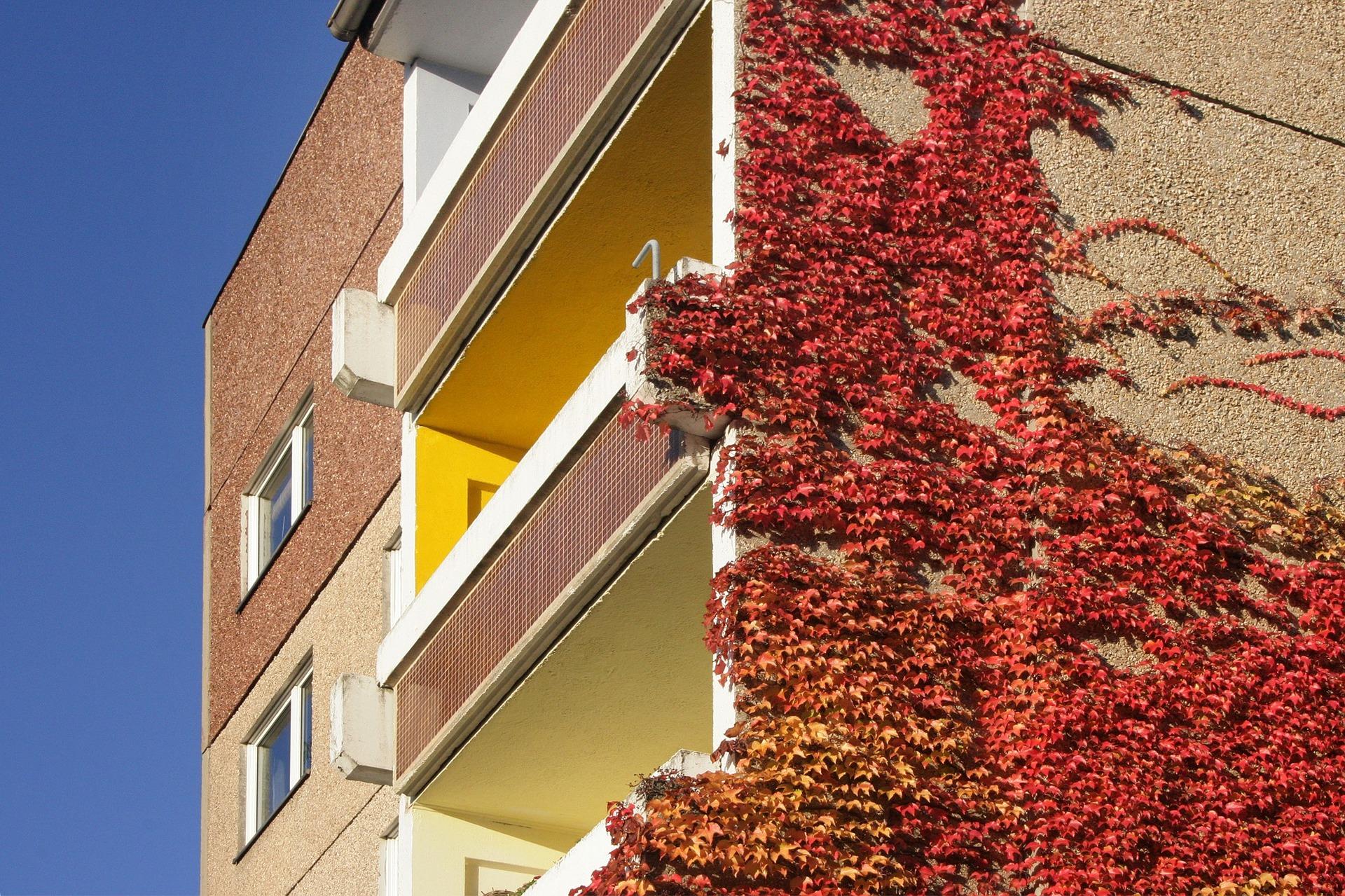
Almost one third of the population of the Czech Republic lives in apartment blocks, which is approximately 2.7 million people. We do not know how many grow boxes there are in apartment flats, but based on the above statistics we have concluded that the following practical tips and information may be useful to many of our customers and readers.
Whether you live in a classic apartment block or perhaps a brick apartment building, even a small flat will, thanks to modern grow tents, allow you to harvest herbs, fruit or vegetables several times a year! Of course, this also applies to ornamental and indoor flowers, but today we will focus mainly on how to care for a home indoor garden economically and efficiently, and how to adapt it best with regard to neighbours and electricity consumption...
Choose a dark and cool corner
The basic prerequisite is choosing the right place where you will put the homebox so that it does not get in the way of you or other members of the household, and above all so that the plants have optimal conditions for healthy development. Therefore, choose a place that does not receive direct sunlight during the day. Discharge lamps, most commonly used as a source of artificial lighting inside a grow tent, generate a considerable amount of heat on their own. In addition, the tent is often black, which, as is well known, attracts light directly, but even if it were not, you certainly do not want it to be passively heated from outside as well, which is doubly true in summer. In winter, by contrast, apartment units are often overheated, which exposes the plants inside the grow box to the same risk. A clever solution, if the conditions allow, is to place the grow box in a pantry, storage room, wardrobe or even a cellar, provided it is maintained and there is not too much humidity in it. However, it is not a problem to place a grow tent even in the kitchen... For example, the Homebox Vista models, with their white finish, overall construction and attractive design, are made to find their irreplaceable place right in the kitchen! If you also have an unused corner of the room, a white tent with a triangular shape, which you can see in the picture, fits it perfectly.
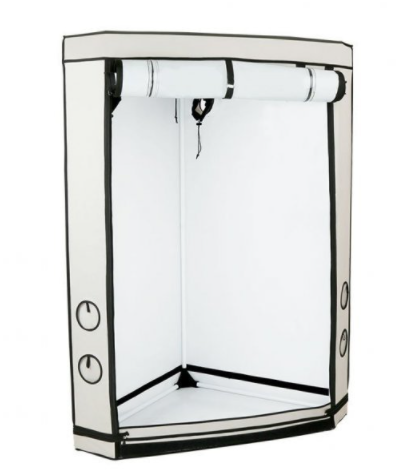
HOMEBOX® Vista Triangle
Light source
As we mentioned a little above, inside grow tents we most often encounter halogen or sodium discharge lamps. However, it is definitely worth investing in more modern sources of artificial lighting for indoor growing, such as energy-saving lamps or popular LEDs. You may pay a little more for them than for ordinary discharge lamps, but the reward will be not only savings on electricity costs, but, more importantly, better yields and a higher-quality harvest thanks to the full light spectrum that simulates natural sunlight for the plants. And that is why you are doing this, after all, isn’t it? If it makes sense to you, we also warmly recommend CMH / LEC lighting, which combines the advantages of high-pressure discharge lamps and LED technology.
Discretion above all
A sufficiently quiet fan supported by a quality odour, or carbon filter, ideally together with silenced ducting, forms a combination with which you can be completely at ease in the flat, allow the same for the other residents of the building, and harvest several times a year with ease. You will surely agree that there is no need to unnecessarily attract neighbours with the scent of your fresh herbs, and the discreet operation of silenced fans will ensure good neighbourly relations as well as peace and comfort in the household. In every flat you will also appreciate odour neutralisers for fresh air, and it does not have to be only for your harvest.
And one final tip. Did you know that with the help of an air ioniser you can easily create a literally mountain environment in an apartment block?
We hope that this article has helped you avoid unnecessary complications when indoor gardening in small and large flats, and if you would like to ask us anything, do not hesitate to write to us at the well-known address info@higarden.eu.
- Grow tents (grow boxes)
- Homebox Vista
- Lighting
- Ventilation
- Grow box sets
Growing kits, or how to become an indoor grower easily and quickly!
Indoor grower may have a season all year round, but the long winter is often an impulse to buy a new grow tent, even for growers who have so far focused only on outdoor gardening. Whether that is exactly your case, or you want to treat yourself to a brand-new grow box with accessories for Christmas, we have a tip for you on how to save money and at the same time achieve higher yields thanks to modern technologies and a finely tuned configuration of all components.
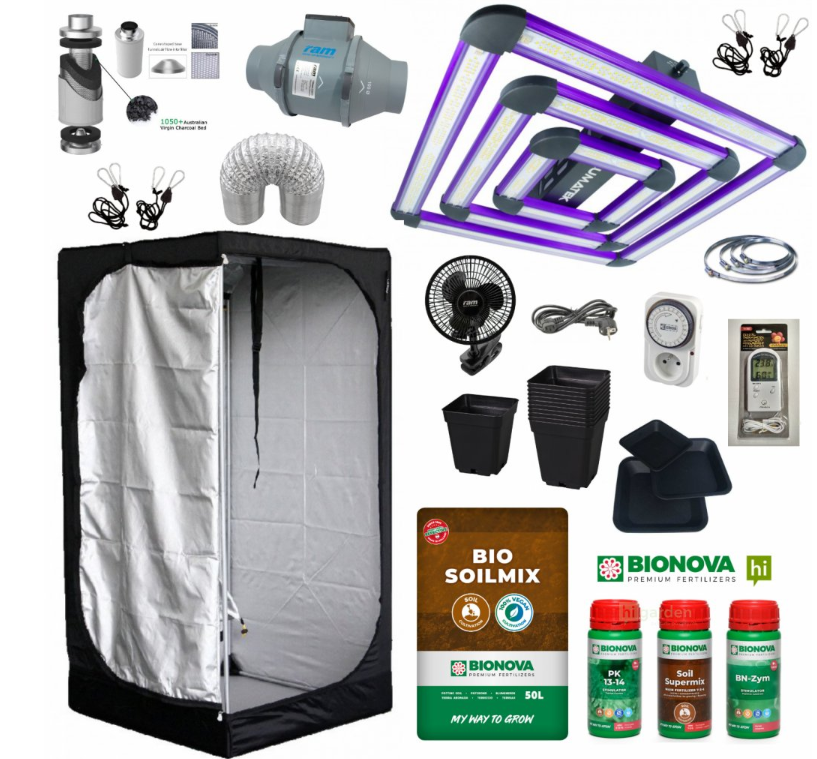
Choosing a grow box is one thing, but selecting the necessary accessories to suit your needs and, last but not least, connecting them properly at home so that it functions correctly, from lighting through various types of ventilation equipment to growing medium and fertilisers, is another matter. Of course, we will be happy to advise you when choosing a grow box and accessories, but why not save a little money and at the same time gain the certainty of a carefully assembled set by our specialists?
In our range you will find grow box sets (grow tents) for all categories of growers, from complete beginners to the most experienced and demanding. It depends solely on your plans and needs.
For beginners: a lot of value for little money and completely hassle-free
- Basic set, equipped with a 250W discharge lamp and an odour filter for discreet home herb growing, based on a grow tent from a legendary Dutch manufacturer, can be purchased for less than seven thousand crowns.
- Simply connect everything and in a few weeks you can harvest for the first time! That is what we call an affordable start for everyone.
Our TIP: Mammoth grow tents are now taller and better. That is also why they form the standard basis of all discounted sets, so you can read everything you need about them HERE in a separate article dedicated to them.
LED sets as an investment with a quick return, even for beginners
- A grow indoor set, containing modern LEDLED diodes, pays off right from the start. We stand by that.
- Moreover, as you can see, the cheapest version of an LED set costs only a few hundred crowns more than the above-mentioned basic set with a discharge lamp.
- We wrote in detail about why investing in LED lighting is clearly worthwhile and how this technology compares with classic high-pressure discharge lamps in a separate article, which you can read HERE.
LED set with Lumatek lighting will take your yields to a higher level. How high will it be?
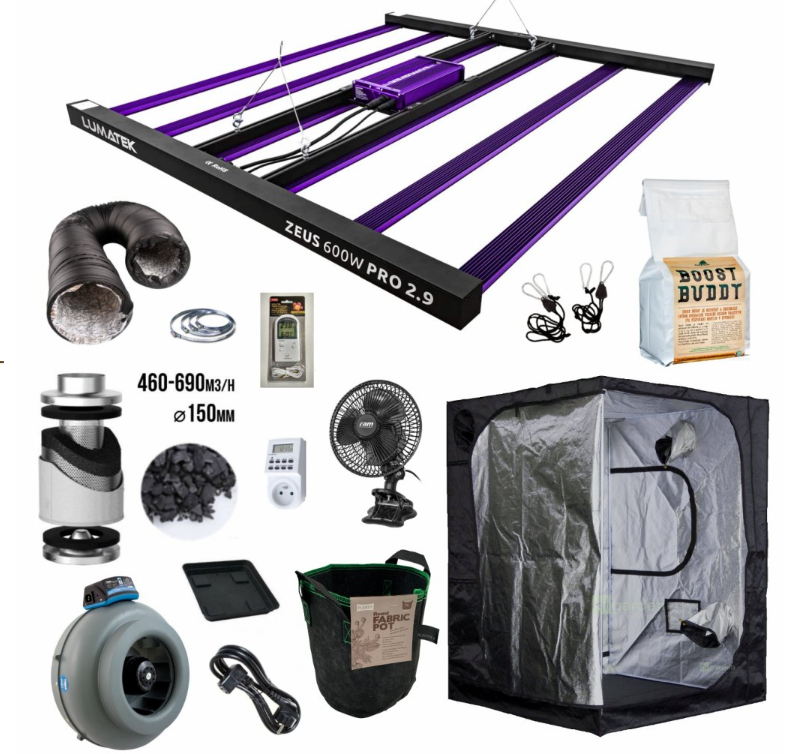
- If you do not need to choose the cheapest possible setup at the beginning, or if you started some time ago with the cheapest possible setup but now it is time to move on, then in our range focus on LED sets with Lumatek lighting.
- The Attis range is undoubtedly the golden middle way for more demanding beginners and advanced growers.
- For example, the LED Set 200W Attis BASIC includes, in addition to the LED light from the ATTIS range by Lumatek, still unsurpassed pioneer in the field of LED grow lights, a silent RAM fan, and a top-quality carbon filter PRO-ECO VF takes care of reliable neutralisation of unwanted odours. We praise these odour filters in another separate article, which you can read HERE. Together with the 300W Attis BASIC LED set, this set is one of the best-selling in its class, so perhaps it will not surprise you too much that the price also includes, among other things, the most popular fertilisers and the renowned Soil, also referred to as soil mixes or peat mixes, which may be more heavily (Growmixes, Allmixes,...) or only slightly (Lightmixes) pre-fertilised, i.e. they contain nutrients for the first weeks of the growing cycle. Inert substrate from the Dutch brand BioNova.
- The professional variant with Attis lighting is the LED Set 300W Attis MASTER for just under twenty thousand crowns, which more customers have bought than any other set right after the basic set, and so we have also given it the cover photo for this article. No wonder, the price-to-performance ratio is truly dreamlike. But the best is yet to come, so read on...
- Next come the LED sets combined with ZEUS lighting from Lumatek. A quality tent is an integral part of every grow set with us, but if you are looking for added value or the latest trends and want to invest in a new professional grow box with accessories, LED sets with Lumatek ZEUS lighting are the right choice for you!
- LED Set 465W ZEUS
- LED Set 600W ZEUS PRO
- Below follow LED sets that have been given the long-awaited new product on the market for LED grow lights. You can read more about it HERE.
- LED Set 600W ZEUS PRO 2.9
- LED Set DOUBLE 2x600W ZEUS PRO 2.9
Do you rather belong to growers who swear by discharge lamps with ballasts and reflectors? We have already introduced the basic 250W set, but you can still choose between 400W, 600W and 1000W sets, divided into basic, medium and pro variants.
Whichever of the discounted grow sets you like, we will be happy to adjust the final configuration according to your requirements and preferences. For example, if you would like to keep the accessories the same, but as the basis of the set you would prefer the light design gem HOMEbox Ambient (link to the article below), no problem. We are always happy to accommodate you as much as possible. Just contact us at the well-known address info@higarden.eu.
What to read next?
- Comparison of top LED lights from Lumatek: ZEUS PRO vs. ZEUS PRO 2.9
- Stylish HOMEbox Ambient grow tents combine the pleasant with the useful
- Indoor plant cultivation and the savings associated with it
How to Start Growing at Home?
Growing in the comfort of your home has never been easier. A wide selection of growing supplies makes indoor growing an accessible hobby with a whole range of benefits. You have absolute control over the entire process, which means you are able to provide plants with ideal conditions and an ideal environment. Compared with a traditional garden, you also do not have to deal much with external influences or pests. Are you already looking forward to the first harvest, but do not yet know exactly where to start? This guide will help you take the first steps so that you can soon enjoy your first growing successes.
Become a gardener in your own house or flat and grow whatever comes to mind yourself! What questions should you ask before you get started?
Remember that everything is connected. When you grow your own plants, you have unique control over the entire process, whether it is the source of the seeds, the quality of the fertiliser, or the ideal light and temperature conditions for a perfect result.
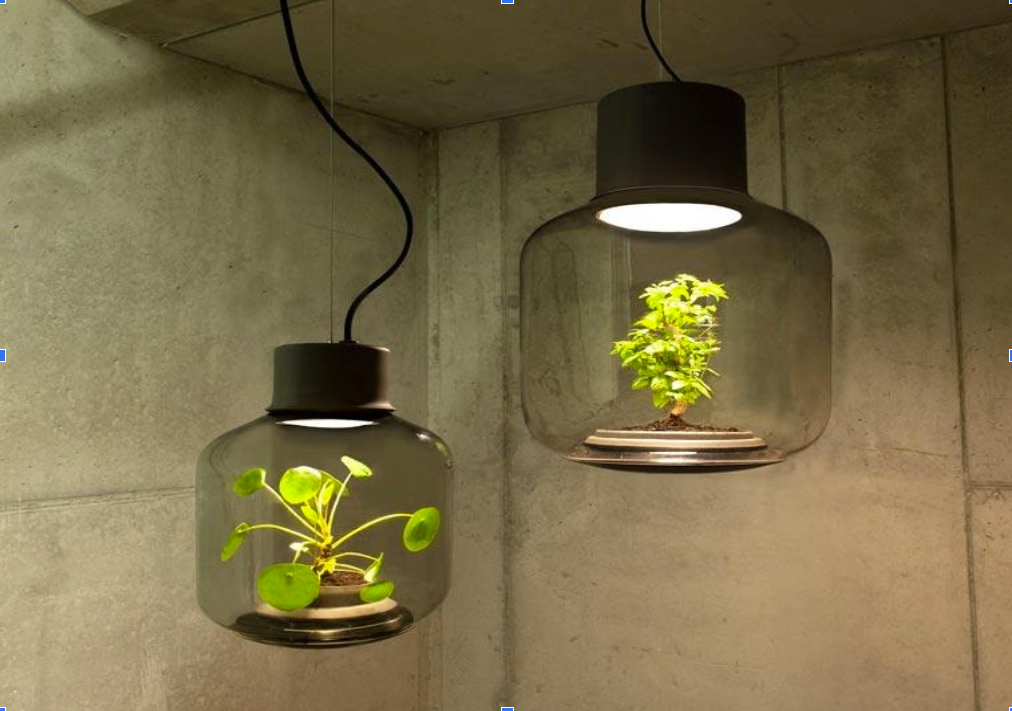
- What will you grow and how much do you want?
There are many possibilities. Let us start in the direction of growth, that is, ascending...<
An ideal choice for beginners is represented by various low herbs (microgreens). Secure a natural source of vitamins and other substances with a beneficial effect on the body at home. Growing small herbs, such as the popular basil, is really simple and offers an opportunity to learn the basic procedures associated with home growing. It is easy to start growing annual herbs as well as perennials. Home-grown ornamental plants, such as orchids, will make a great impression and, with proper care, will reliably outshine pieces from a florist’s shop.
The freshest small fruit and vegetables can grow right in your home. Grow juicy strawberries or bushes full of popular chilli peppers or tomatoes. Broccoli, celery, home-grown cucumbers - what will it be? It is entirely up to you. Grow tents also make it possible, among other things, to overwinter tropical plants.
2. “I have a small tent...” or, in other words, what will you grow in?
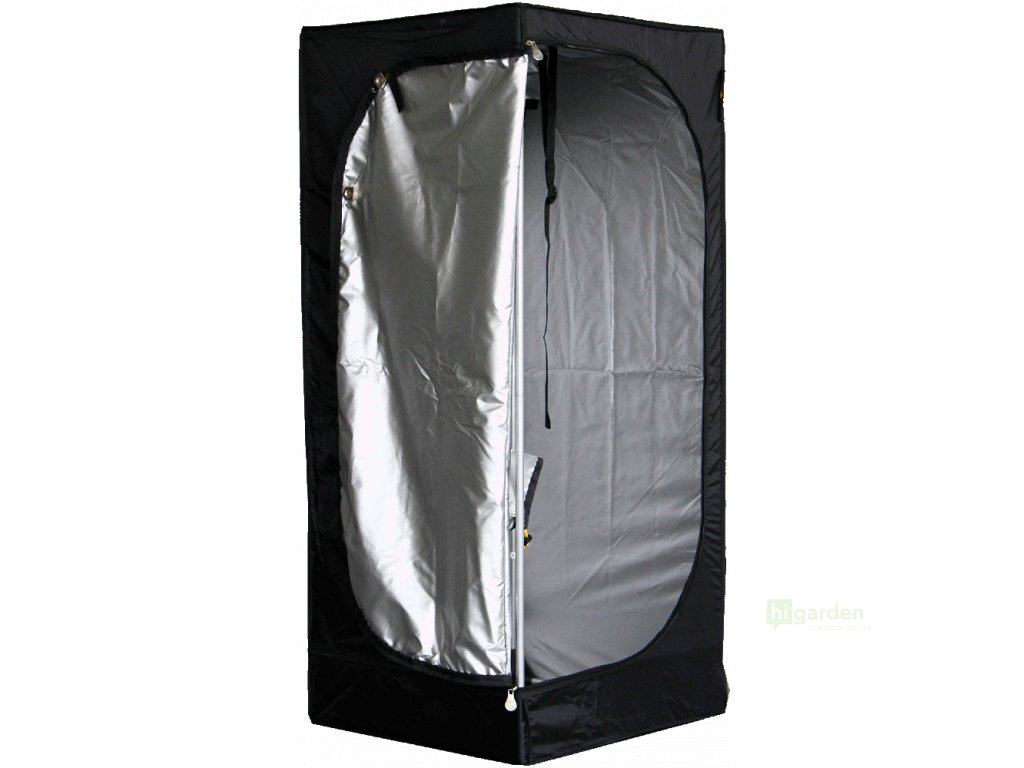
Perfect conditions for plants are ensured by a suitable grow box, in other words a grow tent, and its dimensions are the first thing every beginning grower needs to define. So if you already have an idea of what you intend to plant and roughly how much of it there will be, choose the corresponding size. It is important to bear in mind that a simple equation applies: how much area – that much light. Of course, you will not go wrong if you consult us just to be sure.
- Propagators are boxes for growing or propagating smaller plants, often in several tiers above one another. You can let various seeds germinate in them or use them for raising seedlings. If you need to do this on a larger scale straight away, there is the new XL propagator.
- If you currently plan to use only a few plastic or fabric pots, small grow tents with an area of up to 1 m² are suitable, and they are usually under two metres high.
- A larger number of pots and standard hydroponic systems can be accommodated by medium-sized grow boxes, suitable for both beginners and much more experienced growers.
- Large tents with an area above 3 m² already replace a traditional greenhouse or even more and are intended for very productive experienced growers. We recommend choosing either a purely economical option or the golden middle way at the beginning. It depends on your possibilities and ambitions.
As soon as you open our range, you will find that it includes grow tents that differ not only in size, but also with regard to other important parameters. Let us now introduce the list of the most important ones according to which you will continue selecting:
- Construction and shape: the construction of the products is characterised by high variability; the most sought-after tent footprint is square, but if the interior requires it, there are also boxes with a rectangular footprint. A grow box most often has the shape of a cuboid, but tents in the shape of a triangle are also available, which are especially useful in the corner of a room. If you are planning to garden in a loft, get a grow box with a sloping roof.
- Material quality: grow boxes from different manufacturers are characterised by different levels of workmanship quality and, especially depending on the price, differ from one another in the quality of the seams, zips and the entire construction. The outer shell is a separate topic. The primary indicator of material quality is generally considered to be its ability to reflect light. In this discipline, for example, grow tents from the Homebox Ambient range excel. The durability and lifespan of the material naturally depend partly on you. Even a cheaper option will last you several years if handled carefully. On the other hand, if you have a long-term plan in mind and it is clear to you that growing will not stop being enjoyable after a while, investing in premium products always pays off in the end. That applies at any scale.
TIP for getting started: If you choose one of the pre-assembled value sets, you do not have to deal with selecting the accessories separately, which are discussed in the next points of this article. The equipment must also correspond to the choice of the tent itself, which always has specific outlets, openings or ventilation grilles, as you will be regulating the optimal temperature, humidity or, for example, the carbon dioxide content. Everything must fit so that the whole system works properly in the long term, so at the beginning you can focus only on which set you choose and have no worries. Of course, we are here for all other cases, ready to advise you.
3. Let there be light! What will you use for supplementary lighting?
In order to enjoy the wonders of nature in the warmth of your home and congratulate yourself on the first harvest, the choice of lighting necessary for proper plant development will also play a key role. That is why we have prepared a separate article on this topic, where you will find detailed information on how and with what to supplement plants with light.
4. Plants must breathe - how do you choose ventilation?
We have mentioned that indoor growing makes it possible to provide plants with optimal conditions. By this we mean, above all, the temperature and air humidity inside the tent. In order to regulate these values effectively, it is necessary to equip the box with at least basic air technology. Fans, filters and other gadgets are therefore essential. Thanks to noise dampers, you can make the grow box a beloved but quiet companion in the home. Odour neutralisation allows you to breathe in the room as comfortably as the plants...
5. What should you fertilise with, and how do you avoid over-fertilising?
There are many fertilisers that are a condition for successful growing because of the nutrients they contain. They can be natural or synthetic. At the beginning, it is best if you get clarity with the help of an article that focuses precisely on the basic fertilisers suitable for the start.
6. How do you protect plants against pests and diseases?
You will find inspiration here. It is good that you are starting with indoor growing; pests do not have to trouble you as much as they do outdoors in the garden, but the basic equipment will come in handy.
7. And what exactly is hydroponics?
A great and sophisticated thing, or rather a method. However, it deserves a separate article. There you will read everything you need to know at the beginning.
As everywhere in life, in growing too practice makes perfect. Growing is a wonderful activity, and you will constantly discover new horizons of how and with what to work effectively. Before that, however, you should have the basics clear so that you enjoy it from the very beginning. If there is anything this guide has not answered, do not hesitate to contact us so that you can be clear about your choice. We wish you that the coming cold months take on a new dimension thanks to living plants that you grow yourself at home!
- Grow boxes (grow tents)
- LED sets
- Propagators
- Discharge lamps
- Hydroponic systems
- Fertilisers
- Substrates