
Hydroponics – What Does It Involve and How Do You Get Started?
Hydroponics is a modern and very clean way of growing plants without soil in a nutrient solution. Simply put, for such cultivation you need only a plant, nutrient solution and a growing medium to support the plant in a pot. Cultivating herbs, fruit and vegetables is made easier by a hydroponic system, of which there are several types, so among other things we will advise you on how to find your way around the individual growing systems.
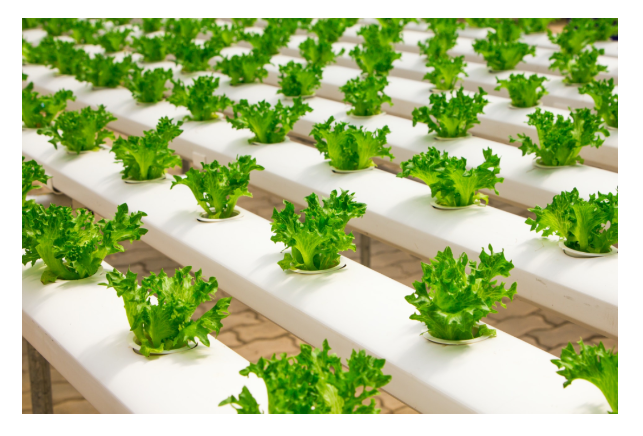
Hydroponic cultivation is really very popular among growers. No wonder. These are the main advantages of hydroponics:
- Perfect control of plant nutrition throughout the entire growing cycle.
- Greater growing efficiency associated with higher yields.
- With proper care of the hydroponic system, this is a very clean growing method, which means:
- Lower risk of pests or plant diseases.
- Much less mess.
Ordinary soil contains many organic and inorganic substances that the plant uses, so it can grow even without much help from fertilisers.
Hydroponic media, with which growers usually achieve the best results, are:
- coconut fibre
- expanded clay (hydroton)
In the past, perlite was also used, for example, but hydroponic cultivation of plants in perlite is now a thing of the past.
When growing hydroponically, be sure to pay attention to the choice of propagation medium, or rather propagation cubes. For example, Jiffy is not suitable for hydro, because dirt is often released, which clogs pumps or the irrigation lines of the watering system. On the other hand, we can clearly recommend rockwool or stonewool for hydroponics, especially Grodan propagation cubes.
The growing media mentioned above are inert, which means that they contain no nutrients, and it is therefore necessary to supply all the nutrients the plant needs for healthy development through the nutrient solution, that is, water combined with nutrients sourced from quality hydroponic fertilisers.
Fertilisers for hydroponics are discussed in more detail in a separate article as well: What are the best fertilisers for hydroponics and how should they be used correctly?
A common feature of hydroponic fertilisers is a mineral-based composition. Growers for whom natural feeding is a priority, but who also like hydroponics, are increasingly turning to bioponics, most often using products from the brand Terra Aquatica. Bioponics is essentially organic hydroponics. You can read more about this method in the article: What is bioponics?
OUR TIP: In addition to the legendary manufacturer Terra Aquatica (formerly General Hydroponics), we also recommend a new addition to our range, namely the best British fertilisers with an emphasis on research.
What should you consider before you start with hydroponics in practice? Above all, answer the following questions:
- What is your budget?
With a smaller budget, you can manage in the beginning, when you can get a feel for hydroponics on your first plants using simple but practical passive systems (see below). With a larger budget, you can afford a sophisticated hydroponic system that allows efficient plant cultivation on a larger scale, with electricity use and additional accessories (see below).
- How much time and effort do you want to devote to your plants?
Hydroponics requires more than just regular watering. You will hardly enjoy beautiful, abundant flowers or tasty fruit if you do not take into account that during the growing cycle it is necessary to regularly check and measure electrical conductivity (EC) and the optimal values of pH of the nutrient solution using pH and EC metres as well as temperature and its stability.
Especially more complex hydroponic systems need to be maintained and cleaned regularly. You can get a better idea of hydroponic system maintenance through the separate article HERE.
- Which specific plants or crops do you intend to grow, and on what scale?
Based on that, we will help you choose the appropriate size of grow tent set with accessories as well as the hydroponic system itself.
Hydroponic systems are generally divided into active and passive.
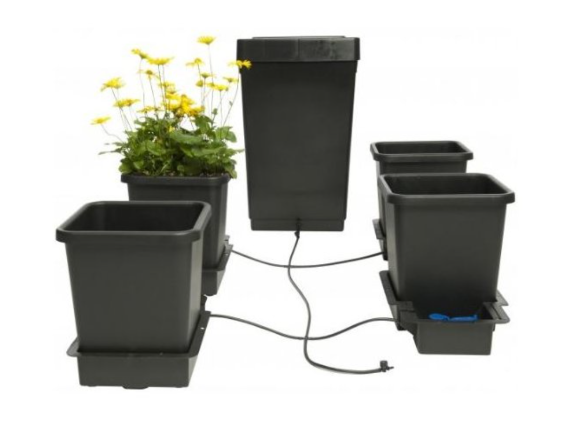
- Passive hydroponic systems, such as the popular AutoPot 1Pot system (pictured below), do not consume any electrical energy. They do not need any switches or pumps to operate. They rely on gravity pressure from the tank, which is usually part of the system. This makes them a perfect choice especially for beginners who want to try hydroponics in practice first on a few smaller plants.
- Advantages: low purchase price and negligible operating and maintenance costs.
- Disadvantages: lack of advanced options for dosing and timing irrigation, suitable only for smaller-scale growing, grower presence required.
- Recirculating hydroponic systems, which include, for example, Atami Wilma (pictured below), allow uncompromising control over growing processes, whether it is irrigation timing or optimal nutrient supply. An undeniable advantage of active hydroponic systems is the use of a circulation pump, thanks to which you can easily go away for several days with the certainty that your plants are being cared for exactly according to the growing plan. To be objective, among the disadvantages we list electricity use in contrast to passive systems, but the reality of modern hydroponic systems is that they are very economical. (This is therefore an investment that pays off, much like modern LED lighting, which may cost more than conventional luminaires, but is light years ahead in both efficiency and economical operation. We definitely recommend it for indoor growing, whether with a passive or active hydroponic system. More HERE.)
- Advantages: savings on fertilisers, which circulate in the system instead of everything having to be poured away, complete control over growing processes, autonomous operation, almost unlimited possibilities with regard to scale and budget, compatibility with different growing media, longer service life.
- Disadvantages: higher purchase and operating costs, electricity use, more demanding maintenance.
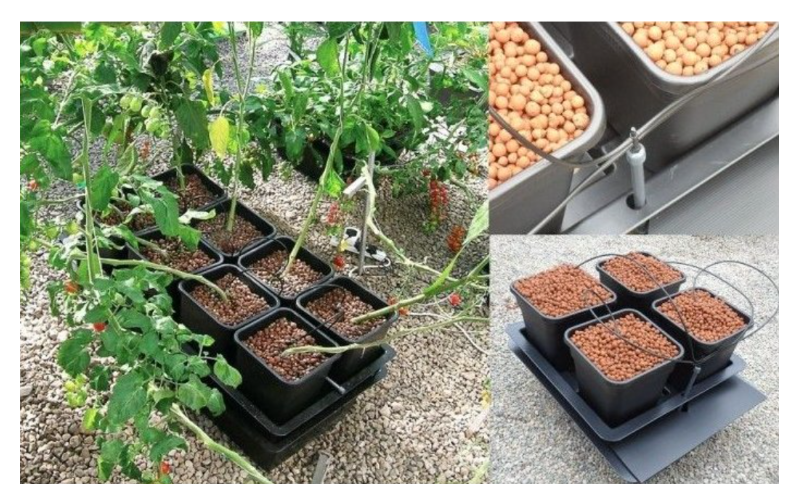
Examples of hydroponic recirculation also include complete flood tray systems from GHE, which are often incorrectly confused with the run2waste systems mentioned below.
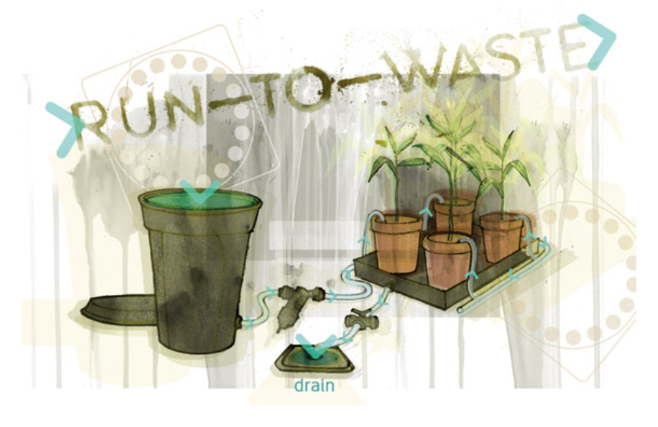
- Run2waste (or Run-to-waste or RTW) are simple hydroponic systems. As the name suggests, with this irrigation method the watering is applied until it flows from the root zone into the waste tank, after which it is disposed of and does not return to the system (unlike the recirculating systems above, where the fertilisers dissolved in water are recycled). Hydroponic growing using the RTW method is illustrated in the picture.
- Advantages: from a practical point of view, above all safer plant cultivation.
- Disadvantages: higher operating costs.
For hydroponic systems, it applies that the smaller the system, the more susceptible it is to fluctuations in values and also that the larger the tank, the better. That is all for their general division into active and passive.
It is also worth becoming familiar with the characteristics, including the advantages and disadvantages, of the individual systems associated with specific hydroponic methods, which we gradually cover in a series of separate articles. These are:
- NFT hydroponic systems and vertical NFT systems
- Ebb and flow - flood hydroponic systems
- Drip - drip irrigation
The most efficient growing method is aeroponics. However, this way of growing plants is also associated with the highest risk, because if the power goes out and the pumps stop working as a result, all plants connected to the system are doomed to die. Aeroponic systems have special chambers with nozzles in which the plant roots hang freely and breathe, while efficiently absorbing nutrients from the microdroplets that cling to them. The most powerful, most efficient, most dynamic and most flexible hydroponic / aeroponic system on the market GrowStream from the brand Terra Aquatica then functionally combines elements of aeroponics and hydroponic NFT systems.
We must not forget to mention that not everything can be grown hydroponically, because it simply is not worthwhile. A typical example is potatoes.
And that is it. Hydroponics is above all about the willingness to learn and improve. It then allows you to start with minimal costs and gradually move further, as far as you want. If you need any advice, do not hesitate to contact us at the well-known e-mail address info@higarden.eu. And while we are on the subject of hydroponic beginnings, we have also prepared a BOOK TIP: William Texier - Hydroponics for Everyone. This is the ideal first step for anyone interested in hydroponics.