
How to ScrOG – Weaving into Nets to Increase Yield and Crop Quality
Screen of Green (ScrOG) is a cultivation technique in which plants are trained into nets so that their tops grow in one level. ScrOG is most often used for indoor growing in grow boxes, but training nets can also be used outdoors and in greenhouses. We will show you how to do ScrOG and help you decide whether this technique is suitable for your growing method.
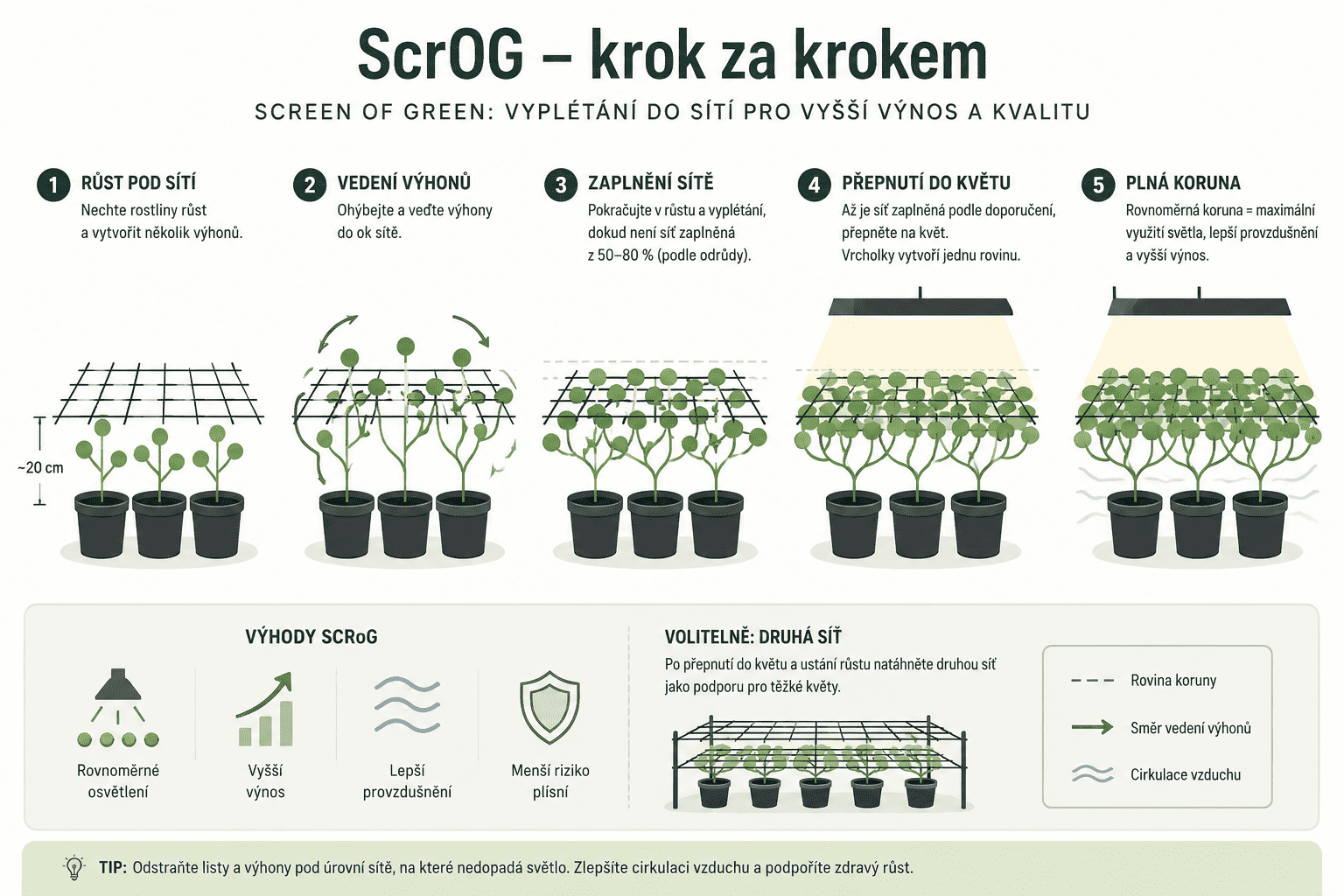 When done correctly, the result of the ScrOG method is a uniform crop of flowers that looks like a dense carpet of fragrant blooms. However, the attractive appearance of the plants is not the only reason why training into nets is worthwhile. The main advantage is that tops growing at the same level are exposed to light evenly, do not shade one another, and therefore ripen at the same rate. In plants grown in the traditional way, flowers in the lower parts of the plant grow more slowly and are sparser than those above them that are not shaded. Especially for indoor growers, ScrOG is an excellent way to use growing space and the energy from grow lights as efficiently as possible. Another advantage of training is better air circulation around the plants and a lower risk of mould.
Advantages of ScrOG
- tops equally far from the light
- higher yields and better flower quality
- more efficient use of grow lighting indoors
- better air access to the plant canopy
ScrOG guide – how to properly train plants into nets
It will probably come as no surprise that the basic accessory for ScrOG growing is support nets. These are sold in various sizes, usually corresponding to different types of grow tents. If you want to train plants in a greenhouse or in beds, you will need a suitable frame on which to stretch the net, for example made of wood or plastic or metal poles. When done correctly, one net is enough for ScrOG, but some growers use a second net as support for stems weighed down by ripening flowers.
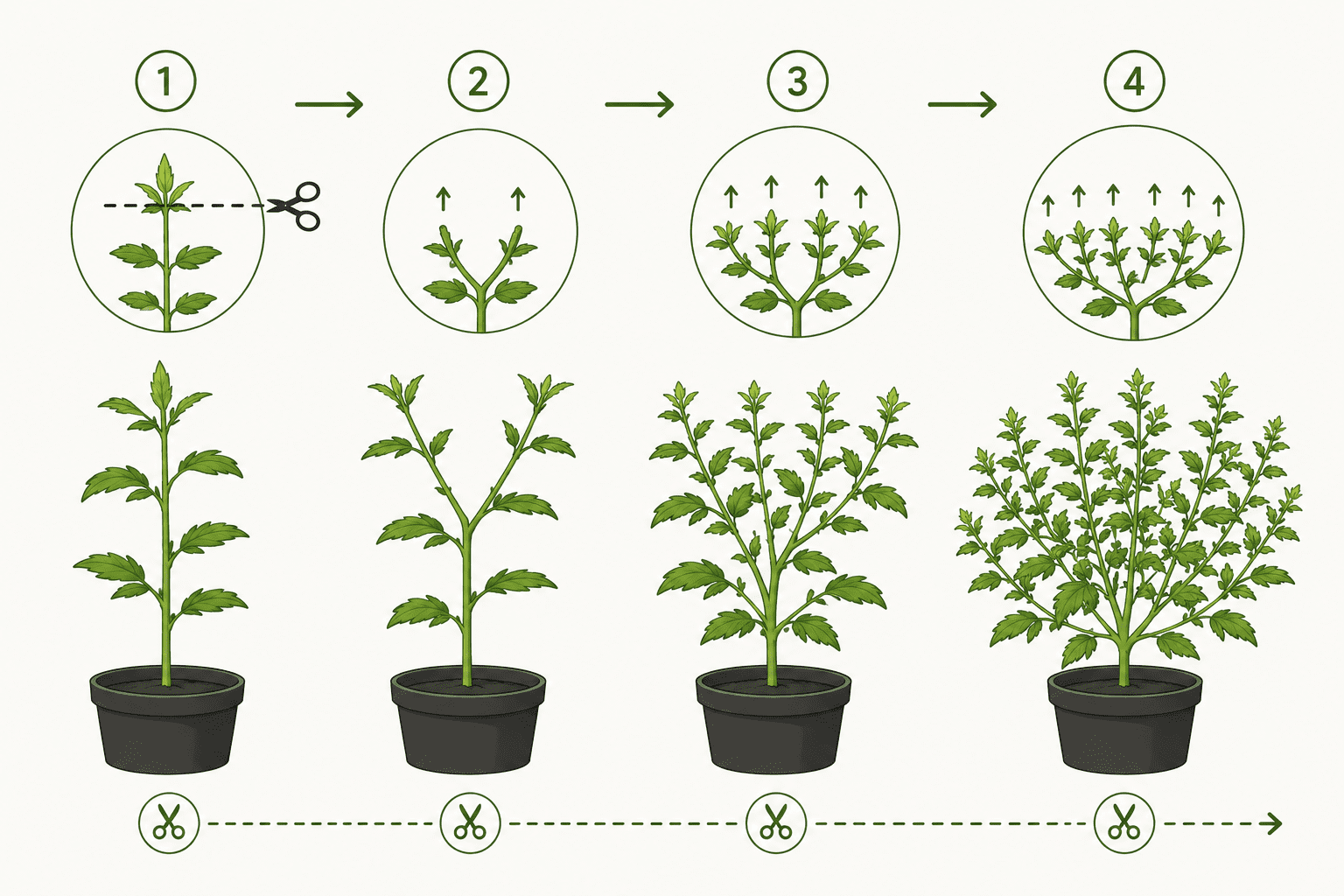 Stretch the first support net approximately 20 centimetres above the base of the plants. Before you start weaving the plants into the net, trim the tops once or twice so that they branch out and have more branches that you can weave into the net.
You may be interested in: How to do topping – trimming the tops
Once you are satisfied with the number of tops, let the plants grow approximately 5 centimetres above the net and begin weaving. Try to ensure that each mesh contains one node (the point from which new shoots and later flower buds grow on the stem). For ScrOG, varieties with reasonably long distances between nodes are generally more suitable than those with nodes very close together.
When indoor growing with the ScrOG method, we time the switch to flowering not according to the age of the plant, but according to how much of the net is filled and also the type of variety. For sativa-dominant varieties, which stretch a lot after the switch, we recommend switching to flowering when 50–60% of the net meshes are filled. Varieties with medium stretch can be switched when 70–80% of the support net is filled. Indica-dominant varieties, which stretch only a little after the switch, can be left to fill up to 90% of the net.
If you want to use a second support net, stretch it once the plants stop stretching after the switch to flowering, which is usually about three weeks after the change in light regime. At this stage, the stems are still flexible and are less likely to break when being trained. Gradually remove leaves below the level of the net that no longer receive light, so that air can circulate beneath the canopy.
Interested in other techniques for increasing the yield and quality of your harvest? Proven guides for growers and news from the world of growing can be found on the Higarden blog.