
VPD: What Is Vapour Pressure Deficit and How Do You Set It in a Grow Tent?
VPD (vapour pressure deficit) indicates how strongly the air “draws” water from leaves. It combines temperature and humidity into a single figure, so you can set the climate in your grow box more precisely than by using a hygrometer alone. This article covers the calculation formula, a clear VPD table based on temperature and humidity, approximate target values for seedlings and fruiting plants, and practical tips on how to increase or decrease VPD.
What is VPD?
VPD (short for vapour pressure deficit) is the difference between the water vapour pressure the air would have if fully saturated and the pressure of the vapour actually present in the air. It is measured in kilopascals (kPa).
- Low VPD: the air is close to saturation. Transpiration is usually slower, and at very low VPD the uptake of water and some nutrients may decrease. Wet leaves and growing medium also usually take longer to dry.
- High VPD: the air is dry. Plants lose water quickly. If the roots cannot replenish it fast enough, the plant closes its stomata, takes in less CO₂ and slows photosynthesis.
- VPD = 0: the air is 100% saturated. If the leaf is at the same temperature as the air, the pressure difference that drives transpiration disappears. However, a warmer leaf can still lose water in saturated air.
Why isn’t relative humidity enough? Warm air can hold more water than cold air. The same humidity of 75% therefore means a VPD of about 0.43 kPa at 15 °C, but about 1.41 kPa at 35 °C. The climate control system manufacturer Argus Controls also highlights this example.
How VPD is calculated: formula
Calculate the saturated water vapour pressure at a given temperature using the Tetens equation. This form is also used in the FAO methodology for calculating evapotranspiration (FAO Irrigation and Drainage Paper 56, equation 11):
- Saturated vapour pressure: es(T) = 0.6108 × exp(17.27 × T / (T + 237.3)) [kPa], where T is the temperature in °C.
- Actual vapour pressure: ea = es(Tair) × RH / 100, where RH is relative humidity in %.
- Air VPD: VPD = es(Tair) - ea = es(Tair) × (1 - RH / 100).
- Leaf VPD: VPDleaf = es(Tleaf) - ea. This assumes that the air inside the leaf is saturated, and uses the leaf temperature instead of the air temperature.
Example: at 25 °C and 60% humidity, es = 3.17 kPa and ea = 1.90 kPa. Air VPD is therefore 1.27 kPa. If the leaves are at 23 °C, the leaf’s es is 2.81 kPa and leaf VPD is just 0.91 kPa.
VPD table based on temperature and humidity
We calculated the values below using the formula above for air VPD. They correspond to leaf VPD only when the leaf is at the same temperature as the air. The colours follow the categories used by Michigan State University (MSU): 0.3–0.7 kPa low, 0.7–1.5 kPa medium, target range for most growing, above 1.5 kPa high. Values are in kPa.
| Air temperature | 40 % | 50 % | 55 % | 60 % | 65 % | 70 % | 75 % | 80 % |
|---|---|---|---|---|---|---|---|---|
| 18 °C | 1.24 | 1.03 | 0.93 | 0.83 | 0.72 | 0.62 | 0.52 | 0.41 |
| 20 °C | 1.40 | 1.17 | 1.05 | 0.94 | 0.82 | 0.70 | 0.58 | 0.47 |
| 22 °C | 1.59 | 1.32 | 1.19 | 1.06 | 0.93 | 0.79 | 0.66 | 0.53 |
| 24 °C | 1.79 | 1.49 | 1.34 | 1.19 | 1.04 | 0.90 | 0.75 | 0.60 |
| 26 °C | 2.02 | 1.68 | 1.51 | 1.34 | 1.18 | 1.01 | 0.84 | 0.67 |
| 28 °C | 2.27 | 1.89 | 1.70 | 1.51 | 1.32 | 1.13 | 0.94 | 0.76 |
| 30 °C | 2.55 | 2.12 | 1.91 | 1.70 | 1.49 | 1.27 | 1.06 | 0.85 |
The table scrolls horizontally. The columns show relative air humidity and the rows show air temperature.
Target VPD by growth phase (approximate)
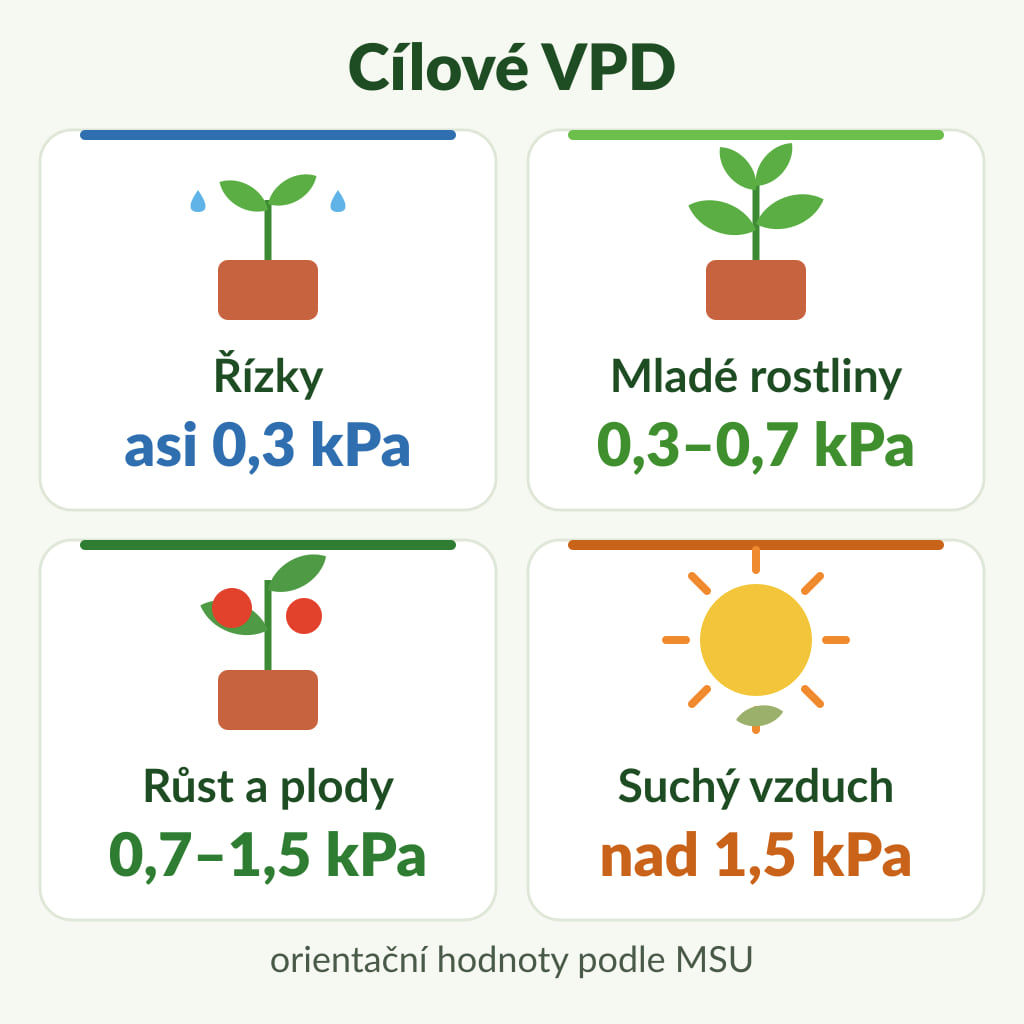
There is no single “correct” VPD. It depends on the plant species, growth phase and how dense the crop is. Below are approximate values according to MSU (Michigan State University):
When rooting cuttings, MSU recommends a low VPD of around 0.3 kPa to prevent young plants from drying out. The range of 0.3–0.7 kPa is suitable for young plants that already have their first roots. MSU identifies the 0.7–1.5 kPa range as the target for most growing. Above 1.5 kPa, the air is dry and photosynthesis may decrease in some crops.
| Phase | Approximate VPD | What to watch |
|---|---|---|
| Rooting cuttings | about 0.3 kPa | Cuttings without roots must not dry out. |
| Young plants with their first roots | 0.3–0.7 kPa | Leaves should no longer remain wet for long. |
| Growth and fruiting plants | 0.7–1.5 kPa | For dense crops, MSU recommends keeping VPD above 0.5 kPa to help prevent leaf diseases. |
| Dry air | above 1.5 kPa | Risk of rapid drying; if water is in short supply, stomata close and growth slows. |
For tomatoes specifically, MSU cites a study in which a VPD of 0.8 kPa during both day and night increased photosynthesis and fruit yield compared with 0.5 kPa. In a study by Leonardi et al. (2000), increasing the average VPD during the six driest hours of the day from 1.6 to 2.2 kPa reduced the fresh weight and water content of the fruit. These results apply to the conditions of those particular trials, not as a universal optimum or a threshold for tomato damage. As an example of an “ideal” range for a model crop, the manufacturer Argus Controls gives approximately 0.5–1.2 kPa and stresses that each crop should be assessed individually.
Leaf temperature: why it matters
The leaf VPD formula uses leaf temperature, not air temperature. Leaves cool as water evaporates from them, so they may be cooler than the surrounding air. A cooler leaf means a lower leaf VPD, as the example above shows: at 25 °C and 60%, air VPD is 1.27 kPa, but for a leaf at 23 °C it is just 0.91 kPa.
- Measure leaf temperature: the easiest way is with a non-contact infrared thermometer aimed at the upper, illuminated leaves.
- Leaves are often cooler under LED: the model by Nelson and Bugbee (2015) estimated that, at the same photosynthetic photon flux and under comparable indoor growing conditions, leaf temperatures under LED were about 1.3 °C lower than under HPS. This is not a fixed difference for every setup: according to the study, water supply and evaporative cooling through transpiration have a greater effect than the type of light itself. When switching from HPS to LED, leaf VPD may therefore decrease even if the thermometer on the wall shows the same air temperature.
- Devices that measure only air temperature and humidity calculate air VPD without correcting for leaf temperature. Some controllers allow you to enter the leaf temperature difference manually; accuracy then depends on this correction. If you know the leaf temperature, you can calculate leaf VPD using the formula above.
How to increase or decrease VPD
You can affect VPD through two variables: humidity and temperature. Before making any changes, measure the temperature and humidity at plant level, not at the top of the tent.
VPD is too low (the air is too humid)
- Dehumidifier removes water from the air. Choose one based on the size of the space; see the dehumidifiers category. Remember that a dehumidifier produces waste heat.
- Higher extraction rate: increase the output of your duct fan. Argus Controls warns, however, that ventilation alone may not reduce humidity if the incoming air contains a similar or greater amount of water vapour. Relative humidity percentage alone is not enough; its temperature also matters.
- Slightly higher temperature: the same amount of vapour produces a higher VPD at a higher temperature. In winter, heating can help.
- Air circulation with circulating fans helps limit pockets of humid air between leaves; a fan alone, however, does not remove water from the space.
VPD is too high (the air is too dry)
- Humidifier adds water to the air; see the humidifiers category. It is particularly useful for seedlings and in summer.
- Lower temperature: if high VPD is caused by heat, dimming the lights or using air conditioning can help. Find tips in the article High temperatures during indoor growing.
- Lower extraction rate: if the temperature is fine, reduce the speed of the fan using a controller. The moisture evaporated by the plants will then remain in the tent for longer.
Watch out at night
After the lights go out, the temperature usually drops and relative humidity rises. Here is an example assuming the actual water vapour pressure remains approximately constant, with no water vapour added or removed: air at 25 °C and 60%, cooled to 20 °C, will have a humidity of about 81% and a VPD of just 0.44 kPa. It is therefore worth monitoring humidity at night, switching on a dehumidifier or preventing the temperature from dropping too far.
VPD measurement and automation
A reliable thermo-hygrometer with a sensor at plant level is essential. Find the range in the temperature and humidity measurement category. Some devices and controllers calculate VPD directly:
- VIVOSUN AeroLab THB1S measures temperature and humidity, calculates VPD from them and lets you view the history in an app.
- AC Infinity Controller AI+ with the AC Infinity Climate Sensor monitors temperature, humidity and VPD, and controls connected devices accordingly.
- VIVOSUN GrowHub Controller E42A+ displays VPD and controls extraction based on temperature and humidity.
- The AC Infinity CLOUDFORGE T5 humidifier and the AC Infinity HYDRONE 7 dehumidifier have their own VPD-based controls.
- A simpler option is a hygrostat, which switches a humidifier or dehumidifier on according to the set humidity. Use the table above to find the target humidity for your desired VPD.
Find more automation options in the controllers category. We cover air exchange and airflow in detail in the article Do not underestimate air exchange and circulation.
Frequently asked questions
What is the ideal VPD?
For most growing, Michigan State University gives a target range of 0.7–1.5 kPa, 0.3–0.7 kPa for young plants and about 0.3 kPa for rooting cuttings. These are approximate values, so monitor how the plants respond as well.
What humidity should I set at 24 °C?
According to the table, at 24 °C a humidity of around 50–75% gives a VPD range of 0.7–1.5 kPa (1.49 to 0.75 kPa). A lower VPD of 0.3–0.7 kPa may be suitable for young, rooted plants; at 24 °C, this corresponds to approximately 77–90% RH, which is higher than the 50–75% range given above. Choose a specific target according to the crop and growth phase, rather than relying only on this general table.
Do I need to measure leaf temperature?
You do not have to; air VPD is a good indicator for everyday growing. Leaf temperature does affect VPD, though, so if the plants are behaving differently than the table suggests, measure it with an infrared thermometer.
Why does VPD change at night?
After the lights go out, the temperature drops and relative humidity rises, so VPD falls. Argus Controls notes that a brief period of low VPD, for example early in the morning, may be acceptable if it does not cause problems with condensation or water droplets being forced out of the leaves (guttation). However, prolonged humid nights increase the risk of mould.
Does VPD also apply to tomatoes, chillies and herbs?
Yes, VPD describes the drying power of the air for all plants. Target values do vary by species, however. The tomato trials mentioned above compared 0.5 with 0.8 kPa or 1.6 with 2.2 kPa under specific conditions; they do not establish a single optimum or a universal damage threshold.
Keep VPD under control
Start with a reliable thermo-hygrometer, use the table to determine your target humidity, and add a humidifier, dehumidifier or circulating fan as needed. For peace of mind, let a controller with VPD measurement manage the climate. Heat from lighting also affects VPD, so take a look at our guide to choosing LED lighting.