
Do not underestimate air exchange and circulation inside the growing space
Tips for indoor growers are an inseparable part of our blog. This time we will focus on fresh air and its movement inside the growing space, where everything must be done to prevent the climate from getting out of control. So what kind of air are your plants breathing? To a large extent, that is also how well they do. And perhaps it is time to get things moving at last! Read on to find out how to ensure that the air in the grow box circulates properly.
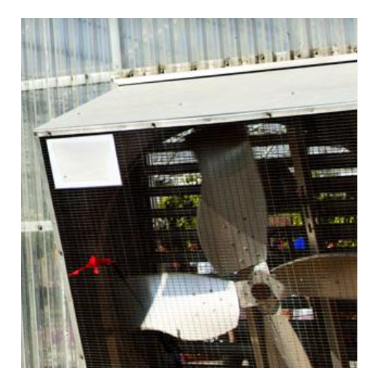
It is rather surprising that regular air exchange or proper air circulation is among the most underestimated aspects of indoor plant cultivation, despite the availability of information today. The clear aim of this article is therefore to explain and remind readers of the importance of these aspects. Plants growing freely in nature automatically have a constant supply of fresh air with enough oxygen and carbon dioxide, which flows freely through the vegetation, thereby also ensuring the removal of accumulated moisture.
Nature, of course, has it all under control. Why, however, so many growers still take these processes lightly is still something of a mystery in the world of indoor gardening. If we use a closed greenhouse or have at our disposal a grow tent, or even an entire room for indoor plant cultivation, we have no choice but to account for completely different conditions than those outdoors and to try to imitate nature using proven methods.
According to experienced growers, we should not be lulled into a false sense of security by the fact that the plants look fairly healthy at first glance and are growing reasonably well. Such an approach could cost you tens of per cent of your potential yields unnecessarily! It would certainly be a shame to miss out on higher yields, which is why we will divide the following advice, related to the perfect climate inside the growing space, into two parts:
- Air exchange
- Air circulation
You probably already know that plants capable of photosynthesis consume carbon dioxide (CO2), while at night it is mainly oxygen. Humidity inside a closed growing space increases as a result of their transpiration. Given that a closed growing environment, for example a medium-sized grow tent, requires an intensive source of artificial lighting, replacing sunlight for the plants present there (partly in the case of discharge lamps or completely in the case of full-spectrum lighting), but also emitting a considerable amount of heat into the surroundings together with the light, which tends to accumulate inside the grow tent or room. Rising temperature and humidity in a closed environment... You have probably quickly imagined, from these words, what scenario would occur inside the grow box without sufficient ventilation. The transpiration activity of the plants would gradually cease. They would therefore be unable to cool themselves naturally, which would lead to their death.
Our TIP: The new Resin+ LED AX 600W 2.8 µmol/J also belongs among full-spectrum LED grow lights, simulating natural sunlight for plants, while emitting less heat into the growing space than a classic discharge lamp.
 1. Air exchange
In terms of air exchange in the growing space, it is first necessary to distinguish between two types of environment, namely open or closed.
- If we mean a closed indoor growing room in the true sense of the word, we count on automatically controlled ventilation and CO2 supplementation (see separate article: Growing plants and carbon dioxide. How and why should it be used?). In practice, however, this usually concerns professionally equipped growing spaces for commercial growers.
- At the moment, we are more interested in home growing, and in this case we refer to the system as open, where a reliable extract fan removes air from the grow tent or room and fresh air flows into the growing space. These are the two options for achieving this effectively in the comfort of your home:
- Active air intake - this requires two fans. The one with the higher output serves to extract air (the so-called extract fan). As you will no doubt correctly suspect, the second fan in this setup serves to bring in air, and it is usually sufficient for it to have a lower output than the extract fan. Negative pressure controllers allow simple control of both fans at the same time and optimisation of their output.
- Passive air intake - fresh air is brought into the growing space thanks to the negative pressure created by the extract fan. If you opt for passive air intake, do not forget that the area of the intake opening for passive intake should be at least twice as large as the area of the extract ducting! Only then will negative pressure not prevail inside the grow box or indoor growing room, which would mean an insufficient supply of fresh air to the plants.
Our TIP: WHISPERBLOWER: professional fans with unrivalled efficiency (in the picture)

One of the most common questions from growers starting out indoors is which factors are most important when choosing air handling equipment for a grow box. Therefore, always consider the following first:
- What is the total volume of the growing space you will be using?
- What is the (average) air temperature and humidity of the air that will be brought into the growing space?
- What grow lighting will you use inside the grow tent or room?
- How many plants do you plan to grow inside the growing space? To what extent will it be filled?
- There is one more very important factor, without which this overview would not be complete, and that is duct resistance.
Returning to the first bullet point, it should be noted that the total volume of air in the growing space should be exchanged at least every 5 minutes and ideally every minute! There is never any shortage of examples, so for illustration let us imagine a grow tent with a volume of 2 m2. Although it might seem that a fan with a flow rate of 120 m3/h will be just right in this case, an experienced indoor grower will choose a fan that allows at least double the airflow, because they also take into account duct resistance (see the last point) and the odour filter. They will leave an even greater reserve if the pipes are long or bent. Simply put, the longer and more complex your ducting system is, the harder the fan has to work to extract air, and therefore it should have adequate output. It is always better to have a higher output available, which can also be easily reduced using controllers, than to have to buy a completely new, more powerful fan because you need more power.
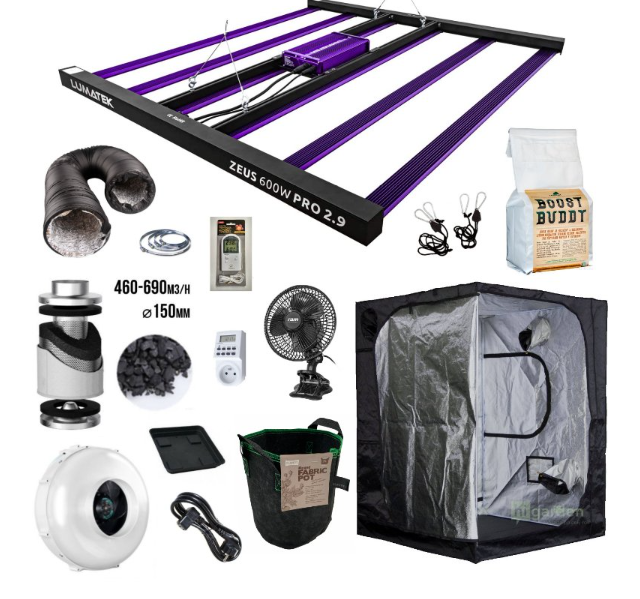
Our TIP: Do you not want to design your growing air handling system yourself? Use a complete tailor-made indoor solution in the form of our cost- effective grow box sets, assembled by our experts (example in the picture). You can leave the technical concerns to us and simply connect the whole system at home and start indoor growing.
 2. Air circulation
One thing is to ensure that plants grown in a closed environment breathe nothing but fresh air through their leaves. However, many growers forget that air exchange and air circulation are interconnected.
It is therefore also necessary to think about proper air circulation, which is absolutely crucial in a closed space of several cubic metres if we want to maximise the genetic potential of the plants being grown.
But beware! Everything in moderation. If you overdo the airflow provided by circulation fans, you will expose your plants to unwanted stress and may even damage their leaves. For this reason, it is important to place a circulation fan inside the grow tent or room so that the air always blows level with the tops of the plants. Truly even air circulation and the associated homogeneous climate in the growing space will be ensured by installing a larger number of circulation fans, about which you can learn everything you need in a separate article: How do you choose a circulation fan?
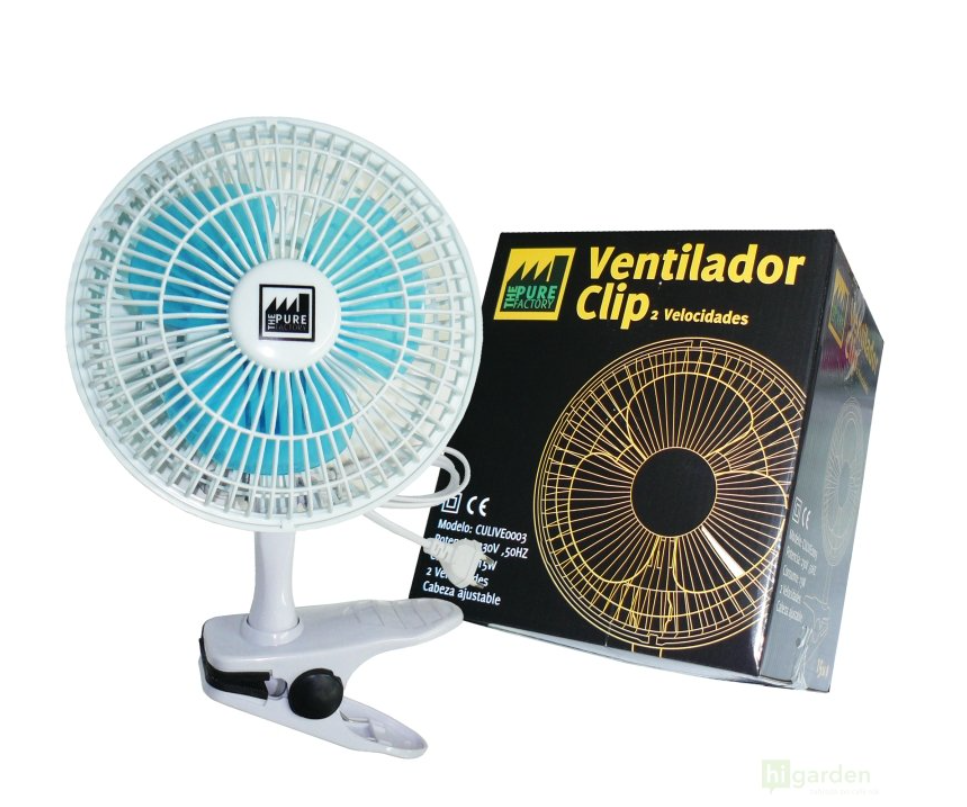
And these are the three reasons why we do not know anyone who does not use circulation fans in a grow tent:
- Photosynthesising plants consume carbon dioxide. They exhale oxygen and moisture. In the immediate vicinity of the leaves, a climate gradually accumulates that is so-called stale and no longer allows the leaves to function normally.
- Fresh air that has just been brought into the growing space is effectively mixed by circulation fans, thanks to which no areas with different temperatures arise in the grow tent or room and overheating of plant leaves is also prevented.
- What is second nature outdoors is once again provided indoors by a circulation fan, whose operation gently moves the plant stems through the airflow, forcing them to strengthen healthily. The leaves of the plants should be in slight motion at all times. This also clearly shows you whether the air in the growing space is circulating continuously. This is easiest to check with grow tents whose construction has viewing windows, such as the BudBox PRO XL (see separate article: BudBox - stable grow tents are number one in England).
After reading the above lines, you should have no doubt whatsoever that a constant and at the same time sufficient supply of fresh air to all leaves in a closed growing system is a basic prerequisite for effective photosynthesis, and thus for high yields indoors.
Would you like to ask us something? We are here for you at the well-known e-mail address info@higarden.eu. We will be happy to advise you, for example, on choosing the right air handling equipment.
We also recommend these products:
What to read next
- Prima Klima - fans for maximum output and minimum noise
- VIPARSPECTRA and growing under LED - definitely a good idea!
- Do you know what VPD is? Discover the key to perfect conditions for plant development