
Winter is coming: Prepare your growbox for winter
One of the main attractions of indoor growing is that you can cultivate all year round, regardless of the whims of the weather. However, it is not entirely true that indoor growers are unaffected by the changing seasons. Even a small drop in temperature in the growing area causes fluctuations in VPD and slows down plant metabolism. You can learn how to prevent this in the following article.
Most plants grown indoors grow best at temperatures in the range of 21-29 °C, with the difference between day and night temperatures not exceeding 5 °C. As soon as temperatures fall, plants slow down their metabolism and the rate of photosynthesis. This means that even if we provide them with a large amount of energy in the form of light, they will not be able to use it to produce sugars and will grow more slowly than they would at higher temperatures. If the temperature drops below 15 °C, plants stop growing and remain stunted.
Plants also respond to low temperatures by slowing transpiration, that is, the rate at which they evaporate excess water through their leaves. Transpiration is crucial for the transport of nutrients and water. A smaller volume of water evaporated through the leaves means that plants use less water, but at the same time they stop taking up nutrients from the substrate or nutrient solution. The result is again slower growth and also an increased risk of overwatering substrates and root rot.
Growing at lower temperatures can also bring some advantages, especially in the prevention of pests and mould. Cold air retains less moisture and is drier than warm air. This can be useful in preventing moulds such as powdery mildew or Botrytis cinerea, which causes flower rot. At low temperatures, some insect pests, such as spider mites or aphids, also reproduce more slowly. However, remember that if the temperature drops below 15 °C, plant metabolism stops completely and they cease to grow.
The effect of low temperatures on VPD
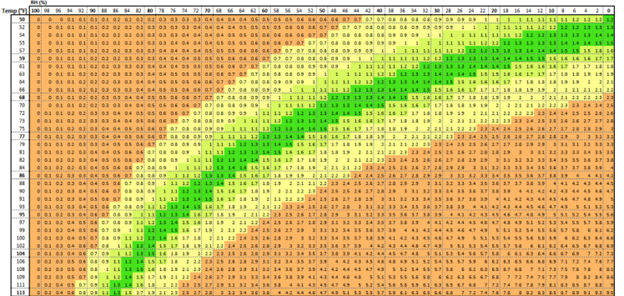 Plants are affected by the temperature and humidity of the air surrounding them. Air temperature affects transpiration and relative humidity plays a significant role in CO2 uptake, which is important in the process of photosynthesis. The effects of climatic conditions on plants are best expressed by vapour pressure deficit (VPD). We covered this topic in detail in an older article on our blog. VPD values are derived from the temperature and relative humidity of the air in the growing area, and even small fluctuations in temperature (+-1 °C) or humidity (+-5 % RH) can represent significant changes in vapour pressure deficit. If you use VPD as a guide when growing plants indoors, it is extremely important to maintain a consistently stable and optimal temperature and humidity in the growing area.
How to keep the grow box sufficiently warm
During winter, you have several options for increasing the temperature in the grow box. The simplest and cheapest solutions consist of insulation, or alternatively blowing in warm air or moving the grow tent to another location. Slightly more expensive (but more reliable) is heating the growing space with a heater or replacing the grow lighting.
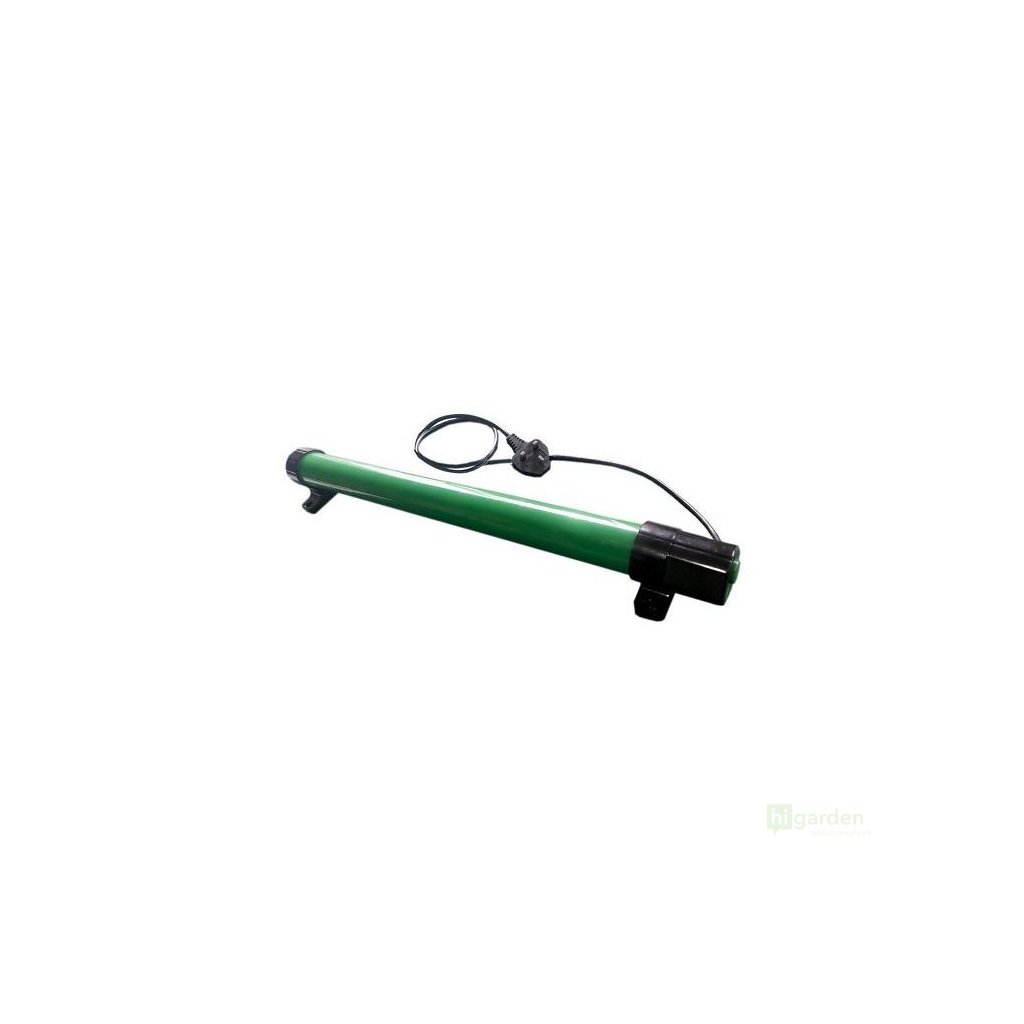 Insulate the grow box: Before you start heating the growing area, make sure that the grow box seals properly and check all zips so that warm air does not escape. If pots or the irrigation system stand on a cold floor, place them on a suitable insulating material, such as polystyrene.
Use warm air from another part of the house: During the winter months, it may be advantageous to bring warm air from heated rooms into the growing area. It is also a good idea to place the grow tent closer to heat sources, for example next to a radiator.
Heaters for the grow box: If insulation and the supply of warm air are not enough, consider getting a suitable heater. For grow boxes, tubular greenhouse heaters are particularly suitable, or hanging heaters. Most heaters are equipped with a thermostat, which keeps the temperature in the growing area stable. Heating the room in which the grow tent stands can also be a solution. Oil-filled or electric radiators are suitable.
Switch to another type of grow lighting: Modern LED grow lights stand out for their efficiency and therefore do not emit too much heat into the surroundings. Older grow lights using sodium discharge lamps (HPS) emit a considerable amount of heat, which can be an advantage in the winter months.
Whether you decide on insulation, moving the grow box, or investing in heating and new lighting, always keep in mind that a stable temperature is the key to success. For more tips and tricks on how to grow even in the winter months, visit our Higarden blog.