
How to correctly measure conductivity (EC)?
The topic of this article is proven methods for measuring the electrical conductivity of a solution, a value that plays a very important role especially in indoor plant cultivation. If you are interested in how to use EC metres, or EC/TDS probes, or how to care for them properly so that your measuring instruments last as long as possible, you are in the right place.
If you would first like to learn what EC actually is, you can start with a separate article: Electrical conductivity of a solution – EC. In practice, this means determining the amount of mineral (“nutrient”) salts dissolved in the nutrient solution.
Measuring EC frequently and accurately is an indispensable part of plant cultivation not only in a growbox. Many beginner growers then wonder what the difference is when measuring between EC (the measured value stated in μS/cm) and TDS (the measured value stated in ppm). The difference lies only in the fact that from the TDS value (Total Dissolved Solids) you can read the total amount of dissolved solids in ppm units.
EC metres and their calibration
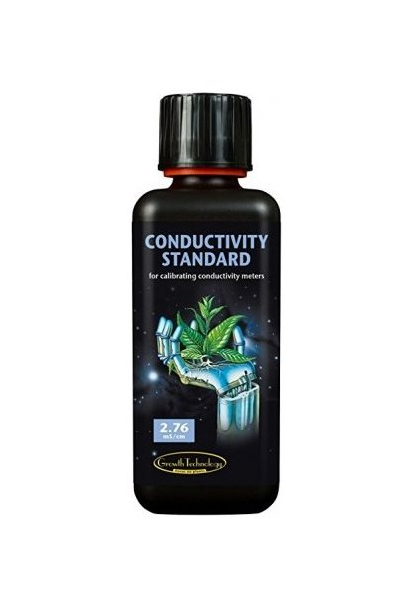
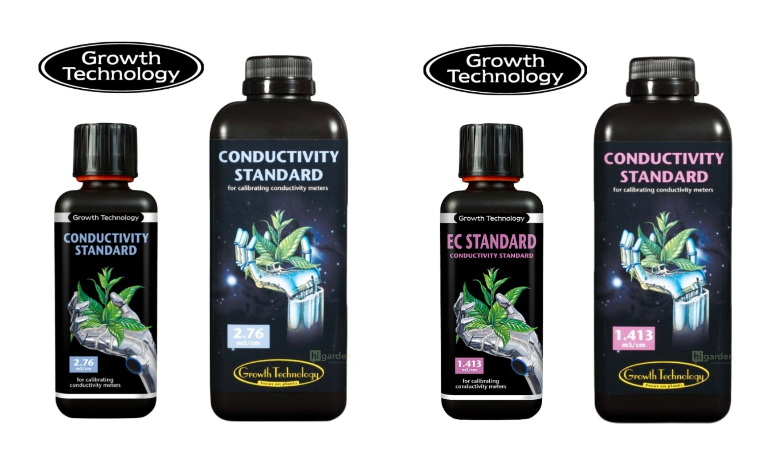
EC calibration solutions are available in 1.413 mS and 2.76 mS variants. However, do not be misled by the 2.8 mS or 2.77 mS variants either, which are equivalent to 2.76 mS solutions and the only difference is rounding.
How often should you calibrate an EC metre?
The answer here is straightforward. To ensure maximum measurement accuracy, the electrodes should ideally be calibrated using the above calibration solutions before each use. If the probe is used on a daily basis, it should also be calibrated every day.
And now we come to further proven methods for measuring conductivity:
- Always use a fresh calibration solution! In other words, calibration standards are easily contaminated and, moreover, they do not have buffering capacity, so there is no point in trying to use them repeatedly.
- Before you start calibrating, rinse the probe with deionised water (see separate article: Reverse osmosis). Only then can you safely immerse the probe in the calibration standard. For even more accurate measurement results, prepare a second separate beaker with calibration solution or sample for rinsing in advance. Proper rinsing of the electrode with deionised water is truly very important. Accumulated salts and other residues can contaminate solution samples and cause inaccurate readings. Therefore, rinse the probe every time you remove it, before storage, or when measuring conductivity of different samples in multiple beakers.
- Plastic beakers are generally recommended because other materials, such as glass or metal, cause electromagnetic interference with the measured electrical conductivity.
- Correct placement of the electrode in the beaker means the same distance from the beaker wall in all directions.
- Also make sure that the electrode is sufficiently immersed. Otherwise, you will only get distorted results when measuring conductivity. Therefore, check that all openings are actually below the surface and that there are no bubbles between the sensors.
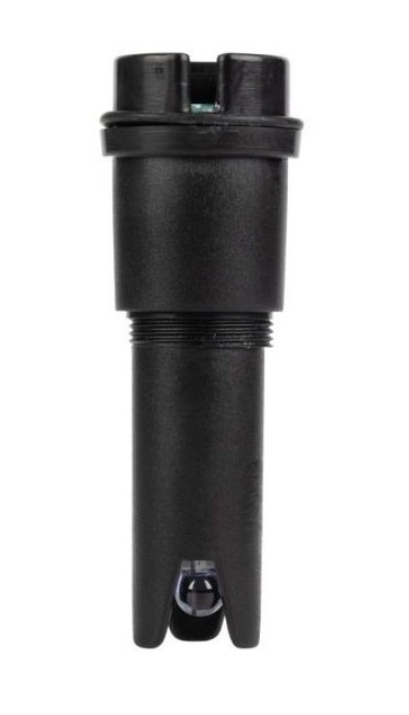
Example of a replacement electrode for an EC metre.
- Check for air bubbles, because air may remain trapped in the body, or on the body, of the electrode even when it is immersed, causing inaccurate measurement. If you notice air bubbles, immerse the probe sufficiently and move it up and down. You can then release any bubbles from the openings by gently tapping it.
- Although electrodes usually have so-called temperature compensation, bear in mind that it takes them some time to reach thermal equilibrium, so always wait until the measured conductivity or temperature value stabilises.
- Choose the appropriate type of electrode, because not all electrodes are suitable for the given range or sample. Sometimes, when selecting a measuring device, the suitable range as well as chemical compatibility may therefore matter. For certainty, you can always consult u