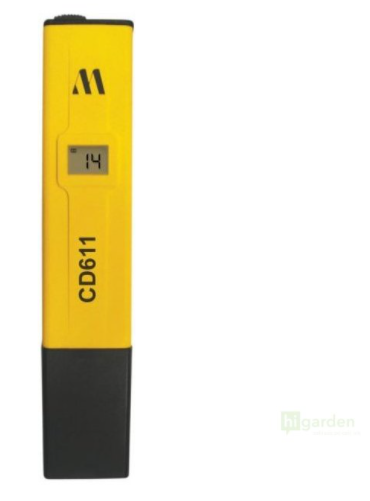
Electrical conductivity of solution – EC
The correct concentration of mineral salts in the nutrient solution is essential for healthy plant development and is one of the most important values a grower needs to monitor during the cultivation cycle. This concentration is indicated by the EC value (Electric Conductivity). How do we measure it, and which values are best for a juicy harvest?
Based on the electrical conductivity values of the solution, we can easily determine the amount of nutrients in water for watering or in the tank of hydroponic systems. It is precisely for hydroponics or, alternatively, aeroponics that the correct concentration of salts present in fertilisers, but also in tap water or well water, is absolutely crucial...
Electrical conductivity can also be described as the potential of electric current transported by water. There is no point in going into detailed physical definitions; for the enjoyment of cultivation, it is enough that we can imagine this physical phenomenon and learn how to work with it.
In growing practice, ordinary tap water is most commonly used. The EC of tap water depends primarily on the location. Within the Czech Republic, we are in the range of 0.3–0.7. That is not a given, so the Czech grower has reason to be pleased. For comparison, there are areas beyond the borders of our country, and there are many of them, where tap water commonly has EC values in the range of 1–2. The lower the EC value of the water itself, the better, because water as such is not yet the main source of nutrients for cultivated herbs, flowers and crops. We supply nutrients to them through fertilisers. When fertilising, it is therefore necessary not to overlook the EC of the input water. Let us give a clear example: if we have a predefined recommended EC value for fertilising, for example 1.9, and we know that the water we use has an EC of 0.6, we can enrich the water with nutrients only to an EC value of 1.3. The key point is therefore that it is good to have water with as low an electrical conductivity as possible. The lower the EC value the water has, the more nutrients we can provide to plants through fertilisers. An excess of nutrients could so-called burn your crop, and is therefore just as harmful to plants as a deficiency. Consistency is important when fertilising. Experienced growers prevent both excess and deficiency of mineral salts by gradually increasing or decreasing EC values, for example by 0.1 to 0.3 each week. In this way, plants are much better able to absorb the nutrients contained in fertilisers than with a sudden increase in doses. Avoid over-fertilisation!
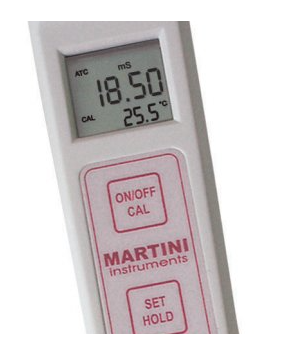 Values shown on the display of a pocket digital EC meter
The EC value is not stable and changes during the life stages of plants. It should be emphasised here that plant needs are individual and depend to a large extent on the species and variety. With this reminder, we can specify the recommended values as follows:
- Young plants: EC 0.6–1.2
- Older and larger plants: EC 1.2–2.5
For measuring and maintaining optimal values, EC meters are an excellent tool. Unlike pH meters, they usually do not even require maintenance solutions and are fitted with a metal probe. In terms of calibration, devices allowing digital or manual calibration are available on the market. However, nowadays the vast majority of growers use the digital version, which is also very convenient for beginners, because automatic temperature compensation means there is no risk of the device malfunctioning due to an incorrect procedure during calibration. EC meters are indispensable, among other things, during the flowering phase and also during flushing. At Higarden.cz you will also find replacement probes or practical measuring sets if needed. Calibration solutions designed for EC meters are produced mainly in the 1.413 and 2.78 mS variants. Solutions in the 2.8 variant are intended for the same use as 2.76, so do not be misled; the difference is only in rounding.