
Light Spectrum and Its Effect on Plant Growth: Outdoor vs. Greenhouse vs. Indoor
Plant cultivation can take many forms, from traditional outdoor growing, through greenhouses, to indoor cultivation under artificial lighting. Each of these methods offers unique advantages, but also has some disadvantages. In today’s article, we will look at the differences in the light spectrum when growing outdoors, in a greenhouse, and indoors under LED grow lights.
Plants perceive light through photosensors called photoreceptors. Most of them are responsible for capturing light photons and converting them into energy during the process of photosynthesis. However, plants are also equipped with specialised photoreceptors that function differently from the others, do not always take part in photosynthesis, and some of them even detect light outside the visible light spectrum. These photoreceptors are important for plants because they affect circadian processes, developmental signals, gene regulation, and much more.
Different colours of light
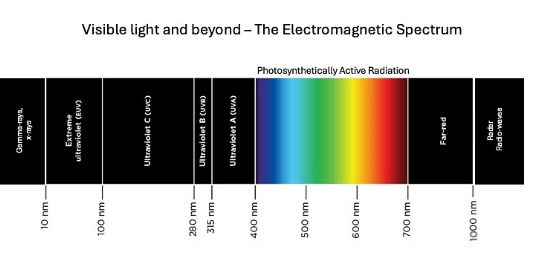 To understand the light spectrum, it is important to realise that light is electromagnetic radiation, which can be characterised both as a particle (photon) and as a wave. Individual types of electromagnetic radiation are divided according to wavelength and the corresponding frequency. The term “spectrum” originally referred to the colour spectrum visible to the human eye (the colours of the rainbow), but over time other types of radiation were also discovered that people cannot perceive visually.
Visible light: The visible part of the light spectrum with wavelengths of 400-800 nanometres. The individual colours in the light spectrum are called spectral colours (red, orange, yellow, green, cyan, blue, violet).
Photosynthetically active radiation: PAR (photosynthetic active radiation) overlaps with visible light and refers to the range of light wavelengths (400 to 700 nanometres) that plants use for photosynthesis. Most LED grow lights include only photosynthetically active wavelengths.
UV: Ultraviolet radiation (400-10 nanometres) is dangerous for both people and plants, damages DNA, and can cause cancerous growth. Most UV radiation is captured by the Earth’s atmosphere, but a small amount reaches the surface.
Infrared radiation: Infrared radiation has a wavelength between 760 nanometres - 1 nanometres and is further divided into near-IR, mid-IR, and far-IR.
X-rays: X-ray radiation with wavelengths of 10 – 0.1 nanometres is used in practice thanks to its ability to penetrate a range of materials (radiography, CT). It has no significance for plant cultivation.
Gamma radiation: Radioactive radiation that arises during nuclear processes. It has no significance for plant cultivation.
Outdoor growing: All colours of light
It will probably surprise no one if we say that natural sunlight is the most complex and covers the widest possible spectrum. Plants grown outdoors are exposed not only to the visible part of the light spectrum, including photosynthetically active radiation, but also to infrared, UV, and other types of radiation. While the effects of extremely short or extremely long light wavelengths are not very well documented in relation to plants, some of the invisible wavelengths, such as UV and far-red radiation, can be crucial for plants, even though they do not affect photosynthesis.
Greenhouses: The absence of UV radiation
 Greenhouses can be made from various types of glass or even plastics, which may have different effects on the light passing through the material. In general, however, glass transmits most of the light spectrum, but naturally blocks a significant part of UV and lower-wavelength radiation. In this sense, greenhouses can be considered semi-permeable, and the absence of UV light can affect plants, for example in the production of terpenes or active compounds.
It is known that in some plants UV radiation stimulates the production of secondary metabolites. There are theories that such plants produce more of these substances because they act as natural protection against the destructive impact of UV rays on DNA. In addition, the unusual photoreceptor UVR8 has been discovered, which is directly activated by UV-B radiation and detects light with a wavelength of (280-320 nanometres). This photoreceptor consists of two UVR8 molecules, which separate after exposure to UV-B and become monomers, changing its function and leading to changes including increased stress resistance, gene function, and the development of the plant.
The absence of UV radiation does not threaten plants’ survival, but it can significantly affect how they cope with stress and pass through individual stages of life. For these reasons, some growers in greenhouses and indoors use special grow lights that enrich the light spectrum with UV-A and UV-B radiation.
Indoor: PAR tailored to plants
Most modern LED grow lights emit a standardised light spectrum corresponding to the wavelengths of PAR radiation (400–700 nanometres). Such a spectrum is more than sufficient for plants to thrive under artificial lighting, and under certain circumstances they may grow faster than they would outdoors or in a greenhouse. On the other hand, the spectrum of LED grow lights lacks not only UV, but also infrared light.
The amount of infrared light reaching plants grown outdoors or in a greenhouse changes throughout the day and year depending on the sun’s movement across the sky, because the angle at which light passes through the atmosphere changes. Plants use this fact to control their circadian rhythms and, thanks to specialised photoreceptors called phytochromes, they can recognise, for example, when it is time to start flowering. Therefore, when growing indoors under artificial lighting, plants may begin flowering a little more slowly (when switching to 12/12) than they would outdoors. As with UV radiation, you can also supplement the infrared spectrum in a grow room or greenhouse using supplementary lighting with an infrared spectrum.
Also read: Indoor growing: How to switch to flowering