
How strong a lamp should I choose?
The following lines will reveal the answer to one of the most common questions asked by beginner growers who use grow tents as a source of artificial lighting for plant cultivation and choose discharge lamps. Do you already know how many watts will be just right for you?
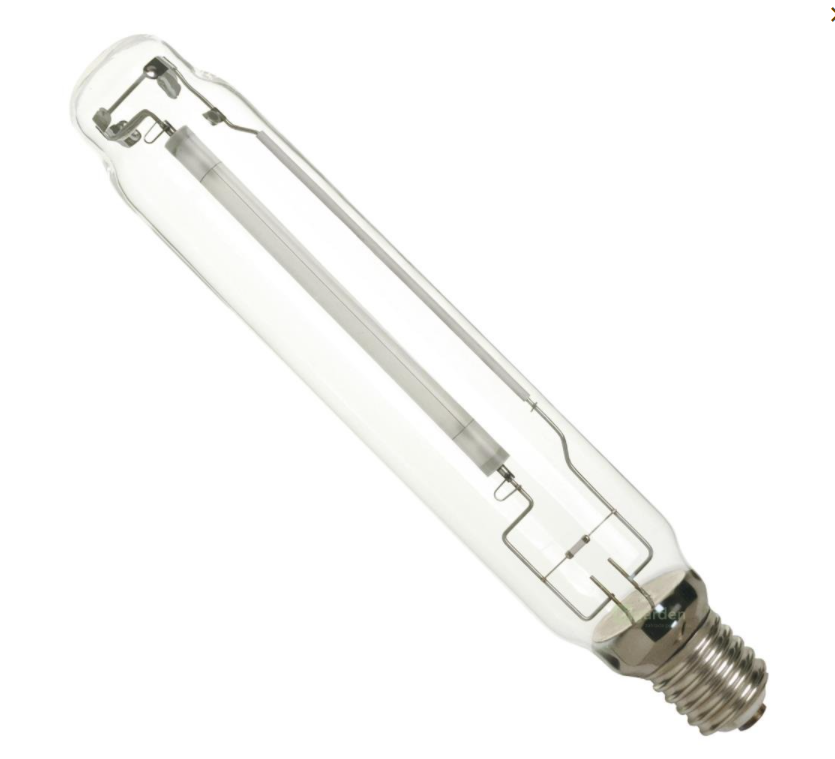
When it comes to the parameters of high-pressure discharge lamps (HID), the wattage of artificial lighting for your plants that will be adequate in relation to your growing space and plans can be estimated as follows:
- 70W discharge lamps are intended to illuminate a growing area of 35 x 35 cm with an effective reach of 25 cm.
- 150W discharge lamps are intended to illuminate a growing area of 45 x 45 cm with an effective reach of 35 cm.
- 250W discharge lamps are intended to illuminate a growing area of 60 x 60 cm with an effective reach of 50 cm.
- 400W discharge lamps already allow reliable coverage of 1 square metre of growing area with an effective reach of 80 cm.
- 600W discharge lamps are intended to illuminate a growing area of 120 x 120 cm with an effective reach of 1 metre.
- 1000W discharge lamps can easily cover a growing area measuring 150 x 150 cm with sufficient light intensity.
However, we must not forget that an important prerequisite for the above values is the use of a high-quality reflector in combination with a high-quality reflective material inside the growing space.
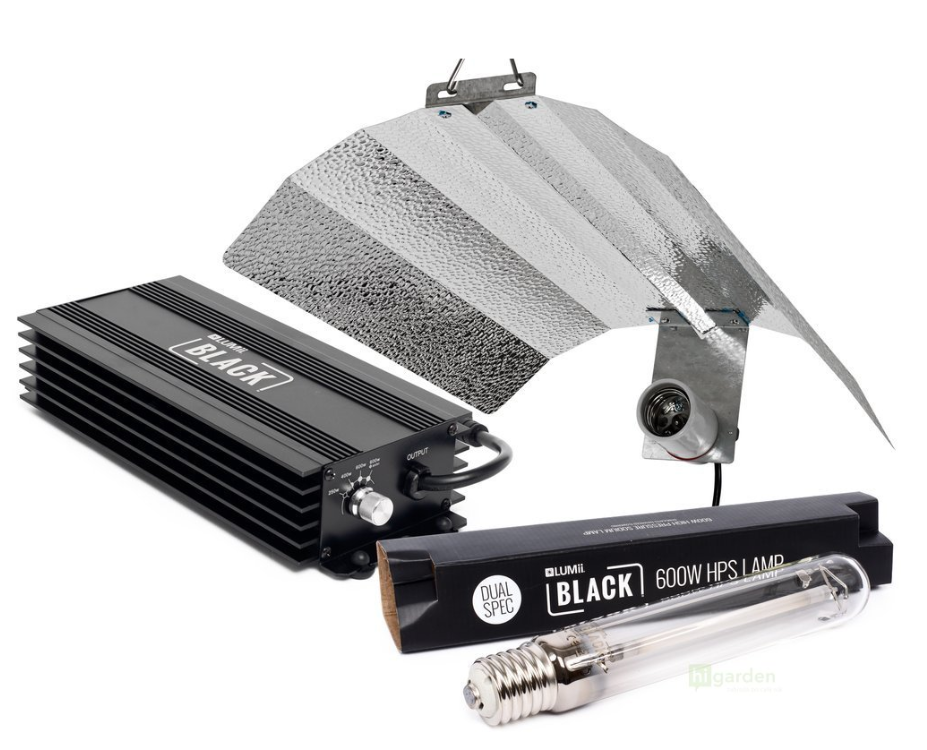
Our TIP: Take advantage of the exceptionally favourable price-performance ratio offered by the LUMii Black Digital Complete 600W KIT. Not only is it one of the bestsellers, but in addition to the lamp and ballast, the price also includes a high-quality reflector!
When it comes to wattage, there are also certain generally accepted rules among growers:
- Mother plants and cuttings (clones) require at least 20 watts (W) per square area. A square foot is equivalent to an area measuring 30 x 30 cm.
- During the flowering phase, stronger lighting is needed, namely 25 to 40 W.
- The greater the output of the grow lamp, the lower the wattage you need in relation to the growing area.
- Many growers solve the situation in an elegant way, namely by replacing one large lamp with several smaller ones whose wattage is the same in total. However, the difference between the two options, and at the same time the advantage of the second variant, lies in the even distribution of light. This is, of course, especially true for discharge lamps, because modern LED lighting takes care of even light distribution on its own.
- Keep in mind that the intensity of light radiation reaching the plants decreases rapidly as their distance from the discharge lamp increases. In practice, you will find that each discharge lamp has a certain reach that is sufficient for the formation of flowers and fruits as you would wish. And again, unlike LED technology, you must subtract a safe distance from this reach from the tops of the plants to prevent them from being scorched by the lamp! Here, the quality and power of the grow tent ventilation system plays an important role, in other words, how and how effectively heat is removed from the tops of the plants.
- The reach (see above) is also related to the height to which the planted plants will grow. It is necessary to bear this in mind. A perfect solution even for taller varieties, so that you can grow them without the risk of scorching their tops, is grow tents with an increased frame height, such as the Dutch Mammoth grow boxes HC or HOMEbox Ambient, marked with a plus sign.
If you need advice on choosing one or more discharge lamps, do not hesitate to ask us anything via the well-known e-mail address info@higarden.cz.
We also recommend these products: