
How to recognise quality seeds?
A seed, which stands at the beginning of every plant’s story, is practically a dormant organism waiting to be awakened. How can you recognise the quality and condition of seeds you have prepared at home for storage, or have just bought? And what is the likelihood that they will produce a beautiful and healthy plant?
- The fact is that, by sight alone, a grower will not answer these questions in the case of smaller seeds, which are the basis of most plants commonly grown in a growbox. Even a magnifying glass will not be enough. We will not determine what we want by touch either. The only exception is really large seeds, such as those of pumpkin, where we can recognise their fullness by feel.
- Growers’ experience speaks clearly. The only proven way to predict the condition of a seed and thus the potential of the future plant is to store seeds in an optimal environment and do everything possible to ensure they remain in good condition.
- The word “germination” undoubtedly belongs among the terms most frequently used in the world of gardening, and it expresses a seed’s ability to produce a sprout. Most seed producers (seedbanks) guarantee seed germination to a certain extent, primarily by the expiry date stated on the packaging.
- However, if you have found seeds that you would like to try after the date has passed, do not despair and give them a go. It is common for seeds whose expiry date on the packaging has already passed to germinate without any problems.
- This does not change the fact that, for seeds of all kinds, a simple direct relationship applies: the older they are, the harder it is for them to emerge into life.
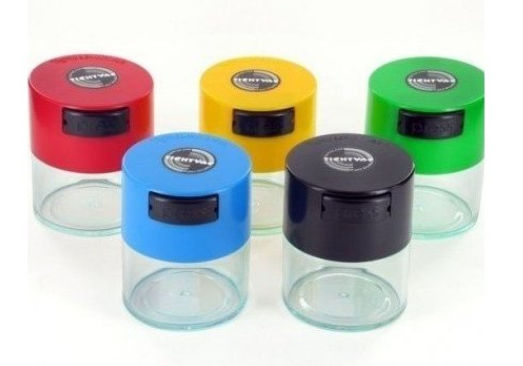
- You can best support germination through proper storage. For this purpose, TightVac vacuum containers are ideal, and you can also use them later for storing the harvest.
- The conditions for flawless seed storage can be summarised in three points:
- Darkness
- Coolness
- Absence of moisture
- Finding a dark place where temperatures remain consistently lower, yet where there is not the slightest moisture, can sometimes be a bit of a challenge. In terms of darkness and coolness, a cellar is often an option, but there is usually also a certain level of humidity there. Some growers then store seeds in the fridge, with emphasis on thoroughly sealing the container.
- Seeds stored under vacuum provide a considerable assurance of quality and improved success in subsequent germination.
- No matter what we do, we simply will not significantly extend the lifespan of some seeds, even with flawless storage. For example, onion seeds, which are very small, lose germination capacity already during the first year.
- These are, on the other hand, examples of seed that are worth taking good care of, because if they are stored under the right conditions (see above), they will retain a high level of germination for a very long time:
- Cucumber
- Pumpkin
- Courgette
- Tomato
- Brassica vegetables
- The concept of GERMINATION is also closely linked to the widely used germination test among growers. What does this checking method involve and what is it good for? The germination test allows us to quickly form a closer idea of the condition of the seeds and therefore how many to plant so that we later harvest the planned quantity of mature flowers decorating vital adult plants. The procedure is as follows:
- Lay several clean paper towels (kitchen towels, napkins, paper tissues, toilet paper, etc.) on top of each other.
- Place the test seeds on them. The larger the sample, the better. Ideally, at least 10.
- Spread the top paper layer over the seeds (see above) and moisten the surface, ideally using a fine spray bottle. It should contain water that has not just been drawn fresh directly from the tap. If you have tap water available, let it stand for at least one day before pouring it into the spray bottle.
- Remember that the seeds should definitely not be floating in water, otherwise they could “drown” and start to rot instead of germinating.
- Once the seeds are prepared in this way, cover them with any glass or plastic bowl and move them from a lower-temperature environment to one with a temperature of 18–20 °C.
- Now all that remains is to keep the towels moist by gently misting them with water (not wet!)
- Everything you can learn about the seeds from a grower’s perspective will become apparent over the following days, or rather weeks. It depends on how long it takes the seeds to wake from dormancy.
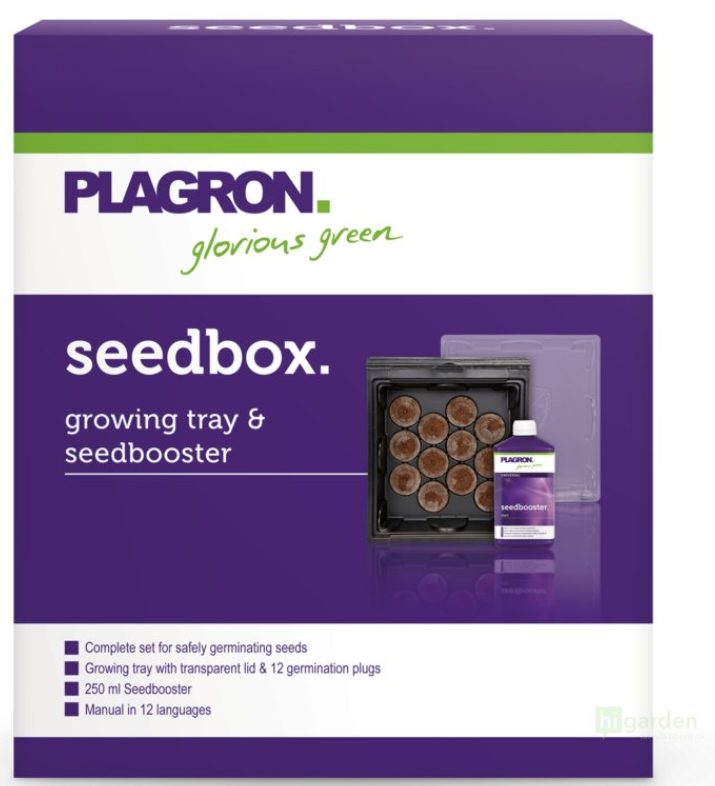
Our TIP: Get the complete Plagron Seedbox set at a discounted price, which contains everything needed for successful germination of 12 seeds, from a small propagator through propagation tablets to the highly effective Seedbooster for rapid rooting. A perfect solution for all beginners, we recommend it!
- A separate topic we would like to highlight at the end is seed treatment. Sometimes this is done using chemicals whose purpose is to protect seeds from pests or moulds. Chemically treated seeds can be recognised by their distinctive colouring.
- However, we recommend choosing seeds that are treated biologically. You can also manage the whole process yourself. Proven natural methods of seed treatment include infusions of chamomile, agrimony or yarrow as readily available herbs with a significant disinfecting effect.
- Make use of the strength of nettle and horsetail as well. These plants have a strengthening effect on the emerging seedling and support its growth.
- There are no limits to combining the herbs mentioned in an effort to strengthen seeds. And the more you strengthen them, the better the results of testing and the subsequent germination o