
Hydroponics Made Easy: EBB & FLOW
This advanced hydroponic technique is also known as “Flood and Drain”, the ebb and flow method. It allows growers absolute control over the plant root system and its nutrient supply. Read more!
- To begin with, it should be noted that Ebb & Flow – this is already hydroponics for the demanding. This hydroponic growing technique, used on so-called EB tables, which is characterised by exceptional efficiency, is therefore intended mainly for demanding, more advanced growers.
- As we mentioned above, with EBB & FLOW you have almost 100% control over the entire growing process, and what is the greatest advantage for more experienced growers can cause unnecessary damage at the beginning. However, as they say, no one is born learned, and sometimes you have to start somewhere, so theoretical preparation will only help you, whether you consider yourself an experienced grower or are only just beginning to flirt with hydroponics. At the beginning, or even before that, read the introductory article about hydroponics HERE.
- The table top, which consists of a shallow filling tray, is filled with nutrient solution at certain regular intervals and then drained again after a few minutes.
- The plants are either in individual pots, or the entire tray is filled with growing medium.
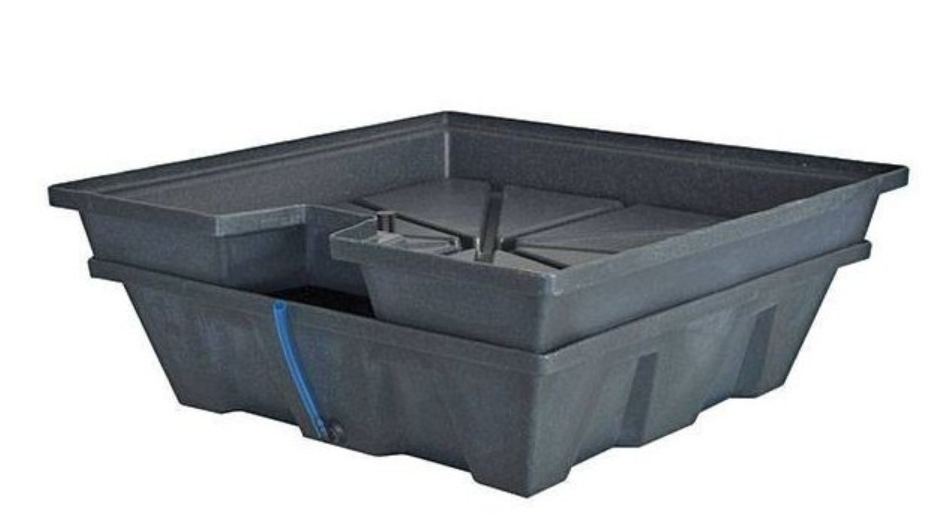
- We recommend the complete flood tray system from General Hydroponics, which you can also see in the image below.
- EBB FLOW brings growers maximum variability when it comes to the ongoing adjustment and control of irrigation for the purpose of supplying plants with the nutrients they need.
- In addition to herbs, fruit or vegetables, this method is also widely used for growing ornamental plants, which, when using EBB FLOW systems, do not need repotting for several years.
- When growing with the EBB & Flow system, residues of nutrients left after the last watering dissolve during the flooding of the substrate.
- This effectively prevents the formation of undesirable deposits and their direct consequence in the form of overfertilisation of plants due to too high a concentration of nutrient solution.
- Any watering that already exceeds the so-called retention capacity of the substrate in terms of volume flows immediately back into the tank with nutrient solution.
- One of the most important things a grower must keep an eye on when growing by the EBB FLOW method is choosing the correct irrigation cycle. Then the plant roots have enough oxygen and nutrients, and you avoid overwatering.
- Watering is supplied to the plants by means of a pump.
- Individual cycles are controlled by timers.
- Most EBB FLOW systems are made so that the nutrient solution reservoir is located below the pots, or growing trays, with the substrate and plants.
- “FLOOD”: Water with nutrients is usually supplied to two-thirds or three-quarters of the height of the growing medium, and even higher in the case of young plants that still have short roots that do not reach deep enough.
- “DRAIN”: Once the nutrient solution reaches the required level, it stops being pumped further by the pump and returns to the reservoir.
As we have already mentioned, the frequency of watering is decisive, so how should it be set correctly?
- The optimal length of the interval between flooding and draining cycles depends primarily on the size and depth of the EB table.
- The choice of substrate also matters (see below). The frequency of watering must, among other things, be adapted to the ability of the given substrate to retain water, in other words its retention properties.
- Keramzit (hydroton): Previous article Next article