
Differences between axial and radial fans. What and why?
Many growers try to save money on the fan they choose right from the start by opting for the cheapest fan possible, assuming that the choice of fan does not matter. As long as it has the required m3 per hour.
Unfortunately, it is not that simple. Fans differ in many respects, and behind that is, of course, mathematics and physics, which I will not present here, and if you wish, you can look it up on Google. ;-)
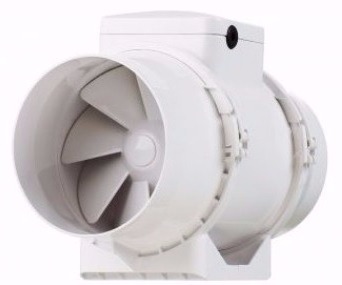
In practical terms, fans are divided into AXIAL (nicknamed toilet fans by some), typically represented by the TT and TD series, and RADIAL fans, which are further divided into fans with forward-curved blades, backward-curved blades and radially ended blades.
Unfortunately, it is not that simple. Fans differ in many respects, and behind that is, of course, mathematics and physics, which I will not present here, and if you wish, you can look it up on Google. ;-)
In practical terms, fans are divided into AXIAL (nicknamed toilet fans by some), typically represented by the TT and TD series, and RADIAL fans, which are further divided into fans with forward-curved blades, backward-curved blades and radially ended blades.
Axial TT fans are the cheapest you can find on the market, and if your ducting is no longer than 2 metres, you do not bend it, and you do not use any silencers, filters (yes, these "pipes" are in fact a significant obstacle to airflow), or any other components that restrict airflow, then TT fans will work quite successfully for several growing cycles.
TD fans are the same, but they use better bearings. The fan is better protected against clogging and generally achieves a much longer service life than TT fans, which is reflected in the price. Airflow for an axial fan is stated at zero pressure.
With one 90-degree bend, the pressure in the ducting increases by 10 Pa and the performance of the axial fan drops by approximately 25%. If you add, for example, a filter, the performance will drop by another 25%, and there is also a risk, in addition to insufficient fan performance, of insufficient cooling of the fan and burning out the thermal fuse. (If this happens, the manufacturer knows that the fan was operated improperly and will not accept the complaint.)
Another obstacle can even stop the airflow completely, and the fan will only "consume power" but do nothing.
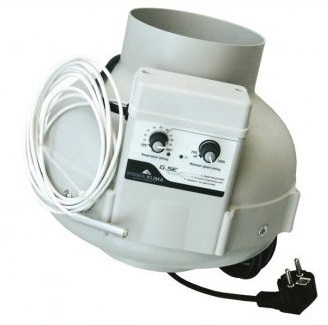
Radial fans, on the other hand, are designed for use in long ducting runs and, by their principle, create pressure that "pushes" air through obstacles and bends. This does not, of course, mean that your ducting can be infinitely long or that you can make a "snake" around the entire room and expect airflow not to be affected. Performance drops are in single-digit % for each obstacle, and under normal conditions, when you use a filter or silencer and have 2 bends in 10-metre ducting, you do not need to worry about the fan's performance or service life.
TD fans are the same, but they use better bearings. The fan is better protected against clogging and generally achieves a much longer service life than TT fans, which is reflected in the price. Airflow for an axial fan is stated at zero pressure.
With one 90-degree bend, the pressure in the ducting increases by 10 Pa and the performance of the axial fan drops by approximately 25%. If you add, for example, a filter, the performance will drop by another 25%, and there is also a risk, in addition to insufficient fan performance, of insufficient cooling of the fan and burning out the thermal fuse. (If this happens, the manufacturer knows that the fan was operated improperly and will not accept the complaint.)
Another obstacle can even stop the airflow completely, and the fan will only "consume power" but do nothing.
Radial fans, on the other hand, are designed for use in long ducting runs and, by their principle, create pressure that "pushes" air through obstacles and bends. This does not, of course, mean that your ducting can be infinitely long or that you can make a "snake" around the entire room and expect airflow not to be affected. Performance drops are in single-digit % for each obstacle, and under normal conditions, when you use a filter or silencer and have 2 bends in 10-metre ducting, you do not need to worry about the fan's performance or service life.
Unlike axial fans, radial fans also have no problem with fragments of activated carbon from filters. These properties have made them popular not only among home growers.
Is something unclear? Do you have a question? Write to us at info@higarden.cz We will be happy to expand the article with relevant questions.