
What are the ideal conditions for indoor growing?
Ensuring plants have the perfect environment should be the goal of every indoor grower. Only then will you use the electrical energy and other resources you have invested in cultivation effectively and achieve high yields. In the following lines, you will learn how to create the perfect climate in a grow room.
The basic climatic factors affecting plant growth are temperature, humidity, VPD, light and air circulation. Your goal should be to keep all these variables within the optimal range throughout the entire growing cycle. Remember that these factors are interconnected and influence one another, affecting the way plants take up water and nutrients. Therefore, if you change any of the climatic factors, you should also adjust watering and fertilising of the plants.
Vapour pressure deficit (VPD)
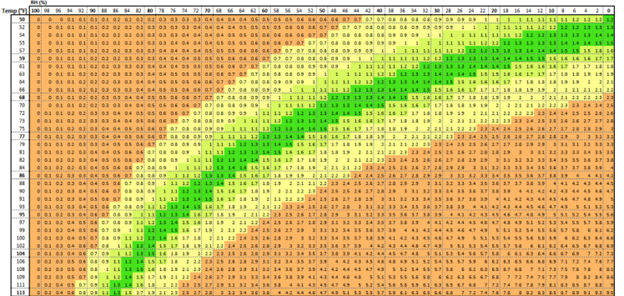 Water constantly flows through plants: roots absorb it and leaves release it back into the surroundings in the form of water vapour during a process called transpiration. This enables them to absorb nutrients, cool themselves and drive metabolic processes and photosynthesis. The rate at which water evaporates from plants through the leaves depends on the temperature and humidity of the surrounding air. The difference between how much moisture the air is able to hold and how much water it is holding at a given moment is called VPD (Vapour Pressure Deficit). At low VPD, the air is saturated with moisture, transpiration slows down and the risk of mould increases, whereas at high VPD transpiration speeds up, leading to greater water and nutrient uptake, but also to the risk of overfertilisation. Optimal VPD helps maintain a balance between water and nutrient uptake and healthy plant growth.
- The simplest way to achieve optimal VPD is to keep a stable temperature in the growing space and adjust the air humidity according to the age of the plants.
- How to handle VPD and advanced climate control.
Temperature
 Temperature affects the rate at which plants absorb and process nutrients. Most plants thrive best at temperatures in the range of 20 to 30 °C. The lower the temperature drops, the more slowly plants will transpire, their metabolism will slow down, and their growth will stop completely at around 16 °C. As temperatures rise, plants can carry out photosynthesis more efficiently. This allows them to use more energy from light and grow faster, with the fastest growth achieved at 30 °C and 1,500 PPFD (Chandra et al. 2009). If temperatures rise above 30 °C, plants will not be able to cool down quickly enough and their growth will stop completely at 32-35 °C.
- Measure the temperature in the growing space with a digital thermometer with an external probe, which you should hang near the new shoots, as they are the most delicate.
- Prepare your grow box for winter.
- High temperatures in indoor growing and how to avoid them.
Humidity
The ideal humidity for indoor growing depends on the age of the plants, the temperature and VPD. Maintaining low relative humidity in the growing space is especially important during flowering and ripening, when plants are more susceptible to mould and botrytis. In general, during germination and rooting the humidity in the growing space should be around 70%, during the vegetative phase 55-65% and during flowering around 50%. Do not forget that air humidity that is too low speeds up transpiration, which results in high water consumption, slow growth and lower yields.
- To increase humidity in the growing space, use humidifiers; to reduce it, use dehumidifiers.
- For indoor growing, you cannot do without a digital humidity meter with thermometer.
Light
 During photosynthesis, plants convert energy from light into sugars, which they then use to power their metabolism. For this process to be efficient, the incoming light must have the appropriate spectrum, intensity, and the length of lighting is also important. Most plants need approximately 18 hours of light per day for growth and 12 hours for flowering. A suitable grow light should have a spectrum corresponding to sunlight. This is usually provided by LED diodes or HPS discharge lamps. Light that is too weak limits growth, while light that is too intense burns and stresses plants.
- How light spectrum affects plant growth.
- The most important criteria for choosing grow lighting.
- How to control photoperiod to increase plant yield.
Air
A sufficient air circulation in the growing space is essential for maintaining the correct temperature, humidity and a supply of fresh CO₂ for plants. Ideal airflow in a grow box or grow room is ensured by a combination of a extract fan and internal circulation fans. The extract fan removes excess humidity and brings in fresh air, while circulation fans ensure even airflow around the plants.
- How to choose ventilation ducting for a grow box or grow room.
- Where and how to correctly place fans in a tent or grow room.
- Buy a fan with control or without?
Would you like to learn the basics of indoor growing or are you looking for information about the latest developments in growing and the newest gardening gadgets? You will find all of that on our Higarden blog!