
Beneficial microorganisms (microbes) are indispensable helpers
Microorganisms, or microbes, are single-celled organisms whose activity can only be observed under a microscope. They are often perceived negatively in the sense of pathogenic microbes. But on the other hand, we also have beneficial microorganisms. These are the ones that do not harm people, animals or plants and, in gardening, are instead widely used to achieve significantly greater efficiency in plant fertilisation, while also protecting plants, for example against the action of harmful pathogens. Microbes mean natural and versatile support for the development of your plants!

Without the activity of microbes, there would be no life on Earth. Such is their importance! It is not the first time we have mentioned that healthy “micro-life” is the best foundation for healthy and strong plants, capable of producing abundant flowers or large fruits with a high content of valuable substances. It is therefore no surprise that more and more growers are enriching the basic nutrition of plants with quality products with microorganisms (see below).
Bacteria, algae, fungi and protozoa, of which there are countless in soil, multiply rapidly and therefore often live in colonies or even form symbiotic relationships. A large group of microbes develops in the area of soil closest to the roots of higher plants and is technically called the rhizosphere. Because we regularly emphasise a healthy root system, you can probably already guess how positive the impact of microbes on your harvest will be. Let us now introduce at least the most important cases.
Rhizobacteria
Rhizobacteria are by far the most numerous group of microbes in the rhizosphere. The first example is bacteria that develop either directly in the root system of plants or in its immediate vicinity. The beneficial effects of rhizobacteria on colonised plants were already observed by ancient growers. Today we simply have much more sophisticated means of initiating and stimulating these processes in soil or substrate. Tips on selected products can be found at the end of this article. Are you interested in how rhizobacteria help plants, or rather growers, achieve the dream natural harvest?
- Better nutrient availability: Some rhizobacteria are able to provide plants with phosphorus and iron from soil, where these elements are present in inorganic form. Bacteria of the genera Bacillus, Pseudomonas, Rhizobium or Erwinia convert them into a form that is easily absorbed by plants, which is of course not only effective but also ecological.
- The ability to bind atmospheric nitrogen: The “superpower” of some rhizobacteria to enrich soil with nitrogen (N) is of enormous importance to every grower or farmer. The best-known example is bacteria of the genus Rhizobium, which form small nodules on the roots of leguminous plants. As German scientists discovered as early as the end of the 19th century, the nodules themselves are the place where these bacteria cluster. However, observation of their activity in a way goes back to antiquity, when farmers noticed how well plants developed when growing in a field with soil enriched with nitrogen because they had grown beans or peas there the year before.
- Natural antibiotics: Antibiotic substances produced by rhizobacteria often have antiviral or fungicidal effects. As we outlined right at the beginning, beneficial microbes and, in this case specifically rhizobacteria, are therefore indispensable helpers not only in plant nutrition but also in plant protection. Thanks to their ability to produce antibiotic substances, they help prevent root rot or the occurrence of insidious types of moulds (e.g. Botritis).
- Source of natural stimulants: Many rhizobacteria also produce phytohormones, especially auxins, the best known of which is probably indole-3-acetic acid, as well as cytokinins or gibberellins, which are synthesised in places of active growth (buds, young leaves, seeds). These plant hormones improve seed germination and cutting root formation, and therefore they are often part of the composition of many root boosters or fertilisers for cuttings and planting.
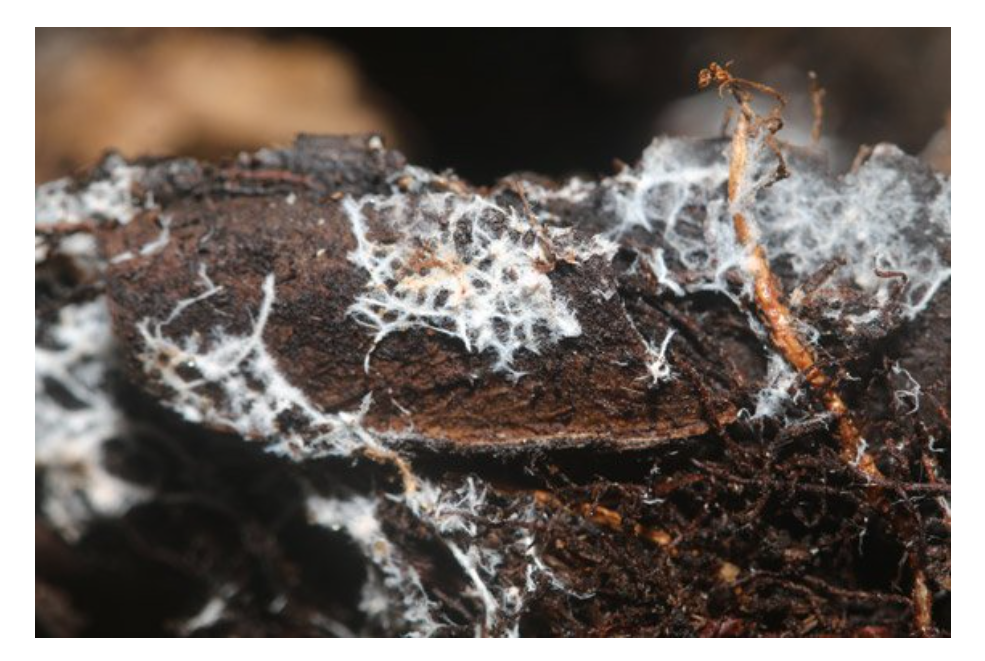
Mycorrhiza