
Grey mould (Botrytis): how to recognise and stop it
A grey, fuzzy coating on strawberries, tomatoes or buds is a typical sign of grey mould, known scientifically as botrytis. Place affected parts in a bag and take them away from the plants. Then reduce the humidity and get the air moving between the plants so that leaves and fruit dry more quickly. Spraying helps limit further infection, but it will not restore tissue that has already rotted.
What is grey mould?
Grey mould is caused by fungi of the genus Botrytis, most commonly Botrytis cinerea. This is where the name botrytis comes from. It affects tomatoes, peppers, cucumbers, beans, strawberries and other soft fruit, as well as herbs and ornamental flowers. Winegrowers know it as bunch rot.
Botrytis spores are practically everywhere, and you cannot eradicate them completely from a grow room or greenhouse. The fungus survives in plant debris and waits for an opportunity, such as a dying leaf, a fallen petal or a pruning wound. Spores are carried by airflow and splashing water. So there is little point hoping that mould will never enter your grow room. It is more effective to avoid giving it the conditions it needs to germinate.
How to recognise botrytis

A typical sign of botrytis is a grey to grey-brown fuzzy coating. It is full of spores, so do not touch it or shake the plant, as this could spread them unnecessarily.
Mould on strawberries
Rot often follows an infection of the flower. The strawberry turns brown and soft, becomes covered in a grey coating and eventually dries into a hard mummy that continues to produce spores. The mould can easily spread from it to fruit that touches it. Severely affected flowers die and do not produce fruit. The infection can also remain hidden in green fruit and only become visible as the strawberry ripens.
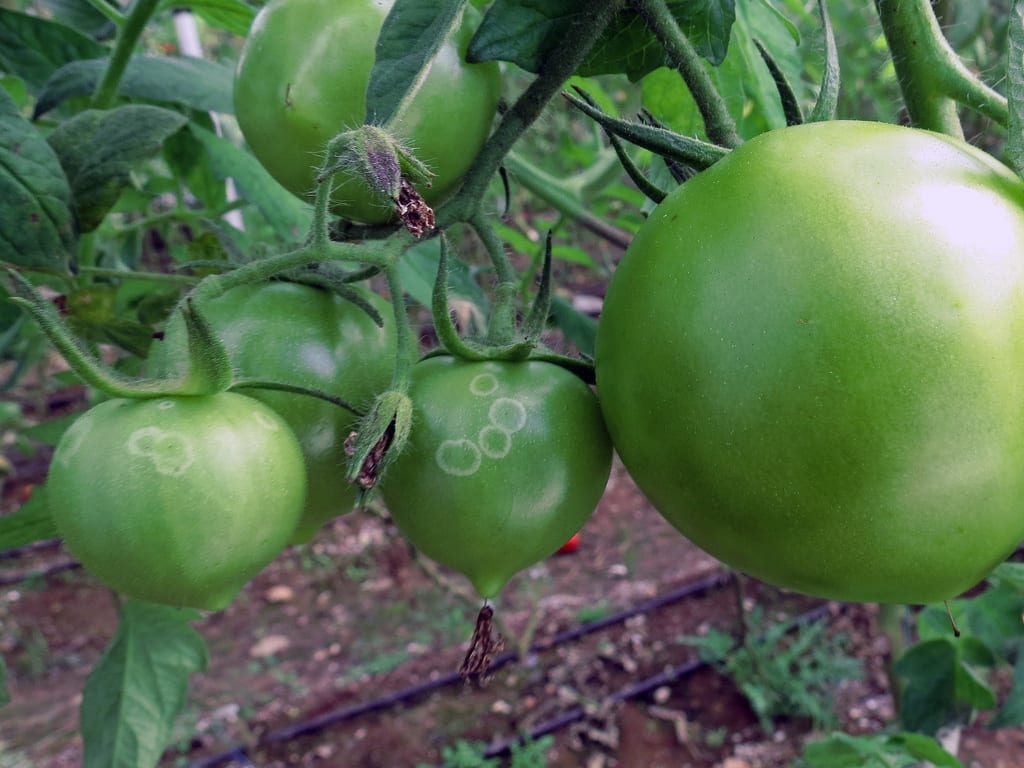
Grey mould on tomatoes
Herbs and flowers
Irregular light-brown spots appear on the petals and merge together. Buds turn brown, look water-soaked and fail to open. Brown, water-soaked spots on leaves often appear where an infected petal has fallen. A grey coating develops when conditions are damp.
Botrytis or powdery mildew?

| Grey mould (botrytis) | Powdery mildew | |
|---|---|---|
| Coating | grey to grey-brown, fuzzy and dusty | white and powdery |
| Where it starts | flowers, fruit, wounds and dying parts | mainly leaves |
| Other symptoms | fruit rot, spots on leaves and stems | yellowing, curling and drying leaves |
| Water on the surface | encourages infection, although high humidity alone can also be enough | not necessary for infection |
For information on how to get rid of powdery mildew, see the article Powdery mildew: how to identify it, prevent it and get rid of it.
When botrytis thrives

Botrytis thrives in damp conditions and at moderate temperatures, such as those found in spring, autumn or at night in a greenhouse. The risk of infection increases when several conditions coincide:
However, botrytis can also affect plants outside these ranges. High humidity alone can be enough for infection, even when the leaves are not visibly wet.
When the air cools and the amount of water vapour stays the same, relative humidity rises. Water condenses on leaves that are cooler than the dew point. In a greenhouse, keep an eye on conditions in the evening and at night; in a grow tent, also watch for cooling after the lights go out.
How to prevent botrytis in a grow tent and greenhouse
The risk of botrytis is reduced by helping plants dry quickly, maintaining airflow and keeping the grow room clean. Monitor humidity inside dense foliage too, where it can remain higher for longer than above the plants.
Humidity: measure it at night too

To limit botrytis, keep relative humidity below 85 %. For greenhouse flowers, limit continuous periods above 85 % humidity to no more than 3 hours; this recommendation applies to measurements taken above the foliage. The exact level to maintain depends on the crop and growth phase.
A reading on the display in the morning will not show how damp it was overnight. The Urban Thermo-hygrometer MEDIUM measures both temperature and humidity and records the minimum and maximum. Place the main unit among the plants, as this is what measures humidity. The probe on a 1.5 m cable measures temperature only.
Reset the memory in the evening and check the maximum in the morning. The memory shows how high humidity rose, not how long it stayed there. If you are having problems, check the readings during the night as well.
VPD, or vapour pressure deficit, relates humidity to temperature. A low VPD means less water evaporates from leaves. Whether water condenses on the leaves also depends on the temperature of the leaves themselves. You can find VPD values for each growth phase in the article What is VPD?
Air: extraction and circulation
Control extraction according to humidity, even after the lights go out.
Ventilation removes water when the incoming air contains less water vapour. So do not compare only the humidity percentages outdoors and indoors. Once warmed, colder air has a lower relative humidity. For example, outdoor air at 10 °C and 90 % relative humidity will have a relative humidity of approximately 42 % when warmed to 22 °C without adding water vapour.
If humidity is not falling, first check the air intake, that the extract is unobstructed and that there is no standing water. If ventilation is not enough, add a dehumidifier. For help sizing your extraction system, see the guide How to choose and set up grow tent ventilation; for help choosing a dehumidifier, see the comparison Humidifier or dehumidifier?
A circulating fan gets the air moving between plants, so leaves dry more quickly after watering and overnight, even when humidity is higher. There should be no stagnant-air pockets in the grow room. The GENT 15 cm clip-on fan clips directly onto a grow tent pole. Position it so that it blows between the plants, not just above them.
Watering, pruning and cleaning
- Water in the morning and at the roots, preferably using drip irrigation. Sprinkling water over the leaves spreads spores and leaves plants wet for a long time.
- Leave enough space between plants for airflow and do not overdo the nitrogen. Over-fertilised plants have soft tissue that botrytis can easily infect.
- Remove side shoots in dry conditions so that wounds dry quickly. Take the cuttings away immediately. Remove debris from your secateurs before moving on to the next plant. Then wipe the blades with 70 % isopropyl alcohol.
- Keep removing dead leaves, fallen petals and rotting fruit. They are a source of spores, so they should not even go in a bin inside the grow room.
- Keep an eye out for pests. Some insects spread spores, and mould can easily infect the spots where they damage a plant. Yellow sticky traps catch flying insects.
- Between growing cycles, remove plant debris from the grow room and clean containers and work surfaces. The fungus can also survive in debris in the soil or growing medium.
Strawberries in the garden
Outdoors, you cannot control humidity, so with strawberries the main priority is to keep the fruit off wet ground and prevent rain from splashing spores onto it.
- Put straw under the plants and between the rows. The fruit will stay clean, and the straw limits spores splashing from the soil onto flowers and fruit when it rains.
- Remove the old straw after harvesting. Put fresh, dry straw under the fruit the following season.
- Do not let the foliage become too dense and do not over-fertilise with nitrogen. Dense foliage restricts airflow and takes longer to dry after rain.
- Water with a drip hose or in the morning on a sunny day so that the leaves dry quickly.
- Harvest regularly, handle the fruit gently and remove any rotten or overripe fruit immediately.
What to do if you find botrytis
Start with cleaning and climate control; spray only afterwards.
- Cut affected fruit, flowers and leaves straight into a bag, tie it immediately and take it away from the grow room or garden bed. Discard the entire affected fruit.
- Remove the whole tomato plant if its main stem or stem base is affected. Do not rely on simply cutting off the top below the spot.
- Inspect nearby plants, especially strawberries that were touching the affected fruit.
- Reduce humidity and switch on circulation that same day. Check the maximum reading on your hygrometer the following night.
- Only after cleaning, protect the parts that are still healthy. For guidance on choosing a product, see below.
Products for grey mould
Spraying protects parts of the plant that are still healthy. It will not restore tissue that has already rotted, so it should only be done after cleaning and adjusting the climate.
Biological prevention
BioGarden Polyversum is used preventively, before the disease appears. It contains the microorganism Pythium oligandrum M1, which parasitises pathogenic fungi. You can use it against grey mould on crops such as strawberries, tomatoes, peppers and greenhouse herbs. Other products are available in the Biological protection category.
Determine the dose according to the crop and the area to be treated. There is no single powder-to-water ratio that works for everything. Follow the instructions on the label of your pack for timing, water volume, intervals, number of applications and the withholding period. Biological protection does not replace cleaning or humidity control.
Chemical fungicides
For outdoor strawberries, focus on protecting the flowers when it is damp and rainy during flowering. The label of the product you choose specifies when and how many times to spray. Depending on the weather, continue protecting the plants after flowering and up to the period before harvest, observing the withholding period.
Botrytis can readily develop resistance to fungicides. Rotate FRAC groups of action, not just product brands. FRAC is an international committee that classifies fungicides into groups according to how they act on fungi. Find the range in the Disease control (fungicides) category.
Harvesting and storage without mould
Botrytis can continue to develop after harvest. It can even take hold at 0–10 °C, so refrigeration slows it down but does not stop it.
- Never put diseased fruit in the same bowl as healthy fruit. Mould can spread from one fruit to another even after harvest.
- Put strawberries somewhere cool as soon as possible and handle them gently, as damaged areas make infection easier. Strawberries are recommended to be stored at 0 °C and 90–95 % relative humidity. High humidity limits water loss from the fruit, but does not replace cooling or removing infected strawberries. At home, store them unwashed in a single layer on a paper towel in the fruit and vegetable drawer of the fridge, and check them regularly. Wash them just before use.
- Store only undamaged tomatoes, and check for softening, rot and a grey coating.
- Process healthy herbs and flowers for drying after harvest, and dry them in a dry, well-ventilated place, for example on a hanging drying net. Put them in containers and jars once they are completely dry. With herbs, dry leaves crumble and stems snap when bent. For more on drying, see the article 3 principles for safe drying.
Frequently asked questions
Is grey mould the same as botrytis?
Yes. Botrytis is another name for grey mould, which winegrowers know as bunch rot.
What should I do with strawberries that have grey mould?
Discard the entire affected fruit, preferably in a bag, and do not put it on the compost heap next to the garden bed. Check neighbouring fruit that was touching it, as mould spreads from one fruit to another.
What humidity should I monitor in a grow tent?
Keep relative humidity below 85 %. Measure it at night and inside the foliage too.
Will spraying help against botrytis?
Only as a supplement. In damp, stagnant air, the risk of further infection remains high even after spraying. Climate control, cleaning and careful handling of plants are essential.
Why did the mould appear only after harvest?
In strawberries, botrytis can remain hidden in young fruit and become visible only as it ripens or during storage. Cold slows it down but does not stop it, so store only healthy, dry and undamaged fruit.
What you will need
- Urban Thermo-hygrometer MEDIUM: a thermometer and hygrometer with a probe and minimum/maximum memory that shows the overnight humidity peak.
- GENT Clip Fan 5W clip-on fan, 15 cm: gets the air moving between plants so that leaves dry more quickly.
- Dehumidifiers: use when extraction alone does not bring humidity down.
- BioGarden Polyversum: biological prevention against grey mould in the greenhouse, before the disease appears.
- Urban Dry drying net, 60 cm: herbs and flowers dry in well-ventilated conditions rather than in a pile.