
Powdery mildew: how to identify it, prevent it and get rid of it
You can recognise powdery mildew by the white, floury coating on leaves. It affects cucumbers, courgettes, tomatoes, strawberries and herbs, and spreads very quickly in a warm grow tent with dense foliage. In this article, you’ll learn how to recognise the typical symptoms of powdery mildew, why it develops, how to prevent it with airflow and the right humidity, and when and what to spray against it—from a homemade baking soda spray to registered fungicides.
What is powdery mildew and how can you recognise it?
Powdery mildew is a fungal disease caused by a group of fungi (for example, the genera Erysiphe, Podosphaera and Leveillula). Each type of powdery mildew affects only certain plants. Powdery mildew on cucumbers therefore usually does not spread to tomatoes, and vice versa.
Typical symptoms:
- white, floury spots on the upper and lower sides of leaves, which gradually grow and merge,
- on cucumbers and courgettes, the first symptom is often pale yellow spots on the leaves,
- affected leaves turn yellow or brown, may curl and eventually fall off,
- the plant weakens and produces fewer, smaller fruits.
Powdery mildew usually does not directly affect vegetable fruits. However, when a plant loses its leaves, its fruits are more likely to suffer from sunscald and may ripen less well.
When and why does powdery mildew develop?
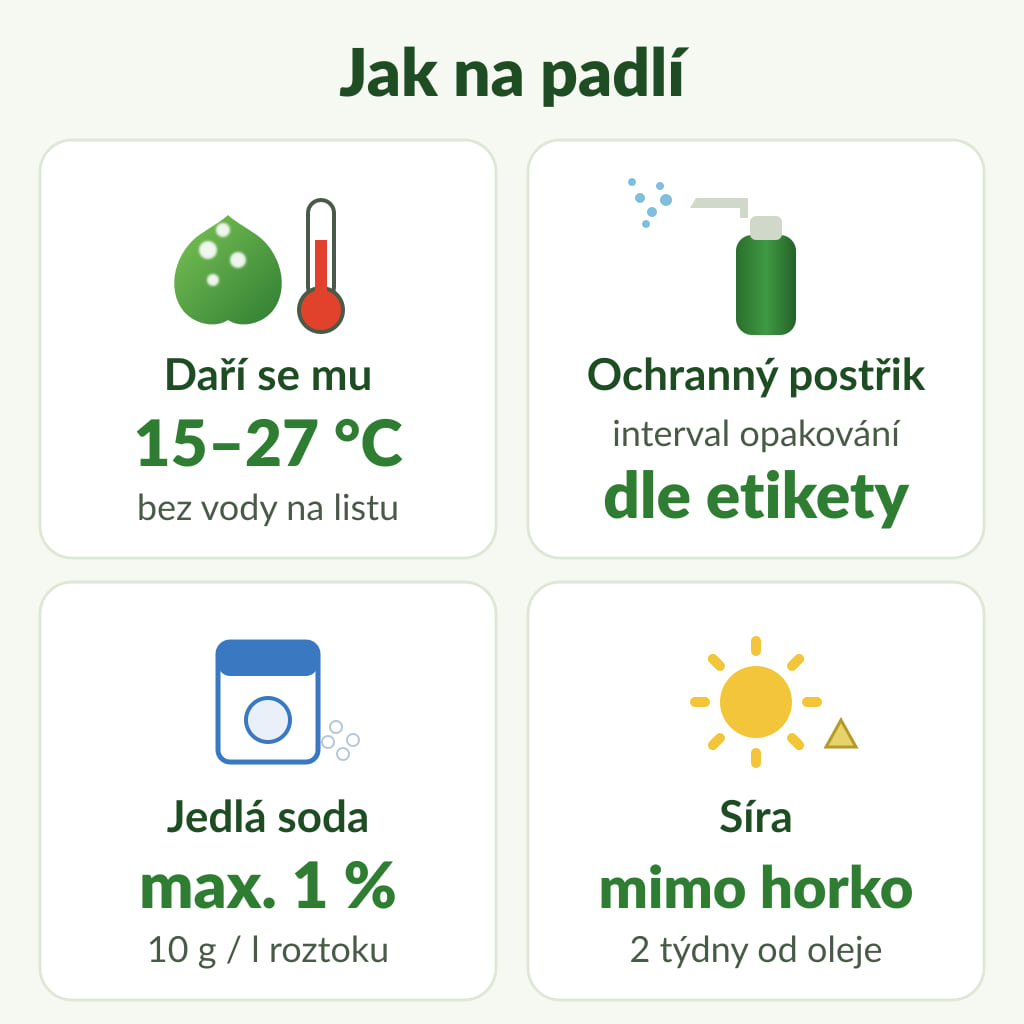
Powdery mildew behaves differently from most moulds. Its spores do not need a drop of water on the leaf to cause infection, so powdery mildew can affect plants even when there is no water on the leaves. A leaf surface that stays wet for a long time can, on the other hand, slow the germination of spores of some types of powdery mildew.
Powdery mildew thrives most in:
Airflow carries the spores. In warm, dry weather, new spores form and quickly spread the infection to other leaves. Temperatures above approximately 32 °C and direct sunlight limit the growth of many types of powdery mildew, but they are not a reliable treatment for an affected plant.
Powdery mildew therefore often finds ideal conditions in a grow tent, polytunnel or greenhouse: consistently moderate temperatures, dense foliage and little airflow between the leaves.
Prevention: humidity, airflow and foliage density
Prevention is the best protection against powdery mildew. Once it has spread across most of the leaves, it is difficult to control with any product.
- Choose resistant varieties. Resistant or less susceptible varieties are available for cucumbers, courgettes and pumpkins, melons, beans and peas.
- Ensure good airflow. Plant with sufficient spacing, tie plants up and remove excess leaves. In a grow tent, use circulation fans to prevent stagnant air from remaining between the leaves. The article Where and how to position fans correctly explains how to place them.
- Monitor humidity. Monitor temperatures and humidity with a thermometer with a hygrometer. If the incoming air contains less water vapour, ventilation can help reduce persistently high humidity; a dehumidifier can also help. The article What is VPD? explains the relationship between temperature and humidity.
- Water in the morning and at the roots. Drip irrigation limits wet leaves and the risk of other diseases. However, powdery mildew does not need water on the leaves, so this watering method will not prevent it from developing.
- Do not over-fertilise with nitrogen. Excess nitrogen leads to lush, soft leaves and dense shade, where powdery mildew thrives.
- Check plants once a week. Check older leaves in particular, on both sides. The sooner you find powdery mildew, the easier it is to stop.
- Remove affected leaves. Cut out small affected areas and dispose of the leaves in the bin. Add them to compost only if the compost heats up properly.
Spraying against powdery mildew: when and what to use
When to spray against powdery mildew
Many products against powdery mildew work primarily as protectants: they prevent new infections. Some can also limit an early infection, but they will not restore leaves that are already damaged. Therefore:
- spray susceptible plants (cucumbers, courgettes) as a preventative measure, or at the latest at the first signs,
- set the repeat application interval according to the label for the specific product and crop, including the maximum number of applications; newly grown leaves may need further protection,
- when spraying, cover the whole plant, including the undersides of the leaves; contact products work only where they land. Follow the label’s application instructions for all products.
For advice on how to prepare a spray solution correctly and choose a sprayer, see the article Sprays and sprayers – everything you need to know.
Homemade spray against powdery mildew: baking soda
Baking soda (sodium bicarbonate) is approved in the EU as a so-called basic substance for plant protection (Commission Implementing Regulation (EU) 2015/2069). Use food-grade baking soda. Under the approved use, it may be used against powdery mildew on vegetables, soft fruit and ornamental plants outdoors and in greenhouses:
- a concentration of 0.33–1%, or approximately 3.3–10 g of baking soda made up with water to 1 l of solution, max. 1% (10 g / l of solution),
- also observe the application rate of 2–5 kg/ha and water volume of 300–600 l/ha, or 20–50 g per 100 m² in 3–6 l of water; adjust the concentration to the volume so that both limits are met,
- 1–8 sprays at intervals of at least 10 days, at the permitted growth stage according to the register,
- you can harvest 1 day after spraying,
- plants tolerate baking soda differently, so test the spray on a few plants first.
Please note: for this approved use, baking soda must be diluted with water only. Adding oil or soap changes these instructions and is not an approved use of baking soda as a basic substance. You can find approved uses in the ÚKZÚZ plant protection product register (product category “Basic substances”).
What about other homemade remedies? The University of Wisconsin warns that common homemade recipes are unreliable. The mention of a promising effect in this source refers to a mixture of baking soda and oil, not baking soda in water on its own. Therefore, do not use this American recipe as instructions for using a basic substance in the Czech Republic; follow the approved method above.
Biological and natural products
- BioTON: an auxiliary product with a physical effect, containing rapeseed oil and lecithin. In the Czech register, it is listed for supporting the health of specified crops affected by powdery mildew. According to the e-shop description, it is used at the first signs and not in direct sunlight; the current instructions take precedence.
- BioAN: an auxiliary product for supporting the health of specified crops affected by powdery mildew, containing lecithins, casein and milk albumin. It is not a universally authorised fungicide for all vegetables and fruit. Follow its instructions for use and leaf coverage.
- NATURA Natural product against powdery mildew: an auxiliary product based on oil from Pongamia pinnata, listed for increasing plant resistance. According to the description, it works by contact as a mechanical barrier on the leaf surface. Do not apply it to flowers or very young plants; also observe the temperature restrictions in the instructions.
According to the University of California, oils (horticultural and plant-based) can also control mild to moderate infections. This is not an instruction to use any oil on any crop. Do not use oil-based products in hot weather or on plants suffering from drought. UC IPM warns against temperatures above approximately 32 °C, but the specific instructions may set a lower limit. Leave at least 2 weeks between using sulphur and oil; the label may require a longer interval.
Sulphur
Sulphur has been used against powdery mildew for centuries and works primarily as a preventative contact treatment. Follow the label for the specific application timing; it will not reliably cure an established infection covering the whole plant. Wettable sulphur is the most practical option for gardens, for example Kumulus WG (80% sulphur) or Sulfurus. When using it, observe the following:
- apply sulphur outside hot weather and intense sunlight; the safe temperature is determined by the label and the plant’s sensitivity, as there is no universal safety threshold,
- leave an interval of at least 2 weeks between spraying with sulphur and using oil (in short: 2 weeks from using oil); a longer interval may be necessary depending on the label and plant sensitivity, otherwise damage may occur,
- some varieties of courgettes, pumpkins and melons do not tolerate sulphur well. Kumulus WG and Sulfurus do not have identical ranges of authorised crops; use each only as directed by its Czech label.
Chemical fungicides
If powdery mildew pressure is high, especially on cucumbers and courgettes, a registered fungicide may be needed. For example, AGRO Padlí zeleniny a okrasných rostlin STOP contains azoxystrobin and is authorised in the Czech register against powdery mildew on, among other crops, cucumbers, peppers, tomatoes and courgettes. Intervals vary: 7 days for peppers and 12 days for cucumbers, tomatoes and courgettes; check the label for the application frequency and whether it can be used outdoors or in a greenhouse. Ortiva, with the active ingredient azoxystrobin, is listed in the Czech register for powdery mildew on cucumbers and tomatoes, among other uses. This does not mean it is authorised for use on every crop mentioned in this article.
Powdery mildew gradually develops resistance to fungicides. Therefore, do not keep repeating the same mode of action. AGRO Padlí STOP and Ortiva contain the same active ingredient, azoxystrobin (FRAC 11); alternating between them does not change the mode of action. Choose a suitable rotation according to the label. Check current authorisation in the ÚKZÚZ product register. Always read the label, use the product only on crops, against diseases and in environments for which it is authorised, and observe the harvest interval (the number of days between spraying and harvest).
Overview of options for controlling powdery mildew
| Option | How it works | When to use it | What to watch out for |
|---|---|---|---|
| Baking soda | basic substance, dilute with water only | as a preventative measure and at the first signs | max. 1%, at least 10 days between applications, test first |
| BioTON | auxiliary product, rapeseed oil and lecithin | as soon as powdery mildew is detected | do not use in direct sunlight or within 2 weeks of using sulphur |
| BioAN | auxiliary product, lecithins and milk proteins | as a preventative measure and at the first signs | spray the whole plant thoroughly |
| NATURA | auxiliary product, physical effect | when powdery mildew is present | do not use on flowers or young plants |
| Sulphur (Kumulus WG, Sulfurus) | contact action, protective | primarily as a preventative measure, according to the label | avoid hot weather, leave at least 2 weeks after using oil, some courgette varieties are sensitive |
| AGRO Padlí STOP | systemic, protective | before infection or at its early stages | interval and harvest interval according to the label for the specific crop |
| Ortiva | systemic, azoxystrobin | before infection or at its early stages | do not alternate with AGRO Padlí STOP as though they had different modes of action |
Find the full range in the disease control (fungicides) and pest and disease protection categories.
Powdery mildew on cucumbers, courgettes, tomatoes, strawberries and herbs
Powdery mildew on cucumbers and courgettes
Cucurbits (cucumbers, courgettes, pumpkins and melons) are among the most susceptible plants. Powdery mildew on these crops is most often caused by the fungus Podosphaera xanthii. It first affects older leaves, where pale yellow spots appear, followed by a white coating. Affected plants produce fewer and smaller fruits, which ripen less well and are harder to store.
For cucumbers and courgettes, resistant varieties, sufficient spacing and spraying as soon as the first signs appear are worthwhile. Be careful with sulphur on courgettes, as some varieties do not tolerate it.
Powdery mildew on tomatoes
Two types of powdery mildew affect tomatoes. One produces the classic white coating. The other (Leveillula taurica, which also affects peppers) is mainly characterised by yellow spots on the leaves and produces little white coating. It is therefore easy to miss.
Powdery mildew on strawberries
Powdery mildew is less conspicuous on strawberry plants. The first symptom is usually the edges of the leaves curling upwards, with white spots on the underside of the leaf. Purple to reddish-brown spots may also appear on the undersides of leaves. Affected fruits lose their shine and may crack. For more about growing strawberries, see the article How to grow delicious strawberries at home.
Powdery mildew on herbs and roses
Powdery mildew affects a wide range of plants, including herbs and roses. The same principles apply: a well-aerated location, adequate spacing, no over-fertilising and prompt removal of affected leaves. For herbs that you harvest regularly, prioritise prevention and carefully observe the harvest interval for each product. For roses, choosing resistant varieties can help.
Powdery mildew or grey mould?
People often confuse powdery mildew with grey mould (botrytis). The difference is significant:
- Powdery mildew forms a white, floury coating, mainly on leaves, and does not need water on the leaf to cause infection.
- Grey mould forms a grey, fuzzy coating on rotting flowers, fruits and dead parts of the plant, and thrives in damp, cool conditions.
Each disease requires a different approach. Grey mould is covered in a separate article: Grey mould (botrytis): how to recognise and stop it.
Frequently asked questions
How can I get rid of powdery mildew quickly?
Remove the most affected leaves, improve airflow and spray immediately with a suitable product. For a mild infection, oil-based products such as BioTON can help. If the infection is widespread, the treatment’s effectiveness is often limited, so it is essential to act promptly.
Does milk help against powdery mildew?
A homemade milk recipe cannot be relied on as universal protection. Baking soda is approved for use as a basic substance in the EU, but only under the prescribed conditions (for the crops listed here, max. 1%, with water only). The oil mixture mentioned in American recommendations is not part of this approved method.
When should I spray against powdery mildew?
As a preventative measure on susceptible plants, or at the latest at the first signs. Set the interval and number of sprays according to the label for the specific product and crop; for baking soda, the interval must be at least 10 days. Do not use sulphur in hot weather or intense sunlight.
Can I harvest the fruits after spraying?
Only after the harvest interval stated on the product label has passed. For baking soda, this is 1 day. Always wash fruits before eating them.
Can powdery mildew spread from cucumbers to tomatoes?
Usually not. Different types of powdery mildew are specialised to affect certain plants, and cucumbers and tomatoes are affected by different types of fungi. Conditions vary depending on the type of powdery mildew, but several crops can be at risk at the same time, so check other plants as well if powdery mildew appears on one crop.
Protect your crops from powdery mildew
Prevention is key: ensure good airflow, monitor humidity and check the leaves regularly. To tackle powdery mildew, choose a suitable product from the fungicides or biological protection category. Circulation fans ensure airflow in a grow tent, a hygrometer helps you monitor humidity, and a dehumidifier can help if needed. Need advice? Write to us at info@higarden.eu.