
NPK: What Is It and What Do the Numbers on Fertiliser Mean?
NPK is an abbreviation for the three main plant nutrients: nitrogen (N), phosphorus (P) and potassium (K). We explain what figures such as 7-3-6 on a fertiliser label mean, why phosphorus and potassium are shown as P2O5 and K2O, and how complete, PK and single-nutrient fertilisers differ. We describe how to choose and use an NPK fertiliser in our separate guide to choosing an NPK fertiliser.
Looking for a specific fertiliser? Find out how to choose an NPK fertiliser based on your substrate and growth phase, how to dose it and which ranges we stock in the article How to choose and use an NPK fertiliser.
What NPK means
NPK refers to the three main mineral nutrients for plants: nitrogen, phosphorus and potassium. They are macronutrients, which plants need in larger quantities. Plants obtain carbon, oxygen and hydrogen mainly from the air and water. The letters N, P and K are the chemical symbols for these elements:
In addition to NPK, plants also need secondary macronutrients, or mesonutrients (calcium, magnesium and sulphur), and micronutrients (iron, manganese, zinc, copper, boron, molybdenum, chlorine and nickel). “Secondary” does not mean less important. Plants need only small quantities of micronutrients; other nutrients may be part of a base fertiliser or supplied separately as needed, for example calcium and magnesium.
What the figures on the label mean (e.g. 7-3-6)
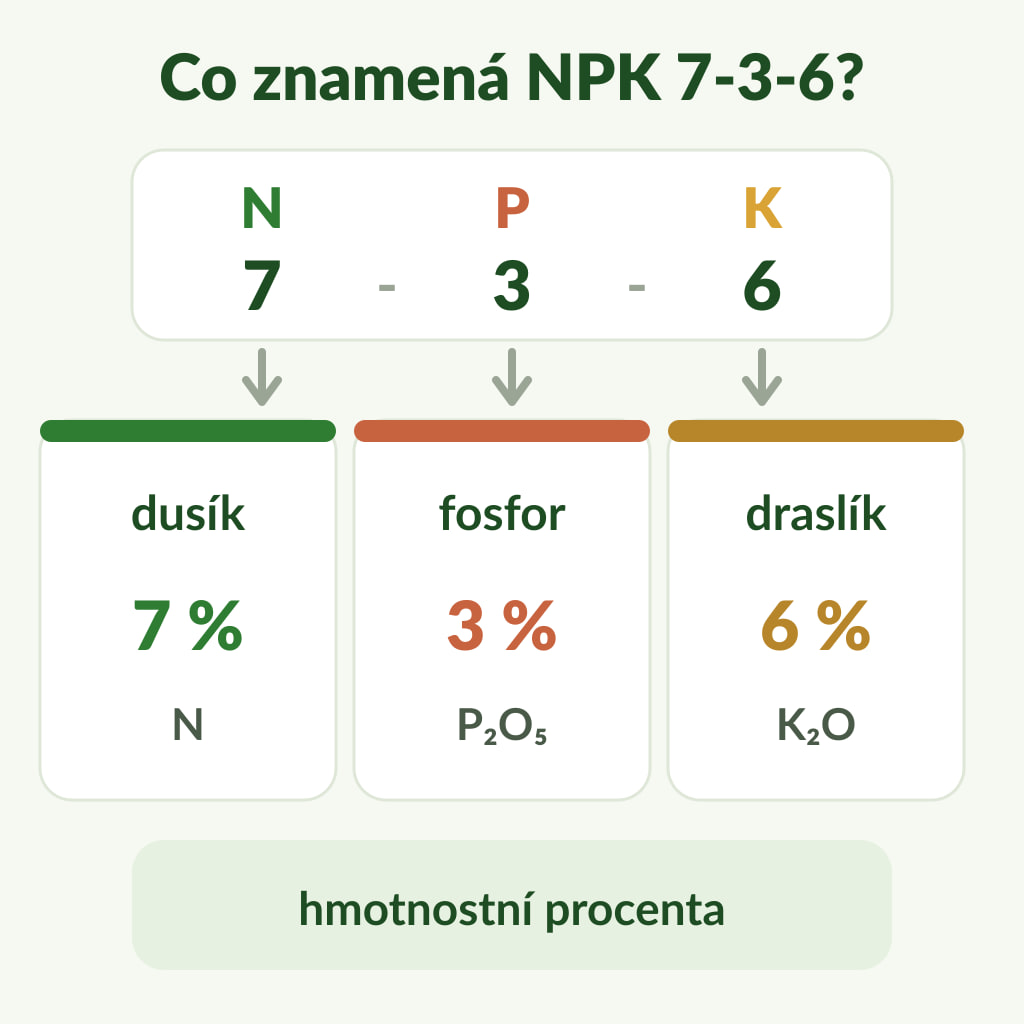
The three NPK figures on a label usually give the nutrient content as a percentage by weight, in the order nitrogen–phosphorus–potassium. Using the usual N–P2O5–K2O notation, a 7-3-6 fertiliser contains 7% nitrogen (N), phosphorus equivalent to 3% P2O5 and potassium equivalent to 6% K2O. So 100 g of fertiliser contains 7 g of nitrogen.
There is one catch: phosphorus and potassium content is usually expressed as the equivalent amount of the oxides P2O5 and K2O. This does not mean that the fertiliser actually contains these oxides. European rules also allow the content to be expressed as the elements P and K, so always check the symbols on the label. With oxide notation, the actual phosphorus and potassium content is as follows:
| Label declaration | Conversion to the pure element | Example: 15-15-15 fertiliser |
|---|---|---|
| N (nitrogen) | given directly as the element | 15% N |
| P2O5 (phosphorus) | P2O5 × 0.436 | about 6.5% P |
| K2O (potassium) | K2O × 0.830 | about 12.5% K |
You do not need to know the conversion for routine fertilising. It is useful when comparing fertilisers from different manufacturers or mixing your own nutrient solution from single-nutrient fertilisers. A figure of 0 means that the nutrient is not declared in the NPK figures; it does not necessarily guarantee that none is present, even in trace amounts. For example, a PK fertiliser with an NPK ratio of 0-13-14 does not declare nitrogen.
Higher figures do not mean a better fertiliser, only a higher declared content of those nutrients. You need a smaller weight of 20-20-20 fertiliser than 4-3-6 to supply the same amount of nitrogen, but the ratio of the other nutrients differs. What matters is the nutrient ratio and correct dosing according to the manufacturer’s instructions; for liquids, their density also matters.
Complete, double and single-nutrient fertilisers
Complete fertilisers contain N, P and K, double fertilisers contain two of these nutrients, and single-nutrient fertilisers contain one. However, a product marketed as a supplement for one nutrient does not necessarily qualify as a single-nutrient fertiliser: P 20 and K 20 also contain nitrogen. The NPK values in the table are taken from the Higarden product pages; the label on the specific pack is decisive.
| Fertiliser type | Contains | Examples from our range (NPK) |
|---|---|---|
| complete (NPK) | all three nutrients | BioNova Soil Supermix 7-3-6, BioBizz Bio-Grow 4-3-6 |
| flower (NPK) | all three, in a different ratio for the flowering range | BioBizz Bio-Bloom 2-7-4 |
| double (PK) | phosphorus and potassium | BioNova PK 13-14 0-13-14 |
| accessories focused on N, P or K | the target nutrient; some also contain others | BioNova N 27 27-0-0, P 20 3-20-0, K 20 3-0-20 |
A complete fertiliser can form the basis of plant nutrition; NPK alone does not guarantee that it contains all the other nutrients plants need. PK fertiliser and targeted accessories are not a substitute for complete nutrition. In pots, coco and hydroponics, use them according to the manufacturer’s schedule alongside a suitable base fertiliser. In soil with enough of the other nutrients, it may be sufficient to add only the missing element, as determined by a soil analysis.
NPK fertilisers in our range: what their figures tell you
Three Plagron fertilisers show clearly how the NPK ratio varies according to intended use. The values are provided by the manufacturer, Plagron, and phosphorus and potassium are expressed as P2O5 and K2O. We use the rounded NPK figures from the manufacturer’s product pages; technical data sheets provide more precise compositions. The label on the specific pack is decisive.
| Fertiliser | NPK | What the figures tell you | Manufacturer’s intended use |
|---|---|---|---|
| Plagron Terra Grow | 3-1-3 | the highest figures are for N and K2O | mineral fertiliser for soil during the growth phase |
| Plagron Terra Bloom | 2-2-4 | the highest figure is for K2O; N is lower than in Terra Grow | mineral fertiliser for soil during flowering |
| Plagron PK 13/14 | 0-13-14 | N is not declared; high P2O5 and K2O figures | mineral supplement for flowering, used with a base fertiliser |
We explain how to choose a specific fertiliser, which NPK ratio to select for growth and flowering, and how to dose it in the article how to choose and use an NPK fertiliser.
How to recognise nitrogen, phosphorus and potassium deficiencies
All three nutrients move from older leaves to younger ones within the plant. Deficiency symptoms therefore usually appear first on older, lower leaves:
| Nutrient | Typical deficiency symptoms | Read more |
|---|---|---|
| nitrogen (N) | lower leaves become uniformly pale and yellow, growth slows | nitrogen in plants |
| phosphorus (P) | dark green to purple leaves and leaf stalks, weak roots, fewer flowers | phosphorus in plants |
| potassium (K) | the edges and tips of older leaves turn yellow and brown (dry out), stems become weaker | potassium in plants |
The appearance of leaves alone is not enough to confirm a diagnosis. Similar symptoms may be linked to unsuitable pH, which limits the availability of certain nutrients even when they are present in sufficient quantities in the substrate, but also to cold, waterlogging or root damage. Before adding fertiliser, check the pH and growing conditions; a soil analysis can help when growing in soil. Find an overview of other deficiencies in the article the most common nutrient deficiencies.
Frequently asked questions
What does NPK 15-15-15 mean?
With the usual oxide notation, the fertiliser contains 15% nitrogen (N), phosphorus equivalent to 15% P2O5 and potassium equivalent to 15% K2O, all by weight. The ratio of the declared figures is 1:1:1, but the ratio of the elements N:P:K themselves is not the same. 1 kg of this fertiliser contains 150 g of nitrogen.
Is a fertiliser with higher NPK figures better?
No. Higher figures mean a higher declared content of those nutrients. A lower weight is needed only to supply the same amount of the nutrient being compared; you cannot use the dose for another product. When choosing, the important factors are the nutrient ratio required by the plants and whether the fertiliser is suitable for your growing medium.
Why does the label show P2O5 and K2O instead of P and K?
This is an established way of expressing the content as oxide equivalents, not the actual chemical form of the nutrients in the fertiliser. The actual phosphorus content is about 44% of the stated P2O5 value, and the potassium content is about 83% of the K2O value. The label may also express the content as the elements P and K, so check the symbols shown.
What next?
Next step: choose a fertiliser. In the article How to choose and use an NPK fertiliser, you will find a point-by-point guide to reading the label, NPK ratios for each growth phase, dosing instructions and an overview of fertilisers in our range.
Or go straight to our range of basic fertilisers and all fertilisers.