
Don't underestimate the importance of air exchange and circulation within your growing space
Tips for indoor growers are an inseparable part of our blog. This time we will focus on fresh air and its movement inside the growing space, where everything must be done to prevent the climate from getting out of control. So what kind of air are your plants breathing? To a large extent, that is also how well they do. And perhaps it is time to get things moving at last! Read on to find out how to ensure that the air in the grow box circulates properly.
It is rather surprising that regular air exchange or proper air circulation is among the most underestimated aspects of indoor plant cultivation, despite the availability of information today. The clear aim of this article is therefore to explain and remind readers of the importance of these aspects. Plants growing freely in nature automatically have a constant supply of fresh air with enough oxygen and carbon dioxide, which flows freely through the vegetation, thereby also ensuring the removal of accumulated moisture.
Nature, of course, has it all under control. Why, however, so many growers still take these processes lightly is still something of a mystery in the world of indoor gardening. If we use a closed greenhouse or have at our disposal a grow tent, or even an entire room for indoor plant cultivation, we have no choice but to account for completely different conditions than those outdoors and to try to imitate nature using proven methods.
According to experienced growers, we should not be lulled into a false sense of security by the fact that the plants look fairly healthy at first glance and are growing reasonably well. Such an approach could cost you tens of per cent of your potential yields unnecessarily! It would certainly be a shame to miss out on higher yields, which is why we will divide the following advice, related to the perfect climate inside the growing space, into two parts:
- Air exchange
- Air circulation
You probably already know that plants capable of photosynthesis consume carbon dioxide (CO2), while at night it is mainly oxygen. Humidity inside a closed growing space increases as a result of their transpiration. Given that a closed growing environment, for example a medium-sized grow tent, requires an intensive source of artificial lighting, replacing sunlight for the plants present there (partly in the case of discharge lamps or completely in the case of full-spectrum lighting), but also emitting a considerable amount of heat into the surroundings together with the light, which tends to accumulate inside the grow tent or room. Rising temperature and humidity in a closed environment... You have probably quickly imagined, from these words, what scenario would occur inside the grow box without sufficient ventilation. The transpiration activity of the plants would gradually cease. They would therefore be unable to cool themselves naturally, which would lead to their death.
Our TIP: The new Resin+ LED AX 600W 2.8 µmol/J also belongs among full-spectrum LED grow lights, simulating natural sunlight for plants, while emitting less heat into the growing space than a classic discharge lamp.
 1. Air exchange
In terms of air exchange in the growing space, it is first necessary to distinguish between two types of environment, namely open or closed.
- If we mean a closed indoor growing room in the true sense of the word, we count on automatically controlled ventilation and CO2 supplementation (see separate article: Growing plants and carbon dioxide. How and why should it be used?). In practice, however, this usually concerns professionally equipped growing spaces for commercial growers.
- At the moment, we are more interested in home growing, and in this case we refer to the system as open, where a reliable extract fan removes air from the grow tent or room and fresh air flows into the growing space. These are the two options for achieving this effectively in the comfort of your home:
- Active air intake - this requires two fans. The one with the higher output serves to extract air (the so-called extract fan). As you will no doubt correctly suspect, the second fan in this setup serves to bring in air, and it is usually sufficient for it to have a lower output than the extract fan. Negative pressure controllers allow simple control of both fans at the same time and optimisation of their output.
- Passive air intake - fresh air is brought into the growing space thanks to the negative pressure created by the extract fan. If you opt for passive air intake, do not forget that the area of the intake opening for passive intake should be at least twice as large as the area of the extract ducting! Only then will negative pressure not prevail inside the grow box or indoor growing room, which would mean an insufficient supply of fresh air to the plants.
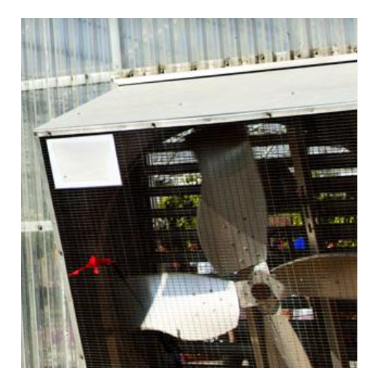
Our TIP: WHISPERBLOWER: professional fans with unrivalled efficiency (in the picture)

One of the most common questions from growers starting out indoors is which factors are most important when choosing air handling equipment for a grow box. Therefore, always consider the following first:
- What is the total volume of the growing space you will be using?
- What is the (average) air temperature and humidity of the air that will be brought into the growing space?
- What grow lighting will