
What do I need a ballast for?
Many people ask us about the differences between magnetic and digital ballasts. Sometimes they also ask what they are for at all. We have therefore tried to answer the most common questions:
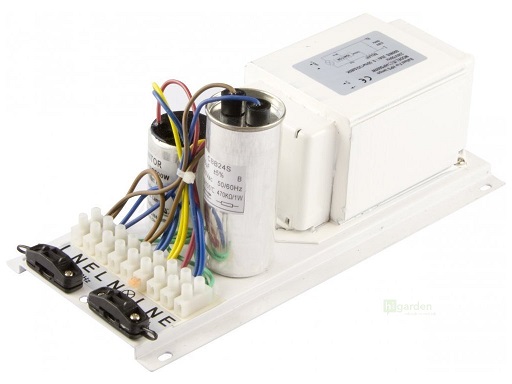
1) Do I need a ballast for all discharge lamps? - Yes, there is no HPS, MH or CMH discharge lamp on the market that does not need a ballast, regardless of whether its power is 70 W or 1000 W. An exception may be the CFL energy-saving lamp, which, however, contains the ballast in its base.
2) Why do I need a ballast then? Because a discharge lamp needs much higher voltage for its "ignition" than 230 V, which is initially supplied by the starter (magnetic ballasts) or voltage converter (electronic ballasts) to provide the necessary voltage at the start.
3) So does the ballast do nothing after that? No, during normal operation it again limits the voltage below 230 V, because the discharge lamp requires a lower voltage than the usual 230 V to run
4) What is the difference between a magnetic and an electronic (digital) ballast?
a) Magnetic - The original technology based on a starter and choke. Low efficiency caused by the very low light frequency (50 Hz), individual components degrade over time, thereby reducing the efficiency of the ballast, and due to its principle it also reacts with a delay to fluctuations in the electrical grid, which reduces the lifespan of the discharge lamp. The ballast cannot be adjusted either and works only at a preset power. Due to the ferrite core of the transformer, buzzing may occur.
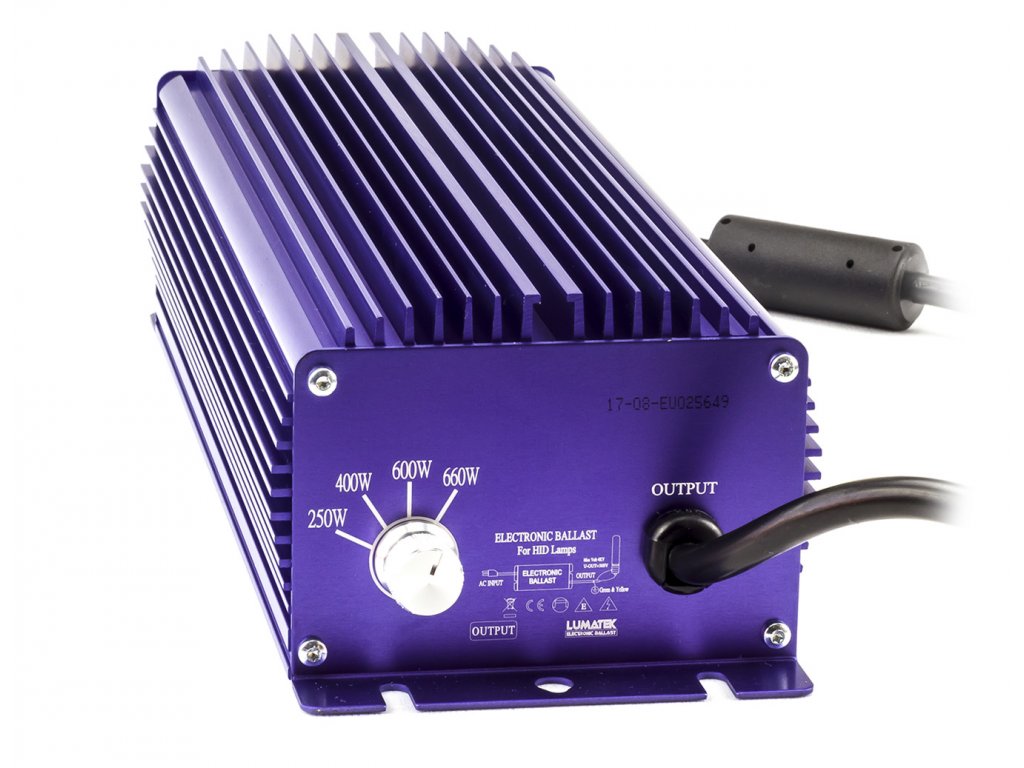
b) Electronic (Digital) - Modern ballasts based on a frequency voltage converter. They operate at a frequency of 30 - 50 kHz (approximately 1,000 times higher frequency). Thanks to the electronics, they react immediately to fluctuations in the grid and always deliver the optimal voltage and current. Most digital ballasts allow power switching, so they can be used with discharge lamps of different wattages (a popular setup is a 400 W growth discharge lamp and a 600 W flowering discharge lamp). Efficiency is also significantly higher, as the power consumption of the ballast itself is approximately one third of that of the magnetic variant. It contains no transformer and is therefore completely silent. The components do not change their properties over time, so their efficiency remains the same throughout their service life. The mean service life, that is, the average lifespan, of digital ballasts is also significantly longer than that of their magnetic predecessors, and they are therefore better in practically every respect. However, these advantages come at a higher purchase price, which is nevertheless returned several times over through the savings during the life of the electronic ballast.
¨
5) What is the difference between the individual ballast brands? - Whether magnetic or electronic ballasts, it always depends on the components used, that is, their quality as well as their price, which allows the manufacturer to significantly influence both the lifespan and the efficiency of the ballast.
6) Which ballasts do you recommend then? - Generally, those that we have tested ourselves and those that are popular among our customers. Mainly:
- Among magnetic ballasts, we recommend the time-tested LUMii Black ballasts. They have a protective casing and IEC connectors, thanks to which they have a lower surface temperature and also work on a Plug & Play principle. So there is no cable wiring.
- For digital ballasts, we recommend Lumatek ballasts, which offer maximum quality for their price, a 5-year warranty and excellent warranty service. In terms of price-performance ratio, we then recommend LUMii Black ballasts (not to be confused with their magnetic variant of the same name), which are very reliable.
- A separate category is 400V Lumatek ballasts, which deliver up to 15% more light at the same power consumption, but we will talk about those another time.