
Grey mould (botrytis): how to identify and stop it
Grey mould (botrytis) can seriously damage strawberries, tomatoes, herbs and flowers, both on the plant and after harvest. In this article, you will learn how to recognise botrytis on fruit and flowers, why it thrives in a grow box, how to prevent it by monitoring humidity, VPD and ventilation, what to do if it appears, and how to store your harvest to prevent it from going mouldy.
What is grey mould (botrytis)?
Grey mould is caused by the fungus Botrytis cinerea, which is why it is also called botrytis. It attacks a huge variety of plants: vegetables (tomatoes, peppers, cucumbers and beans), strawberries and other soft fruit, herbs and ornamental flowers.
Botrytis is ubiquitous and has several characteristics that make it a troublesome opponent:
- it mainly attacks weakened parts of the plant: dying leaves, fallen petals, injuries and pruning wounds,
- it survives in plant debris as mycelium or tiny black sclerotia,
- it spreads through spores, carried by moving air and splashing water. Handling infected plants can release more spores,
- in a grow room or greenhouse, it cannot be eradicated completely. Its occurrence can be limited by suitable conditions, good hygiene and, where necessary, targeted treatment.
How to recognise botrytis on fruit and flowers
The most characteristic sign is a grey to greyish-brown, fuzzy coating. It consists of fungal threads and spore-producing structures, which can puff up like a cloud of dust when touched. Other symptoms often appear before this coating develops.
Strawberries
- rot most often starts at the stalk, where the fruit touches infected remnants of the flower,
- it spreads from an infected strawberry to neighbouring fruit that is touching it,
- the fruit turns brown, softens and develops a grey coating, eventually drying into a mummy that continues to produce spores,
- infected flowers do not develop into fruit,
- infection can remain hidden in young fruit and only become apparent as it ripens.
Tomatoes
- whitish, soft rot on the fruit; the skin cracks in the centre and spores emerge,
- small whitish rings 3–8 mm in diameter, known as “ghost spots”, are infections that have stopped developing and reduce the fruit’s appearance,
- brown spots on the stem, often at the site of a wound left by removing side shoots. The spot can encircle the whole stem, causing the part of the plant above it to wilt,
- infection often starts on the petals and spreads from there to the stalks and fruit.
Herbs and flowers
- irregular light brown spots on the petals that merge together,
- buds turn brown, look water-soaked and fail to open,
- brown, water-soaked spots on the leaves, often where an infected petal has fallen,
- in high humidity, an infected area may develop a grey, fuzzy coating.
Take care not to confuse it with powdery mildew. Powdery mildew forms a white, powdery coating on infected leaves and does not need water on the leaf. Find out more in the article Powdery mildew: how to recognise it, prevent it and get rid of it.
When botrytis thrives
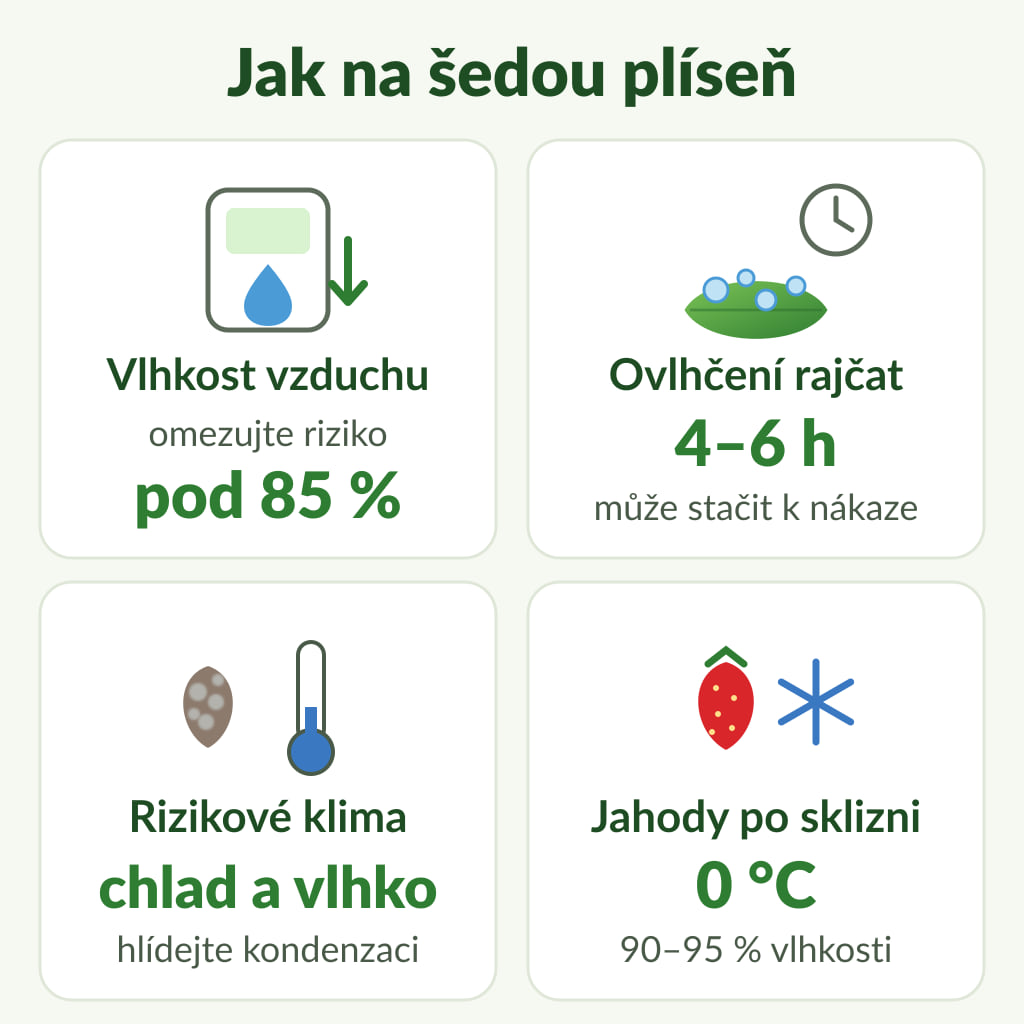
Botrytis thrives in cool, damp conditions. According to university sources from the USA:
The most dangerous time is when warm, humid air cools down. If the amount of water vapour remains unchanged, relative humidity rises; if plant surfaces reach the dew point, water condenses on them. In greenhouses, this happens in the evening and at night. The same physical principle can apply in a grow box after the lights go out if the temperature drops; check the risk by taking measurements.
Prevention in a grow box: humidity, VPD and ventilation
Adjusting the environment and maintaining good hygiene are the foundations of grey mould prevention. They can significantly reduce the need for sprays, but may not be enough when infection pressure is high.
Humidity and VPD
- To reduce the risk, keep air humidity below 85% and keep leaves wet for as little time as possible. For greenhouse ornamental plants, NC State recommends avoiding high humidity lasting more than 3 hours a day; staying below this limit does not guarantee safety.
- Monitor humidity continuously, ideally with a hygrometer that records minimum and maximum values, so you can see nighttime peaks as well.
- It is also helpful to monitor VPD (vapour pressure deficit). A low VPD at a given temperature means there is only a small difference between the saturation and actual water vapour pressure in the air. A smaller pressure difference between the leaf and the air limits evaporation; the risk of condensation also depends on leaf temperature. The articles What is VPD? and VPD and transpiration explain how to adjust VPD to suit the growth stage.
- If ventilation does not reduce humidity, use a dehumidifier. The article Humidifier or dehumidifier? can help you choose.
Ventilation and airflow
- An extract fan removes air from the space. It reduces humidity when the incoming air contains less water vapour. Based on your measurements, leave it running after the lights go out as well, when relative humidity may rise. Find out how to size your extraction in the article How to choose and set up ventilation for a grow tent.
- A circulating fan keeps air moving between plants. Airflow reduces humidity within the canopy and the length of time leaves remain wet, even when humidity is higher. There should be no areas of stagnant air in the growing space. Suitable options include circulating or clip-on fans.
Watering, pruning and hygiene
- Water in the morning and at the roots, ideally using drip irrigation. Spraying over the leaves spreads spores and prolongs the time the plants remain wet.
- Do not plant too densely or over-fertilise. Over-fertilised plants develop soft tissue that botrytis can easily attack.
- Prune only dry plants, and do so when wounds can dry quickly. Remove cut material immediately.
- Remove dead leaves, fallen petals and rotting fruit. They are the main source of spores. Do not leave them in a bin in the growing space: the mould will continue to grow on them, and handling the bin can release more spores.
- Watch out for pests. Insects carry spores and cause wounds that allow botrytis to enter the plant.
- Thoroughly clean all plant debris from the growing space between growing cycles.
Overview of risks and measures
| Risk | Why it is a problem | What to do |
|---|---|---|
| Humidity of 85% or more | encourages infection and sporulation | extraction, a dehumidifier, monitoring nighttime readings |
| Wet leaves and flowers | a wet surface allows infection | water at the roots in the morning; do not spray |
| Stagnant air | slower drying and a risk of dew when temperatures drop | circulating fan, spacing between plants |
| Dead plant debris | main source of spores | remove regularly and take out of the growing space |
| Pruning wounds | an entry point for infection | prune only dry plants so wounds dry quickly |
| Cool, damp conditions | risky conditions; favourable temperatures vary depending on the crop and stage of infection | watch for temperature drops after the lights go out and ventilate |
What to do if botrytis appears
- Carefully remove infected parts. Cut infected fruit, flowers and leaves straight into a bag and tie it up immediately. Shaking them can release a cloud of spores.
- Take them out of the growing space and do not leave them in a bin indoors.
- Reduce humidity and increase airflow. Check humidity at night, when it is usually highest.
- Inspect nearby plants. For strawberries, pay particular attention to fruit that was touching the infected fruit.
- Consider using a product if conditions remain favourable for mould (see below).
Biological products
Biological products based on microorganisms can be part of grey mould prevention. Results depend on the conditions and how early the treatment is applied. Authorisations for outdoor and protected spaces may differ. The range includes, for example:
- AgroBio Serifel with the bacterium Bacillus amyloliquefaciens (strain MBI 600). Czech authorisation for small packs 5897-1 covers use against grey mould on strawberries, tomatoes, peppers and lettuce in the field. This authorisation cannot automatically be extended to a greenhouse or grow box. Apply the product preventively; its efficacy is average and varies depending on conditions.
- BioGarden Polyversum with the organism Pythium oligandrum strain M1, which the manufacturer says parasitises pathogenic fungi. Authorisation for small packs 4556-1 covers use against grey mould on crops including strawberries, tomatoes, peppers and herbs in protected spaces; check the dose, growth stage and other conditions for the specific pack. Use it preventively.
Chemical fungicides
In cases of high disease pressure, you can use a registered fungicide. For example, AgroBio Signum (boscalid and pyraclostrobin) is authorised in the Czech Republic for small packs under authorisation 4738-3 for use against grey mould on strawberries from flowering to the start of ripening. This authorisation does not permit spraying tomatoes or herbs. AgroBio Scala (pyrimethanil) is authorised in the Czech Republic for small packs under authorisation 5440-1 for use on strawberries during flowering. Always follow the specific label for timing, number of applications and pre-harvest interval.
Things to bear in mind:
- Botrytis quickly develops resistance to fungicides that are repeatedly used with the same mode of action. Therefore, alternate products. The mode-of-action group (FRAC) is shown on the label.
- Protecting strawberry flowers is important. The University of Minnesota emphasises treatment during flowering and the limited benefit of late treatments. However, the timing for using a specific Czech product must follow its label; some authorisations also cover later growth stages.
- Always follow the label, authorised crops and pre-harvest interval. Check the current authorisation in the ÚKZÚZ product register.
Find more products in the Disease control (fungicides) and Biological protection categories.
Harvesting and storage without mould
Botrytis is also a storage disease. It can take hold even at 0–10 °C, so cold only slows its growth. Keep the following in mind when harvesting and storing:
- Harvest frequently and remove infected fruit from the plants regularly throughout the season.
- Keep diseased fruit separate from healthy fruit. Grey mould continues to spread after harvest, from one fruit to another.
- Chill strawberries as soon as possible. According to UC Davis, the optimal conditions for storing strawberries are 0 °C and 90–95% humidity (relative). This refers to controlled storage of harvested fruit, not a recommendation for the crop. High humidity limits drying out, but condensation and wetting of the fruit must be prevented. Handle the fruit gently and discard any damaged fruit.
- Store tomatoes only if they are undamaged, and check them regularly.
- Process herbs and flowers for drying immediately after harvest. Dry them in a well-ventilated environment on drying nets and place them in storage containers and jars only when completely dry. For detailed instructions, see the articles 3 principles of safe drying and How to store your harvest correctly.
Frequently asked questions
Is grey mould the same as botrytis?
Yes. Both terms refer to the disease caused by the fungus Botrytis cinerea. In English, it is called “grey mould”.
What should I do with strawberries infected with grey mould?
Carefully remove infected fruit into a bag and dispose of it. Check neighbouring fruit that was touching it, as the mould spreads from one fruit to another. Do not leave the fruit in the growing space or near the plants: the mould will continue to produce spores on it.
What humidity should I monitor in a grow box?
Relative humidity below 85% reduces the risk but does not in itself guarantee safety. Also watch out for wet leaves, condensation and nighttime temperature drops. The recommendation to limit high humidity to less than 3 hours a day comes from research on greenhouse ornamental plants and is not a universal limit. Also monitor VPD to manage the climate.
Will spraying help against botrytis?
Spraying only helps as a supplementary measure. When humidity is high and the air is stagnant, the risk of further infection remains high. In addition, botrytis quickly develops resistance to fungicides that are used repeatedly. Climate control, good hygiene and careful handling of plants are always the foundations of prevention.
Why did the mould appear only after harvest?
Botrytis can remain hidden in young fruit and become apparent only as it ripens or during storage. Cold slows its growth but does not stop it; it can take hold even at 0–10 °C. Therefore, store only healthy, dry and undamaged fruit, and check it regularly.
Keep grey mould out of your growing space
The key to keeping botrytis at bay is monitoring humidity and airflow. Equip yourself with a hygrometer, a circulating fan and, if needed, a dehumidifier. For your harvest, drying nets and storage containers are useful. If mould does appear, products from the fungicides category can help. We will be happy to help you choose at info@higarden.eu.