
What is reflective foil and which one to choose?
Light in the growing area should certainly not fall anywhere other than on the plants, so that they can grow and flower intensively thanks to it. Reflective films are therefore one of the most important tools for growers engaged in indoor plant cultivation to achieve a massive harvest in the shortest possible time. Which film is best? You will learn everything in the following article.

You may think that a good reflector is enough for perfect light reflection in the growing area. Yes, a reflector will help you direct the light flow as needed, so you cannot do without a quality shade, but in addition to the direction of the light, it is also necessary to deal with the intensity with which it falls on your plants.
Walls, floor and ceiling – light in the growing room is reflected there through the reflector. Each time it hits these surfaces, losses in light intensity are inevitably associated with it. And that is, of course, something we do not want. That is precisely why these surfaces are lined with reflective film.
Let us summarise what reflective film is good for:
- You make maximum use of the light source in the growing area.
- Thanks to reflective film, more light falls on the plants and its rays also reach shaded areas, where larger or smaller parts of the plants usually suffer from a lack of it, which is why supplementary lighting is also used for their supplementary lamps.
- Reflective film also protects plants from top burn.
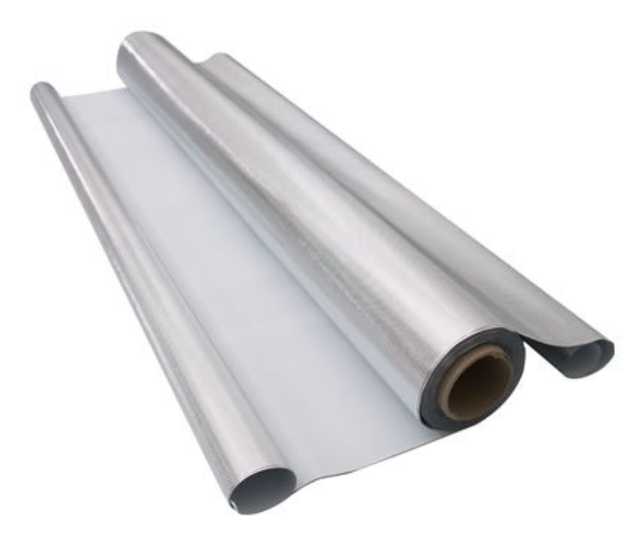
Diamond reflective film ECO is available in our range at an unbeatable price.
We will now look at how the individual reflective films differ from one another based on the production materials and their properties:
- Black-and-white PE film is the basic type of reflective film and, as the name suggests, consists of two layers, with the white one reflecting light (reflectivity approx. 90%) to harder-to-reach places and the black one absorbing it. This also clearly determines its placement on the wall of the grow room, with the white side facing inwards and the black side facing outwards. The advantage of this type of film is its low price and decent light reflection. The disadvantage is its lower ability to diffuse light evenly, as more advanced types of film can do.
- Silver films reflect light more than half as well again as the black-and-white film above, so your plants make use of 50% more light. Silver film is easy to work with, but again it is characterised by a lower ability to diffuse light evenly. It is a durable material resistant to creasing and wear, easy to maintain and also completely non-toxic, whether you choose the REFLECT-A-GRO, MYLAR or ECO version.
- Diamond films are available in our range in two versions. The A-GRO version will of course do a better job, but you will not go wrong with the cheaper version either, which is the diamond film ECO. What is the difference compared with silver films? It is the ability to diffuse light evenly. By using diamond film, you will therefore not only ensure that your plants make use of more of the light radiation from the discharge lamp, but the lighting will also be even, which is an added value that will certainly be reflected in the final yield. The disadvantage may be maintenance, as the film needs to be washed and polished with a dry cloth.
- ORCA are Canadian-made films with a unique surface topography formed by fibres of high-density specialised reflective plastic. The white colour of the film ensures a high standard in both factors mentioned above, namely reflectivity and even light diffusion. ORCA film is also much easier to clean than diamond film. Simply wipe it with a damp cloth and that is it. The main advantage is the Canadian manufacturer’s promise that by using ORCA film you will significantly reduce growing