
How to Use UV Radiation Indoors: UVA, UVB, UVC and Safety
UV radiation can help plants in a grow room, but only in the right form and dose. In this article, you will learn how UVA, UVB and UVC differ, when UV LEDs make sense as a supplement to the main light, what germicidal UVC lamps are used for, and how to protect your eyes and skin when working with UV.
What types of UV radiation are there?
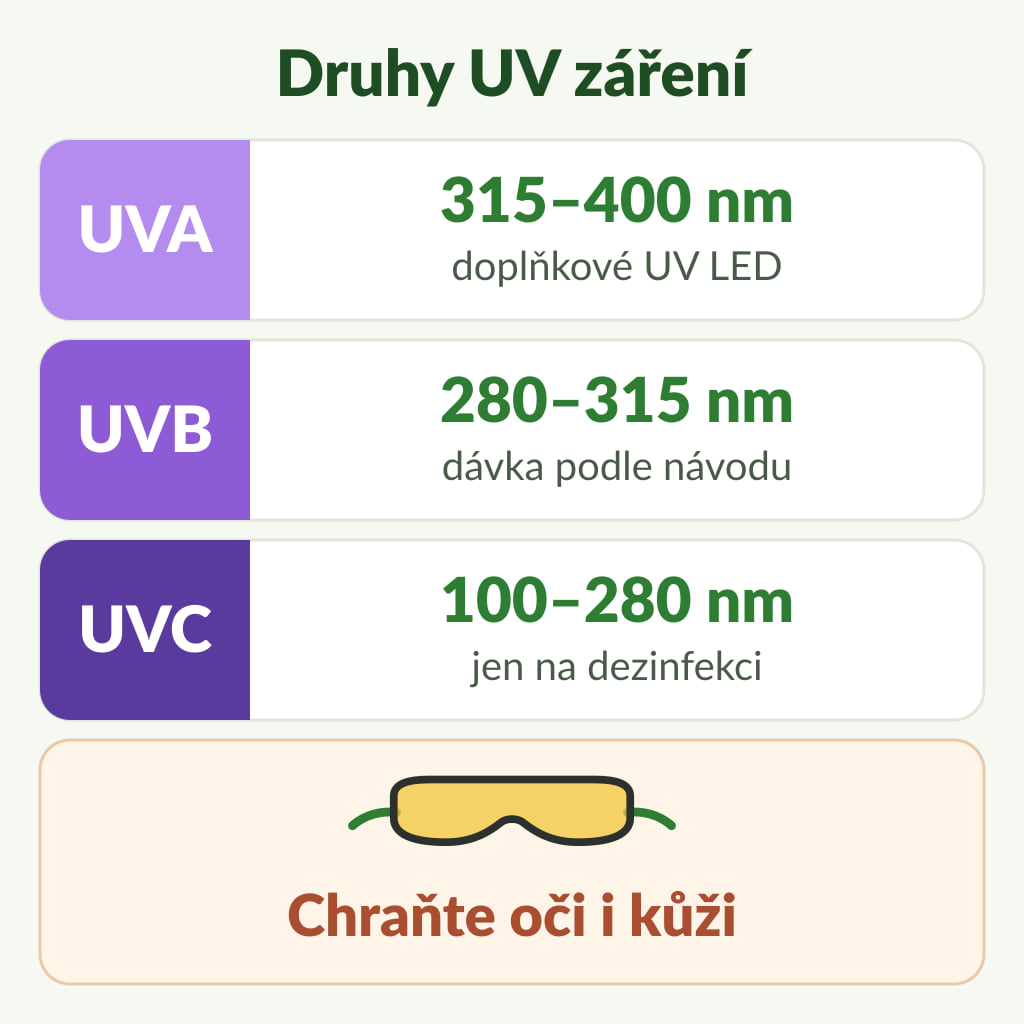
Ultraviolet (UV) radiation has a shorter wavelength than visible light. It is divided into three bands according to wavelength:
How UV affects plants
Plants detect UVB radiation using their own photoreceptor, UVR8. This triggers a signalling pathway that supports, among other things, the production of protective flavonoids. Depending on the species and conditions, UVB can affect their content, pigment production, and plant shape and growth. This does not automatically mean a higher yield or a better harvest. Full-spectrum LEDs or a discharge lamp remain the main light source for photosynthesis.
The effect depends heavily on the dose and plant species. Responses vary according to the crop, environment, spectrum, intensity and exposure time. Excessive UV damages plants. Follow the instructions for the specific light and monitor how the plants respond. The dose depends on the irradiance of the crop and the time the light is on; electrical power consumption in watts alone does not determine it.
UVA and UVB LEDs: when and how to use them
- As a supplement only. UV LED bars are hung alongside the main full-spectrum light. They are not sufficient on their own for plants. For example, Lumatek explicitly advises against using a UV bar without a full-spectrum panel.
- Growing stage according to the model and crop. The Lumatek UV BAR instructions describe use during the flower stage and the option to start 4 weeks before harvest. This schedule cannot be applied to all plant species or other UV lights.
- Lighting time according to the manufacturer. The Lumatek UV BAR instructions describe 12-hour operation at the same time as the main ZEUS light; they recommend limiting exposure if signs of plant damage appear. This is not a universal starting dose or a safe exposure time for people. Other bars have their own recommendations, so follow the instructions for the specific model.
- Distance from the plants. Hang the bar according to the manufacturer’s instructions. For general advice on light height, see the article How high to hang grow lights.
- Timer. Switch the UV bar on using a separate timer, so you can control the dose independently of the main light.
UVC: germicidal lights for disinfection only
Standard low-pressure mercury germicidal fluorescent lamps, such as the source in the GL08 light, emit mainly at around 253.7 nm. Other UVC sources may have a different wavelength. They are used to disinfect air and surfaces, for example in an empty grow tent, on tools or in a drying room between two cycles. Do not use the open germicidal lights listed here to irradiate plants; specialised, controlled UVC procedures in professional growing are a different application.
- Switch on an open lamp only in an area without people or animals, remove plants and prevent anyone from entering accidentally. The US Food and Drug Administration (FDA) warns of the risk of eye and skin injury from unprotected exposure to UVC.
- Choose the lighting time according to the lamp instructions and the intended disinfection; a timer is only for controlling the time and does not provide protection if someone enters. UVC acts mainly on directly irradiated surfaces; shaded areas may not be disinfected.
- Some UVC lamps produce ozone, which irritates the respiratory tract. For both GL08 and GL14, the manufacturer specifies filter glass that limits ozone production. This does not guarantee that no ozone will be produced; follow the instructions and ventilation requirements.
Safety: protect your eyes and skin
- Never look directly at a UV source, even briefly. Exposure to a powerful UVC source can damage the cornea (photokeratitis) and skin, even after a short time; for some hazardous devices, the FDA cites exposure of just a few seconds. The time it takes for damage to occur depends on the spectrum and irradiance, and symptoms may appear later.
- Switch off UV before entering and working in the area. If exposure cannot be avoided during specialist work, protection must match the source’s spectrum and intensity: suitable safety glasses or a face shield with side protection, and coverage of all exposed skin. Ordinary sunglasses or an unspecified “UV filter” are not proven protection against UVC.
- Switch off the UV bar or lamp and disconnect it from the power supply before installation and maintenance. Prevent it from being switched on again accidentally.
- Keep UV lights out of reach of children and animals. Secure the area so that UV cannot reach people during operation; simply closing the grow tent does not verify that it is safe.
UV lights in our range
| Light | UV type | Power consumption | Use |
|---|---|---|---|
| Lumatek LED UV BAR 30W | UVA + UVB | 30 W | supplement for Lumatek ZEUS panels, area 1.2 × 0.6 m |
| SunPro UV A+B 30W | UVA + UVB according to the e-shop (390 and 310 nm) | 30 W | supplementary bar with dimmer according to the e-shop |
| DIMLUX Xtreme UV-B Booster | UVB | depending on the variant | add-on module for DimLux Xtreme Series lights |
| AC Infinity IONBEAM U2 | UVA (365 and 395 nm) | check the label for the specific revision | 2 strips with a controller; the manufacturer specifies approximately 61 × 61, 61 × 122 or 91 × 91 cm, depending on the settings |
| Secret Jardin Cosmorrow LED 40W UV | UVA 365 nm + white 6500 K | 40 W | supplementary bar; according to the e-shop, the power supply is sold separately |
| GL14 germicidal light 11 W | UVC | 11 W | hanging; check the sizing and exposure time in the instructions for the specific version |
| GL08 germicidal light 11 W | UVC (253.7 nm) | 11 W | wall-mounted; check the sizing and exposure time in the instructions for the specific version |
Find more germicidal lamps and replacement fluorescent tubes in the germicidal lights category, and main grow lights in the LED lighting category.
Frequently asked questions
Do plants in a grow tent need UV light?
Not necessarily. Plants can be grown without supplementary UV if they receive enough light for photosynthesis. UV is an optional supplement; UVB in particular can affect flavonoids and pigments, depending on the species and dose.
Can I use a germicidal UVC lamp to shine light on plants?
Do not use the open germicidal lights listed here on plants. They are intended for disinfection; switch them on only where there are no people, animals or plants, and follow the instructions.
How long should I use a UV bar each day?
Follow the instructions from the manufacturer of the specific bar, taking into account the distance from the crop and the plant species. Do not apply one bar’s schedule to another model. If plants are damaged, stop exposure and adjust the conditions according to the instructions.
What safety glasses should I use when working with UV?
Above all, switch off UV before working. Any safety glasses or face shield must be specified by the manufacturer for the relevant UV spectrum and intensity, including side protection. Do not look at the source, even while wearing safety glasses.
Is UVA safer than UVB?
Individual UVA photons have less energy than UVB photons, but safety also depends on the intensity and exposure time. UVA is not harmless. It penetrates deeper into the skin and contributes to skin ageing. Protect yourself from both.
Related articles
- The light spectrum and its effect on plant growth
- The most important criteria for choosing grow lighting
- How high to hang grow lights
- How to prevent mould and get rid of it
Choose your UV light
Would you like to supplement your main light with UV? Take a look at the Lumatek UV BAR or AC Infinity IONBEAM. For disinfecting your grow room between cycles, choose a germicidal light. Need advice? Write to us at info@higarden.eu.