
How to use calibration solutions and pH meters?
Quality pH meter is a very useful and at the same time the most accurate available tool for testing pH values, which tell us whether a given solution reacts acidically or, conversely, alkalinely. To be able to rely on the accuracy of your pH meter, it needs to be calibrated often enough. For this purpose, calibration solutions are used, which not only help you ensure correct measurement results, but also extend the service life of meters.

Calibrate often
First of all, it should be emphasised that there is no universal answer to the question of how often to calibrate a pH meter. Every manufacturer has a slightly different device, and therefore also a different procedure. We therefore always recommend reading the manufacturer’s instructions for use carefully. That is the best start. It also depends on the required measurement accuracy, which determines the calibration frequency. The ideal situation is calibration every day, or before every measurement.
Preparing the pH meter for calibration
- Switch on the pH meter.
With the first point, we again return to the importance of the instructions for use for every instrument for measuring pH. Among other things, it tells you the exact time needed to warm the device up to the ideal operating temperature. After you switch on the pH meter, it usually needs half an hour to warm up. Only then can you begin calibration and subsequently start using it.
- Clean the electrode.
Remove the electrode from the storage solution and then rinse it with distilled water under an empty waste beaker. Sometimes the electrode is extra dirty. In these cases, the manufacturer’s manual should again provide you with a safe solution. After rinsing, dry the electrode carefully with a cleaning wipe. Try to avoid excessive rubbing of the electrode, which has a very sensitive membrane around it. Do not forget that you need separate containers for rinsing and calibrating the pH meter (i.e. waste and calibration).
- Prepare a pH calibration solution, also known as a buffer.
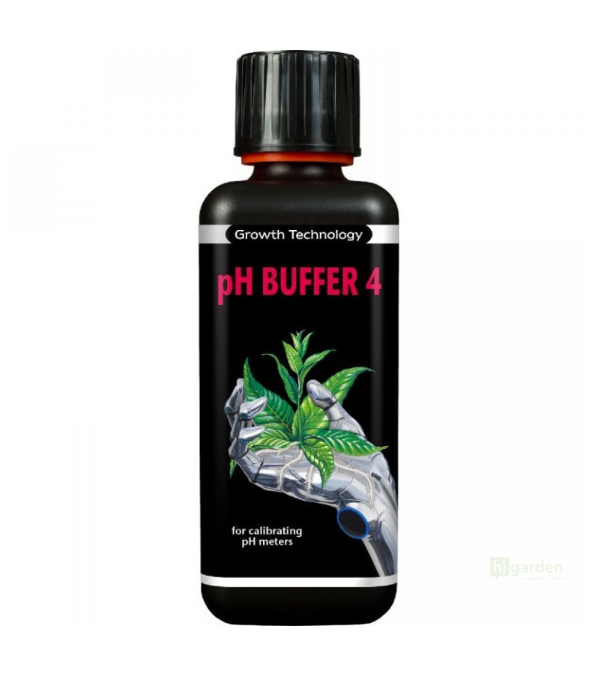
For calibrating a pH meter, you will usually need more than one buffer. To ensure proper operation of the pH meter, two buffers are usually used, because two different concentrations have different results. The first will be a “neutral” buffer with pH 7. The best-selling one is Growth Technology pH BUFFER 7. The pH value of the second calibration solution should be close to the expected pH of the sample. That means either pH 4 or pH 9.21. Buffers with a higher pH (9.21) are best for measuring alkaline solutions, while buffers with a low pH (4) are best for measuring acidic samples. Given that the correct pH of the substrate ranges between 6.5–7.0 and in hydroponic growing the optimal value is usually even lower (between 5.5 and 6.5), as a grower you will be interested only in the first of the two mentioned options, for example again the most popular one from Growth Technology. The procedure in which you use two calibration solutions for calibration at pH 7 and pH 4 is called two-point calibration, which is more accurate than one-point calibration (only at pH 7).
p