
Three plants outdoors! Prepare for the outdoor season with Higarden
The first legal outdoor season is slowly knocking at the door. Are you planning to try outdoor growing for the first time this year and unsure how to choose the right site and time your planting? We will advise you on how to start outdoor growing and reveal several tricks used by professional growers.
Outdoor growing has one major advantage over indoor growing: nature does a substantial part of the work for you. Sun, wind and rain are free, and healthy soil does not need expensive fertilisers. However, if you want to make full use of nature’s power, you must not underestimate the start of the season.
Where to grow outdoors
A site for outdoor growing should meet several basic conditions. First and foremost, plants need as much sunlight as possible. If you plant them in a shady corner of the garden, they will grow slowly and be weak. Therefore, try to ensure that the growing site faces south and is not shaded by anything.
You may also be interested in: Choosing a site and preparing the soil for spring planting
In addition to sunlight, plants also need quality soil with enough nutrients. They will do best in a loose substrate rich in organic matter. Soil that is too clayey or too sandy is unsuitable for growing, and it is better to replace it with a gardening substrate for outdoor use, or alternatively plant the plants in a raised bed or pot. Is it better to grow outdoors in a bed, greenhouse or pot? Each of the methods listed has its pros and cons.
Bed: Growing in a bed in open ground is the most natural for plants. Their roots can grow without restriction, and if they have enough nutrients, water and sunlight, nothing will prevent them from reaching their maximum size. The disadvantage of growing under the open sky is the fact that the plants will be exposed to the vagaries of the weather throughout the entire growing cycle. The greatest risks are ground frosts in the first weeks of life, strong gusts of wind, and storms and rain in the period before harvest.
Greenhouse: The advantage of a greenhouse is higher temperatures and a protected environment. In a greenhouse, you can start growing a little earlier in spring than under the open sky. Plants grown in a greenhouse usually have a significant head start during the growth period over those growing in an unprotected site. Another huge advantage of greenhouse growing is protection of the plants from wind and rain.
Pots: Outdoor growing in a pot is a solution for those who do not have a suitable place in the garden or want to grow on a balcony or house terrace. For outdoor use, you can use plastic or fabric pots, or grow directly in a bag of growing substrate. Avoid ceramic or stone pots. For outdoor growing, use growing containers with a volume of at least 15 litres so that the substrate does not dry out too quickly. If you plant the plants in a pot that is too small, they will topple over and the soil will dry out in a few hours in the sun.
Pre-grow seedlings indoors
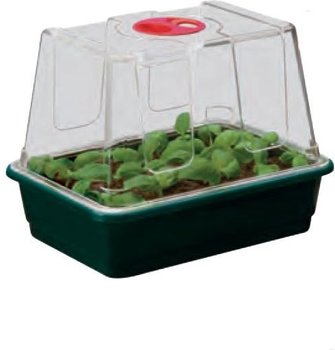 Few growers sow seeds directly into the soil. Most germinate seeds at home in the safety and warmth of the home, and only plant the seedlings outside once they have grown a little and become stronger. You can pre-grow seedlings on a windowsill or in a conservatory, but they will do best in a propagator. A propagator is a miniature plastic propagator designed for seed germination and young plants. The advantage of the small space is that you can easily maintain the high humidity inside that seeds need for germination.
You can germinate on a paper towel, but more suitable are germination cubes or Jiffy plugs, where there is no risk of damaging the sprout when transplanting the germinated seed. A few days after germination, you can transplant the seedlings outside or into a grow box under artificial lighting, by a window or into a conservatory, where you can grow them into larger seedlings.
You may also be interested in: How to pre-grow seedlings for outdoor planting
When to germinate seeds and plant outdoors
The conditions for outdoor growing here are roughly from the end of April to the beginning of November. However, it is necessary to take into account that bad weather can significantly shorten the season. You can start germinating photoperiod varieties already during April and May. You will plant them outdoors approximately in the second half of May after the three frosts, as folk wisdom advises.
Until then, you can keep the seedlings on a windowsill, but they will do best in a grow tent under artificial lighting. For this purpose, a TLED grow light with an output of several dozen watts and a growth spectrum, which will give the seedlings enough energy for vigorous growth, is sufficient. If you place the seedlings in a grow box where you maintain air humidity around 60 to 70%, they will grow even faster. Light the seedlings for 16 to 18 hours a day.
You may also be interested in: Is it better to grow autoflower or photoperiod varieties here?
A slightly different strategy is needed when growing autoflower varieties outdoors. They begin to flower independently of day length after approximately 3 to 5 weeks from seed germination. It is therefore important that in the first weeks of life, autoflower plants have the best possible conditions for rapid growth. If you plant them outside too early, they will not grow and the harvest from them will be poor. That is why most growers germinate and plant autoflower varieties only in the second half of May. Remember that autoflower varieties are not suitable for transplanting, and after germination they must be planted directly in their final site. However, you can also pre-grow autoflower plants indoors if you plant them in a large pot, in which you then place them outside. In this way, it is possible to achieve 2 to 3 harvests per season even here.
You can find more advice on legal growing and guides for beginner and advanced growers on the Higarden growing blog.