
Spider Mites: How to Identify Them and Get Rid of Them
Pale spots on the leaves, fine webbing and a plant that is wilting even though it has enough water? Spider mites are often to blame. These tiny mites reproduce exceptionally quickly in warm, dry conditions, so it is important to identify spider mites early. In this article, you will learn how to recognise spider mites, why they thrive in grow rooms and greenhouses, how to control them using predatory mites, natural and chemical products, and how to proceed step by step.
What are spider mites and why are they so dangerous?
Spider mites are tiny mites from the Tetranychidae family, so they are related to spiders, not insects. A common species in grow rooms, greenhouses and gardens is the two-spotted spider mite (Tetranychus urticae).
- Size: an adult female measures 0.4–0.5 mm. To the naked eye, it looks like a tiny moving speck; you will only see the details with a 10× magnifying glass.
- Appearance: adults have eight legs and an oval body. During the growing season, they are usually yellow-green with two dark spots on the sides of the body. Overwintering females are orange.
- What they attack: herbs, ornamental plants and woody plants. They attack cucumbers, tomatoes, peppers and strawberry plants, for example.
Spider mites suck the contents of cells on leaves. The plant loses leaf area, becomes weaker and may even die if the infestation is severe. They cause the most damage in warm, dry conditions, typically in summer, in greenhouses and in indoor grow rooms under lamps.
How to identify spider mites on plants
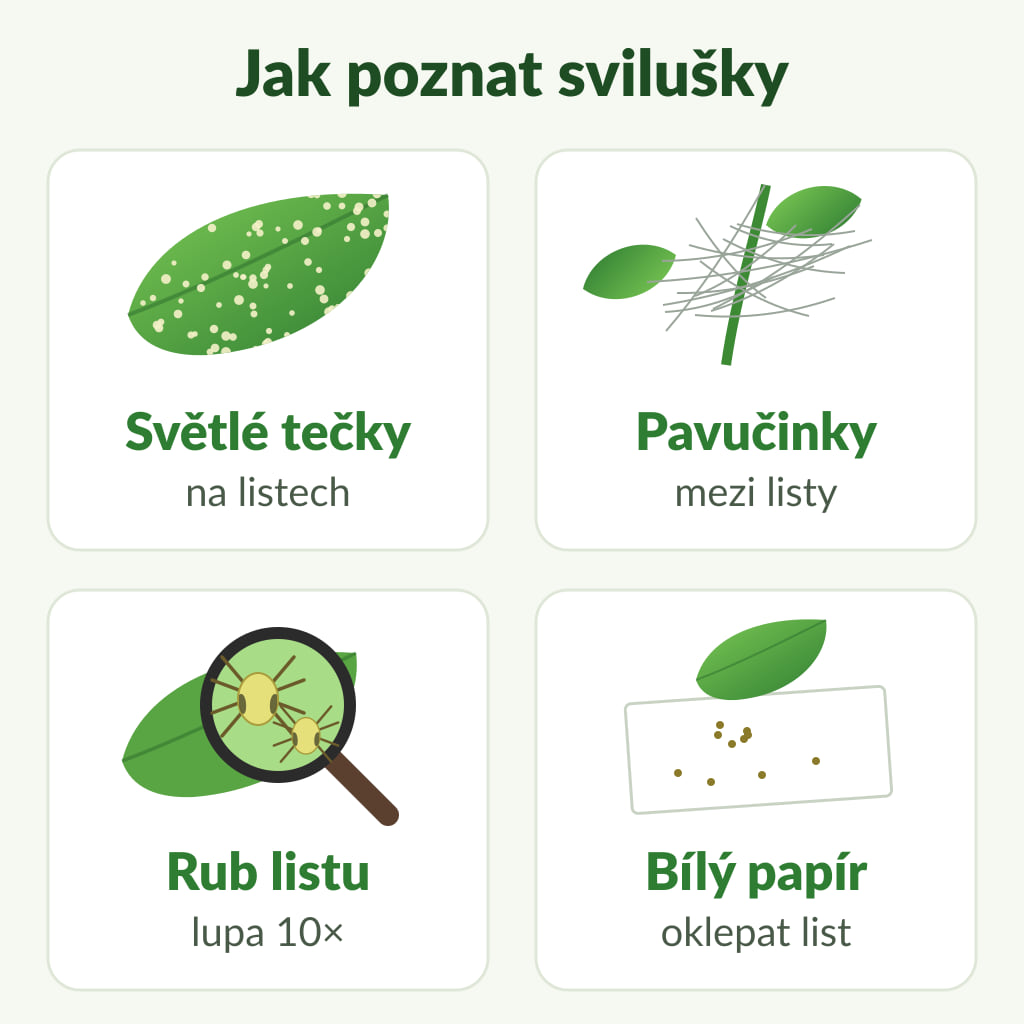
Spider mites themselves are easy to miss. Look out for the symptoms and check the undersides of leaves regularly:
Life cycle: why spider mites reproduce so quickly
The two-spotted spider mite reproduces quickly in warm, dry conditions. A temperature of 20 °C or relative humidity of 70 % are not fixed limits for its occurrence. Within the normal growing range, higher temperatures accelerate development; this does not apply without limit up to extreme temperatures.
- Eggs: round, translucent and approximately 0.1 mm in diameter, found on the undersides of leaves and in webbing. A female may lay dozens to more than one hundred eggs during her lifetime; the number depends on the temperature and host plant.
- Larvae: they hatch after several days depending on the temperature; hatching may take longer in cooler conditions. They have six legs and are almost colourless. Two nymphal stages follow; before reaching adulthood, they moult three times in total. The duration of these stages depends on the conditions.
- Nymphs and adults: they have eight legs. The adult lifespan and the development time from egg to adulthood are different values; one fixed duration cannot be applied to both.
- Generations: under favourable conditions, one generation is completed in approximately one to two weeks, and at a suitable temperature with sufficient food, according to UC IPM, in less than one week. Generations overlap, so eggs, larvae and adults can be found on the plant at the same time.
- Overwintering: outdoors, orange females overwinter in shelters such as under bark, stones or in the soil.
In practical terms, this means that a single treatment may not be sufficient. Repeat the treatment according to the product instructions so that it also affects individuals that hatch from eggs.
Prevention: how to make life harder for spider mites
- Monitor the climate. Spider mites like warmth and dry conditions. In a grow room, avoid overheating and excessively dry air. Adjusting the humidity can form part of prevention, but it will not solve an infestation on its own. When growing in a growbox, however, increase humidity cautiously, as damp conditions create a risk of mould.
- Do not allow plants to suffer from drought. Plants under drought stress are much more susceptible to spider mites.
- Reduce dust. Dusty conditions support the occurrence of spider mites. Shower or wipe the leaves from time to time.
- Check the undersides of leaves at least once a week, especially in summer and on sensitive plants such as cucumbers, peppers and strawberries.
- Do not use broad-spectrum insecticides unnecessarily. They also kill the natural enemies of spider mites and some, such as certain pyrethroids, may even trigger an increase in spider mite numbers.
- Apply a natural product preventively, for example NATURA Herbal Mixture for Spider Mites (soapwort and cinnamon). According to the manufacturer, it acts as a repellent, has no pre-harvest interval and can be used throughout the growing cycle.
How to get rid of spider mites
Mechanically: showering and cleaning leaves
In the case of a light infestation, a stronger jet of water can help, especially on the undersides of leaves. On infested plants, repeat spraying with water or misting the undersides of the leaves at least once a day. Small plants can be showered and the leaves wiped with a damp cloth. Remove severely infested leaves and dispose of them in a sealed bag.
Biologically: predatory mites and other natural enemies
Predatory mites from the Phytoseiidae family have proven effective against spider mites in greenhouses and grow rooms:
- Phytoseiulus persimilis specialises in spider mites. It works best at temperatures of 13–27 °C and humidity above 70 %. According to Koppert, it is not effective above 30 °C and is sensitive to relative humidity below 70 %.
- Neoseiulus californicus (formerly Amblyseius californicus) tolerates higher temperatures and lower humidity better than P. persimilis. However, it is not suitable for extremely dry conditions either: Koppert states that its most effective range is 13–32 °C and that it is sensitive below 60 % relative humidity.
- Other natural enemies: predatory gall midges of the genus Feltiella, ladybirds of the genus Stethorus, predatory bugs of the genus Orius and lacewing larvae.
Release predatory mites as soon as an infestation begins. UC IPM gives an approximate ratio of one predator to 10 spider mites for gardens and orchards. In a greenhouse, follow the supplier’s dosage for the specific predator species, crop and infestation severity. Do not combine biological control with products that harm predatory mites, and always check the label.
Natural sprays
Many natural sprays act by contact, so the spray must thoroughly cover both sides of the leaves, especially the undersides. Treatment usually needs to be repeated. Do not use soaps or oils on plants suffering from drought or at temperatures above 32 °C (90 °F), and always test them first on a small part of the plant.
| Product | What it is based on | According to the manufacturer |
|---|---|---|
| Biocont PREV-GARD | orange essential oil | contact insecticide and acaricide; only for use stated on the label, pre-harvest interval depends on the crop |
| NATURA for Sap-Sucking Pests | natural substances | the seller states a contact effect and a pre-harvest interval of 0 days; check the instructions for the specific variant |
| NATURA Rock Effect NEW | natural substances | a plant protection product supporting resistance when threatened by pests and powdery mildew; according to the label |
| Spider Mite Control | oil-based product; check the exact composition on the packaging | the seller states 25 ml per 1 l of water and repetition after approximately 10 days; the packaging instructions take precedence |
| Agrobacterias Spider Plant | amino-acid product supporting plants | according to the manufacturer, 2–4 ml per 1 l of water, repeat after 7–10 days; this does not constitute evidence of Czech registration as an acaricide |
| AgroBio INPORO PS | sodium docusate (3.3 g/l) | for ornamental plants, ready-to-use sprayer |
Other products for plant care include Biocont NeemAzal T/S with azadirachtin from neem, Botano Health BHB MM, BioBizz Leaf Coat or CannaCure. NeemAzal-T/S has insecticide registration, which in itself does not document use against spider mites. Do not automatically consider the listed supporting products to be registered acaricides. Check the permitted purpose for all of them and follow the manufacturer’s instructions.
Chemical acaricides
Products intended specifically for mites are called acaricides. In the case of a severe infestation, check the appropriate permitted treatment in the current ÚKZÚZ register. Not every product sold is a registered acaricide, and some formulations are for professional use only. Use them only on plants for which they are registered, comply with the dosage and pre-harvest interval, and do not exceed the maximum number of applications. If further treatment is necessary and permitted, alternate modes of action according to the label recommendations; changing the trade name does not necessarily mean changing the active substance.
| Product | Acts on | Conditions of use in the Czech Republic |
|---|---|---|
| Agro Sviluška STOP 2×2 g (Nissorun 10 WP, hexythiazox 100 g/kg) | eggs, larvae and nymphs; sterilises adults | interval and number of applications depend on the crop; usually max. 1×, on vines max. 2× with an interval of 30 days. The pre-harvest interval is not uniform: for example, apple trees 28 days, vines 21 days, strawberries 3 days |
| Sviluška STOP RTD 0.5 l (older packaging with Vertimec 1.8 EC) | product containing abamectin; historical information | Do not use: according to the register, the usability of Vertimec 1.8 EC ended on 30. 10. 2025 |
| Floramite 240 SC (bifenazate 240 g/l) | eggs and mobile stages | for ornamental plants, max. 2×; in the verified register, professional use only. Check compatibility with the specific biological control agent with the supplier |
Some insecticides that are not intended for mites, such as certain pyrethroids, are not very effective against spider mites and also kill their natural enemies.
Step-by-step procedure
- Confirm the spider mites: inspect the undersides of the leaves with a magnifying glass and tap a leaf over white paper.
- Isolate the infested plants and remove severely infested leaves.
- Shower the plants with a stronger jet of water, especially the undersides of the leaves.
- Adjust the climate: lower the temperature, do not allow the air to become too dry and do not let the plants suffer from drought.
- Choose a treatment: predatory mites or a natural spray at the start of an infestation, and an acaricide in the case of a severe infestation. Always spray both sides of the leaves.
- Repeat and monitor: repeat the treatment according to the product instructions and check the undersides of the leaves every week for several weeks after treatment.
Frequently asked questions
What does a spider mite look like?
An adult female two-spotted spider mite measures approximately 0.4–0.5 mm, has eight legs and an oval body. It is usually yellow-green with two dark spots, while overwintering females are orange. To the naked eye, it is visible only as a moving speck.
Is a spider mite an insect?
No. Spider mites are mites, meaning arachnids. This is why insecticides often do not work against them and products against mites, known as acaricides, are used instead.
What works against spider mites on cucumbers and peppers?
Regularly checking the undersides of leaves, showering with water and treating the infestation promptly. Predatory mites have proven effective in greenhouses. Choose products that are registered for the particular vegetable and comply with the pre-harvest interval.
How long does it take to get rid of spider mites?
Allow several weeks. Generations overlap and new individuals hatch from eggs. Continue checking the plants; determine the need for treatment, the interval and the number of repetitions according to the chosen method and the label.
Will increasing the air humidity help?
Adjusting an excessively dry environment may help as part of prevention and may improve conditions for predatory mites. It will not solve an infestation on its own; 70 % is not a universal threshold, and excessive humidity in an enclosed grow room increases the risk of mould.
Products for controlling spider mites in our online shop
Natural sprays can be found in the natural pest control products category, acaricides in the insecticides category and other tools in the pest control section. Not sure which product to choose? Write to us and we will be happy to advise you.
You may also be interested in: How to deal with fungus gnats, How to deal with whiteflies, How to get rid of slugs, Sprays and sprayers.
You can find more tips for indoor and outdoor growers on our Higarden blog.