
Zeolite for plants: what it is, how to use it and how much to add to your growing medium
Zeolite is a natural volcanic mineral that acts as a small reservoir of water and nutrients in the substrate. It traps excess moisture and some of the fertiliser, then gradually releases them back to the roots. Unlike organic additives, it does not break down, so it lasts for years in a plant pot or garden bed. In this guide, you will learn how zeolite works, which particle size to choose, how much to add and how it differs from perlite and vermiculite.
What is zeolite?
Zeolite is a crystalline hydrated aluminosilicate of alkali metals and alkaline earth metals (calcium, potassium, sodium and magnesium). It forms through the transformation of volcanic ash. The most common natural form, clinoptilolite, is most often used for horticultural purposes.
The key to its properties lies in its internal structure. The zeolite crystal lattice forms a network of channels and cavities of a fixed size, where water and positively charged nutrient ions are trapped. Zeolite is a natural, non-toxic and non-allergenic material, so you can use it with herbs or vegetables without worry.
How zeolite works in the substrate
- It manages water. Zeolite pores absorb excess moisture and gradually release it on drier days. This reduces fluctuations between waterlogged and dried-out substrate.
- It keeps nutrients near the roots. Zeolite has a high cation exchange capacity. It binds positively charged nutrients to its surface, especially potassium, ammonium nitrogen, calcium and magnesium, and prevents them from being washed out during watering. Plants then take them up gradually.
- It improves structure. Zeolite granules are hard and do not break down or compact, so the substrate remains airy and roots grow well in it.
- It improves problem soils. In sandy soil, it helps retain water and nutrients, while in heavy clay soil it helps to aerate the soil.
Zeolite is not a fertiliser in itself. It does not add nutrients to the substrate; it simply helps manage the nutrients you supply through fertilising.
Which zeolite particle size to choose
| Particle size | When to use it |
|---|---|
| 1–2.5 mm | As an additive in finer substrates, seed-sowing and propagation mixes, for young plants, herbs and houseplants, or for incorporation into garden beds or lawns. |
| 4–8 mm | As a drainage layer at the bottom of a plant pot, in coarser mixes for mature plants, cacti and succulents, or as decorative mulch on the surface of the substrate. |
How much zeolite to add
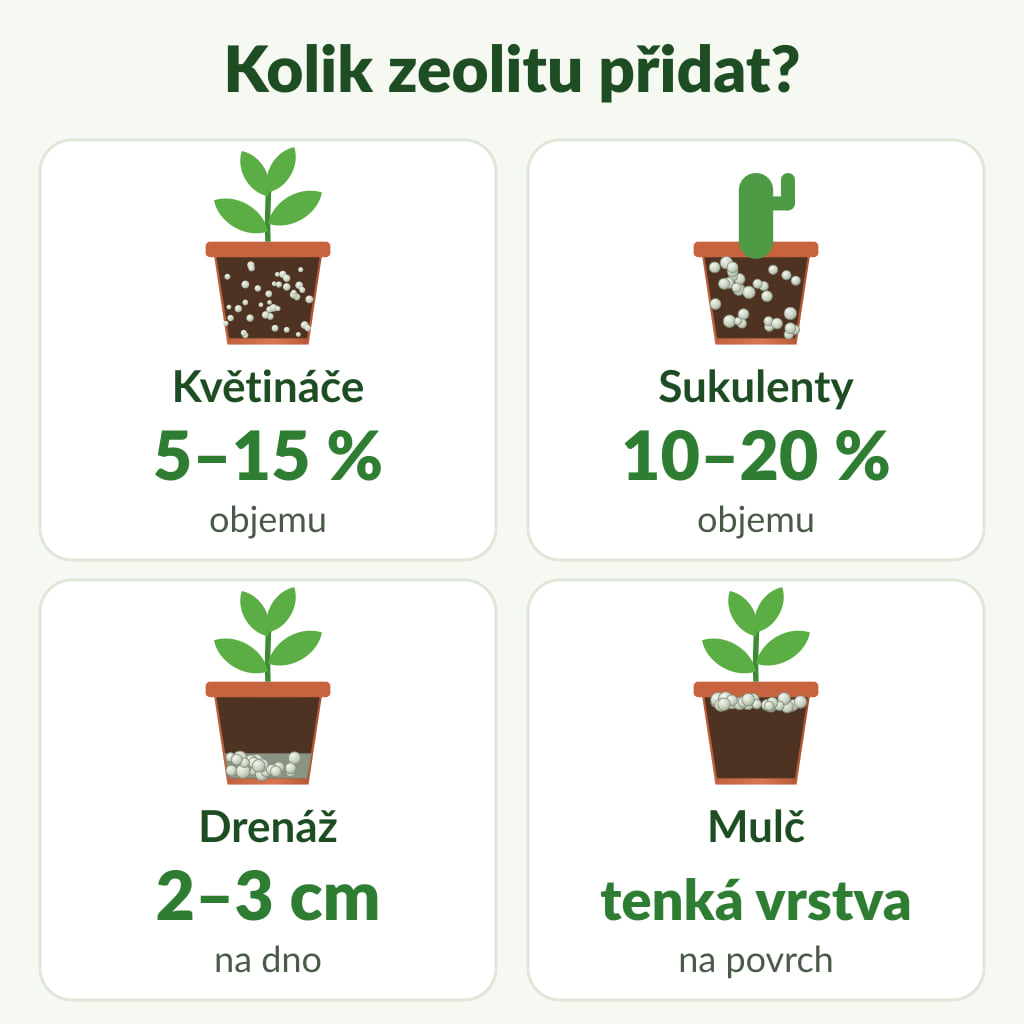
The exact amount depends on the plant and the type of substrate. Use these suggested quantities as a starting point:
Zeolite does not break down, so you only need to add it once. You can reuse it with the substrate when repotting.
Zeolite, perlite or vermiculite?
All three materials are mineral additives, but each does something different in the substrate:
| Zeolite | Perlite | Vermiculite | |
|---|---|---|---|
| Main function | retains nutrients and water | aerates | retains water |
| Nutrient binding | high | almost none | medium |
| Weight | heavy | very light | light |
| Lifespan | does not break down | crumbles over time | compacts over time |
In practice, the materials work very well together. Perlite adds air to the substrate, while zeolite adds a reserve of nutrients and water. Find out more about perlite in our article Everything you have ever wanted to know about perlite.
Zeolite for indoor growing and hydroponics
In coco or soil, zeolite is used as an additive just as it is for other plants. It helps even out fluctuations in humidity and nutrient availability between waterings.
Zeolite can also be used as a hydroponic growing medium. However, bear in mind that fresh zeolite will initially bind some of the nutrients in the solution, especially potassium and ammonium nitrogen. For the first few weeks, check EC and pH regularly and adjust the fertiliser dosage according to the readings.
Common mistakes
- Watering as before. Substrate containing zeolite retains water for longer. If you water at the same intervals as before, you may overwater your plants. Always check the moisture level before watering again.
- Too much zeolite. More is not better. Above approximately 20% of the volume, the substrate becomes unnecessarily heavy, and the effect no longer improves significantly.
- Dust. Fine particle sizes may contain mineral dust. You can rinse them with water before mixing.
Frequently asked questions
How long does zeolite last in the substrate?
Zeolite is a mineral and does not break down. It lasts practically indefinitely in the substrate and can be reused.
Is zeolite suitable for herbs and vegetables?
Yes. It is a natural, non-toxic and non-allergenic material that is commonly used in horticulture and for growing edible plants.
Can zeolite also be used in a pond or aquarium?
Yes, zeolite is often used as a filter medium because it binds ammonia from water. However, the zeolite in our range is intended for horticultural use, not for internal use.
Where can I buy zeolite?
In our zeolite category, you will find natural Rosteto zeolite in 1–2.5 mm and 4–8 mm particle sizes, in 5 and 20 litre packs. We will be happy to advise you on choosing the right one at info@higarden.eu.