
Plagron - Dosing Chart
How should Plagron be dosed? Here is a proven procedure!
- The dosing of Plagron fertilisers depends on the product range you use. These are 100% natural fertilisers from the Alga range, mineral fertilisers from the Terra range, or fertilisers for coconut or for hydroponics?
- It also depends on the substrate in which you are growing. We recommend substrates of the same brand. For example lightly pre-fertilised, aerated soil mixes with perlite or, for example, coconut substrate.
- The growth schedule directly from the manufacturer is clearly divided for each product range according to the individual weeks of the growing cycle and developmental stages. Starting with the vegetative phase (growth), through the flowering phase, to the desired harvest, when you should water mature plants with clean water (flushing) so that they have time to use up all the fertiliser. This is important for the final taste and the health of the fruits. This applies to all fertilisers except special flushing fertilisers, or flushing.
- All growth schedules are adapted to the needs of indoor growing of various plant species, especially in a grow box.
- The tables can be applied to young plants, from freshly rooted cuttings to seedlings one week old. The length of each period then depends on the specific plant species.
- Dosing fertiliser according to the manufacturer’s tables minimises the risk of over-fertilisation. Nevertheless, we recommend continuously observing how the herbs and crops are doing during the growing cycle, as every plant has individual needs, just like people do.
When should you add more and when should you reduce it?
- You can reduce the intensity of fertilisation for a while if you notice typical symptoms associated with an excess of nutrients. These are most often indicated by yellowing leaves, spots on their edges, or a white surface on the substrate.
- If you notice that, on the contrary, the plant has a lack of nutrients, it is advisable to start fertilising a little more. If the plant is growing unhealthily slowly and its leaves are smaller than is usual for the given species, it is likely to be undernourished. In such a case, you can try increasing the intensity of fertilisation and monitor whether this has a positive effect on the plant and whether it begins to thrive better.
- Our TIP: For better watering and improved nutrient management, it is worth using filters and reverse osmosis units Growmax.
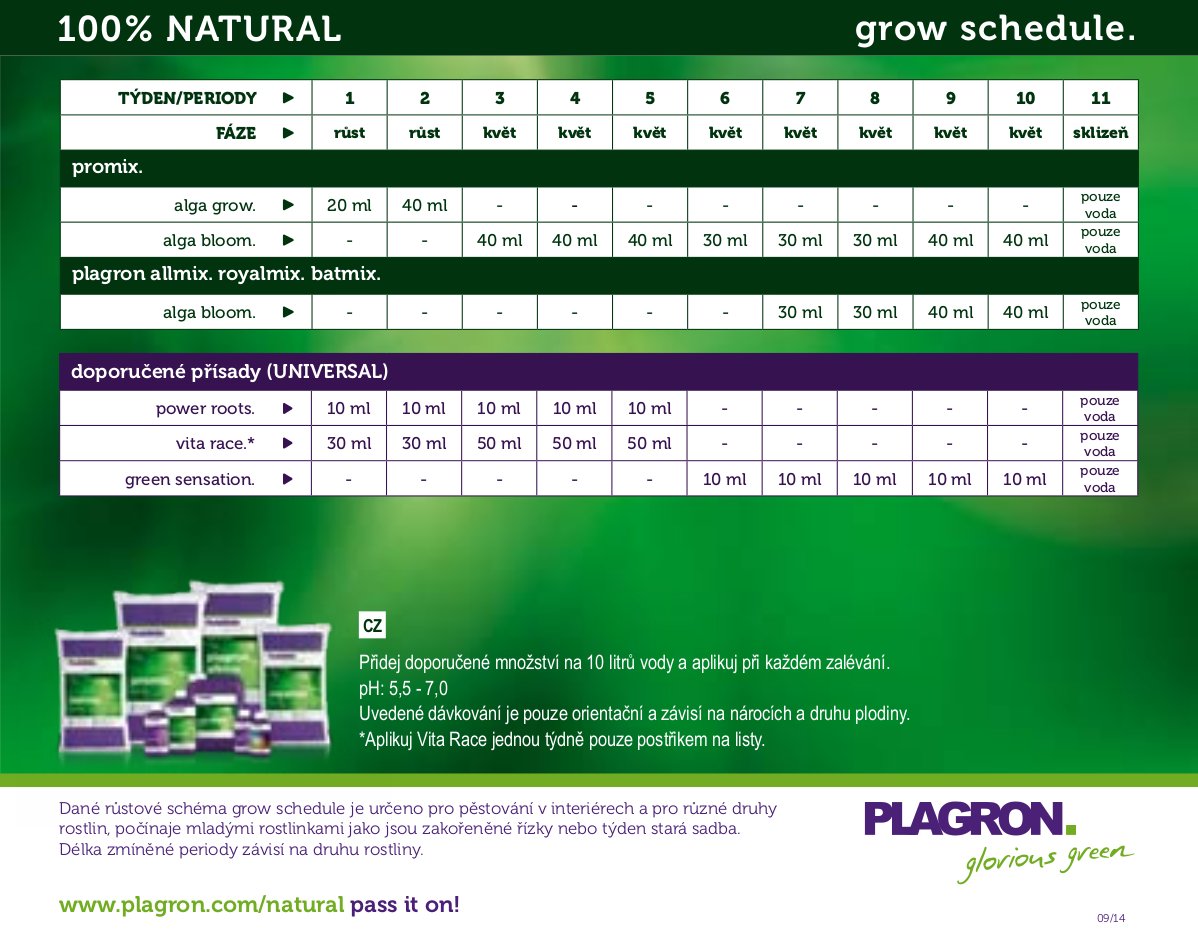
Organic Plagron Alga fertilisers:
- The table shows the recommended amount of fertiliser for the given week. Mix this amount in 10 litres of water. Apply the watering solution (water + fertiliser) at every watering.
- The substrates Allmix, Royalmix and Batmix are pre-fertilised, which means they already contain nutrients for the first 6 weeks. Therefore, Plagron BIO fertilisers are added to the watering solution only from the beginning of the 7th week of the growing cycle.
- The support fertiliser for both growth and flowering, Vita Race, is ideally applied as a spray directly onto the plants, once a week, usually during the first 5 weeks of the growing cycle.
- Use the root stimulator Power Roots for the same length of time; mix it into water in the usual way. It is characterised by extra-fast absorption and beneficial effects on the development of the root system and the overall resistance of plants.
- After the first five weeks, these support biological fertilisers are followed by the professional flowering stimulator and activator – Green Sensation.
You can find Plagron products here.
Mineral Plagron Terra fertilisers:
- The table shows the recommended amount of fertiliser for the given week. Mix this amount in 10 litres of water. Apply the watering solution (water + fertiliser) at every watering.
- A column with the value of electrical conductivity of the solution (EC) has also been added to this table, and it is important to measure and check it regularly. Never exceed the limit value of 3.0 mS/cm!
- Growers most often use tap water, and therefore the stated EC values already include its average electrical conductivity of 0.5 mS/cm. Take this factor into account even more if you decide on one of the water filtration options.
- The liquid mineral fertilisers for growth (Terra Grow) and flowering (Terra Bloom) are intended exclusively for the given phase. As you can see in the table, if you apply the watering solution to a lightly pre-fertilised substrate (Lightmix) containing basic nutrition for the first 2 weeks, it is sufficient to use Terra Grow for the first two weeks and switch to Terra Bloom in the 3rd week.
- If you prefer a more pre-fertilised substrate, Growmix, containing nutritional components for the first 3 weeks, it is sufficient from the 4th week onwards to use only the liquid flowering fertiliser Terra Bloom.
- An undeniable advantage of both of the above-mentioned peat mixes from Plagron is the composition enriched with perlite, which ensures perfect aeration of the substrate and thus better development of the root system and overall use of fertilisers.
- It is also highly advisable to support Plagron mineral fertilisers with a trio of unique supplements. Their dosing is particularly simple in combination with mineral nutrition: 10 ml of product per 10 litres of water.
- From the 1st to the 5th week of the growing cycle, watering enriched with the root stimulator Power Roots and the unique enzymatic fertiliser Pure Zym will take care of explosive growth.
- A plant equipped with such strong foundations will then, to your delight, develop abundant flowers if you add the flowering activator Green Sensation to the watering solution from the 6th week onwards.
.jpg)
You can find Plagron products here.
Plagron Coco fertilisers:
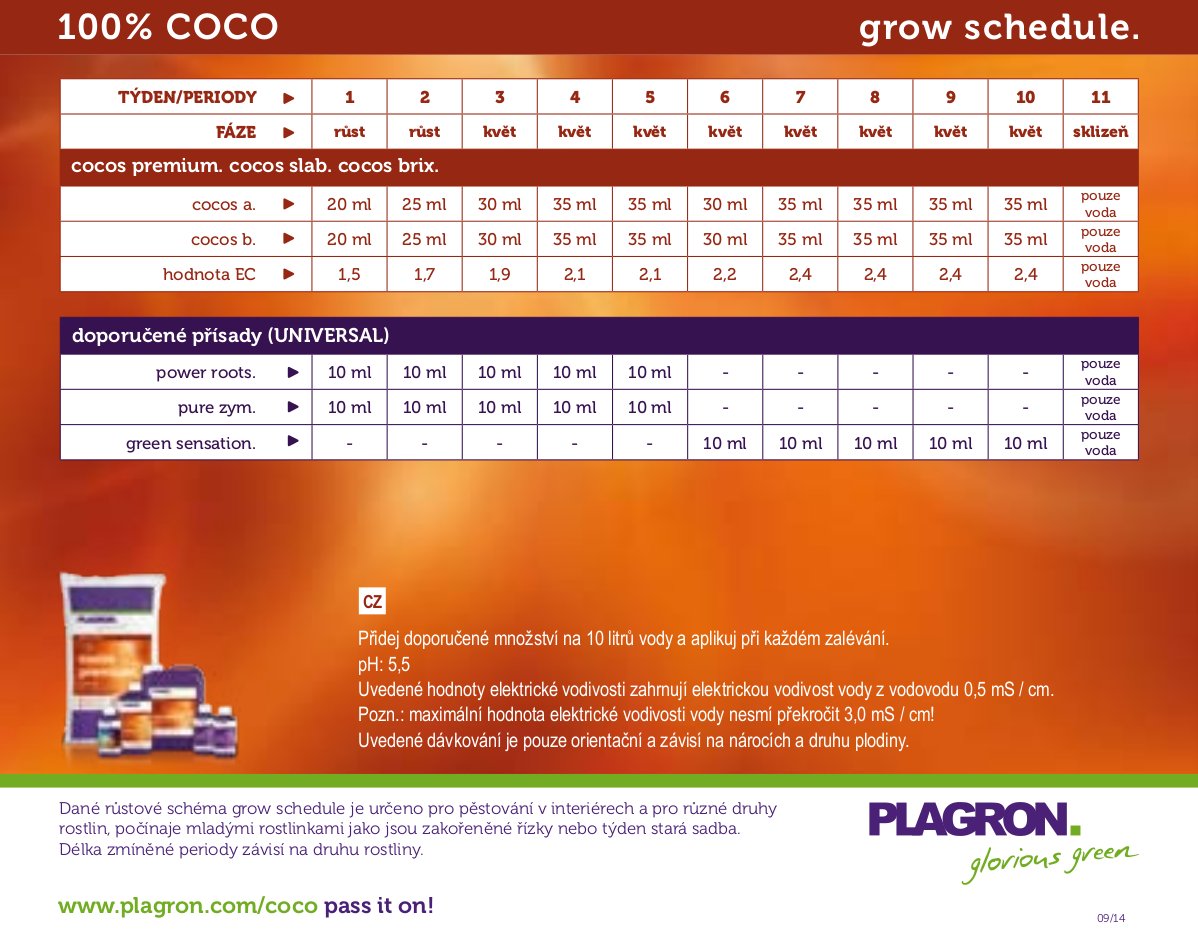
- The table shows the recommended amount of fertiliser for the given week. Mix this amount in 10 litres of water. Apply the watering solution (water + fertiliser) at every watering.
- As in the case of the mineral fertilisers from the Terra range, this table also includes a column with the value of electrical conductivity of the solution (EC), which is important to measure and check regularly when growing in coconut.
- Never exceed the limit value of 3.0 mS/cm! Growers most often use tap water, and therefore the stated EC values already include its average electrical conductivity of 0.5 mS/cm. Take this factor into account even more if you decide on one of the water filtration options.
- For growing in coconut substrate, the two-component fertilisers Plagron Cocos A+B are ideal and undoubtedly among the best available on the market. They are easy to apply, because, as the table illustrates, they are added to the watering solution throughout the entire growing cycle even in the same ratio.
- If you want to achieve better results, use the same supplementary fertilisers as are used in combination with the liquid nutrition from the Terra range (Power Roots, Pure Zym, Green Sensation). To make growing in coconut even a little easier, the same rules also apply to these products as for the combination with the Terra range.
You can find Plagron products here.
Plagron Hydro fertilisers for hydroponic growing:
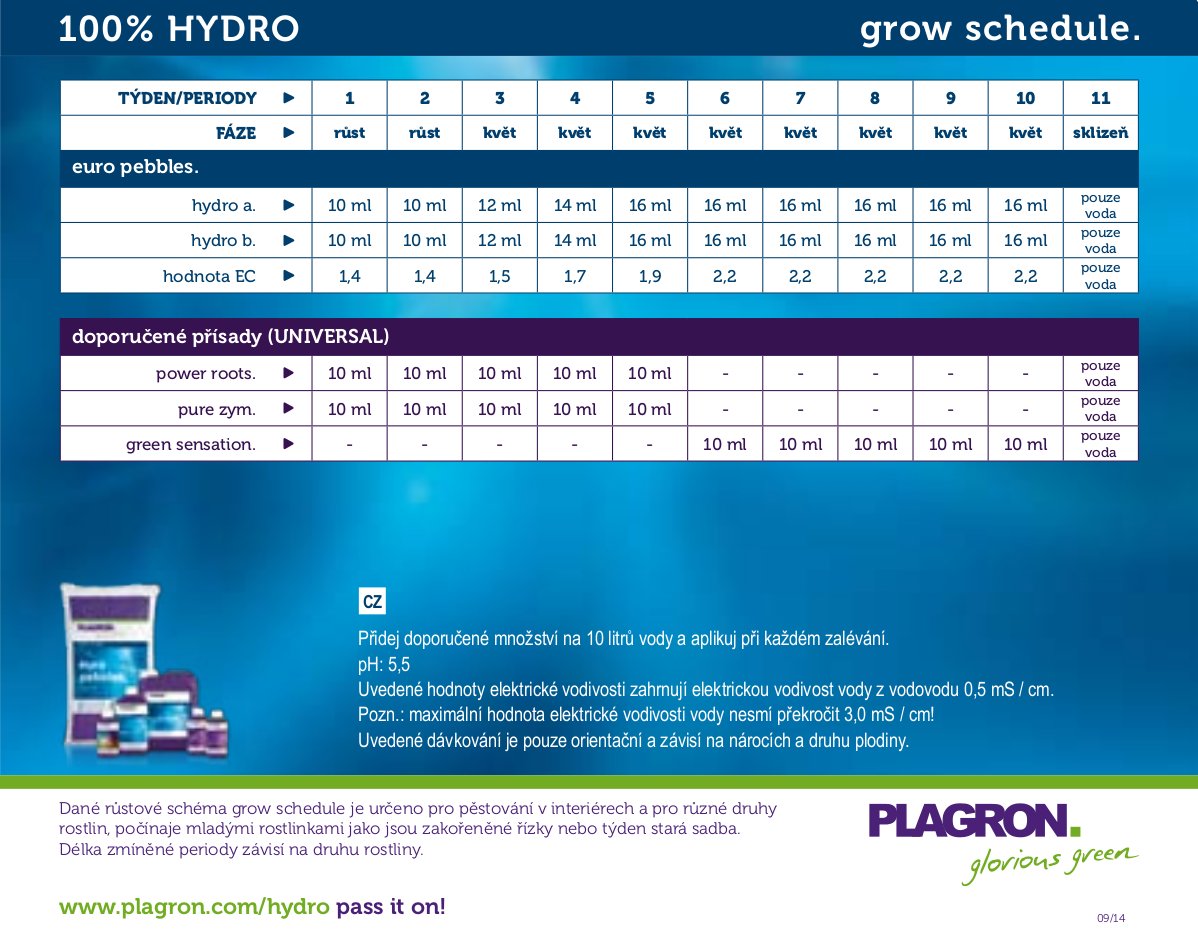
- The table shows the recommended amount of fertiliser for the given week. Mix this amount in 10 litres of water. Apply the watering solution (water + fertiliser) at every watering.
- As in the case of the fertilisers from the Terra or Coco ranges, you will also find a column with the value of electrical conductivity of the solution (EC) in this table, which is important to hydroponics and should be measured and checked regularly.
- Never exceed the limit value of 3.0 mS/cm! Growers most often use tap water, and therefore the stated EC values already include its average electrical conductivity of 0.5 mS/cm. Take this factor into account even more if you decide on one of the water filtration options.
- For substrate-free hydroponic growing of plants, the two-component fertilisers Plagron Hydro A+B are ideal and again among the best available on the market. Add them to the watering solution throughout the entire growing cycle in the same ratio.
- If you want to achieve better results, use the same supplementary fertilisers as are used in combination with the liquid nutrition from the Terra and Coco ranges (Power Roots, Pure Zym, Green Sensation). When hydroponics is used, the same rules for their dosing apply as for the combination with the previous fertiliser ranges, namely 10 ml per 10 litres of water.
For ideal dosing across all ranges and substrate types, you can use the Plagron dosing calculator.
We will also be happy to answer any questions about fertiliser dosing at info@higarden.cz.
You can find Plagron products here.