
Mills - Dosing Chart
How should you dose Mills fertilisers? Here is a proven method!
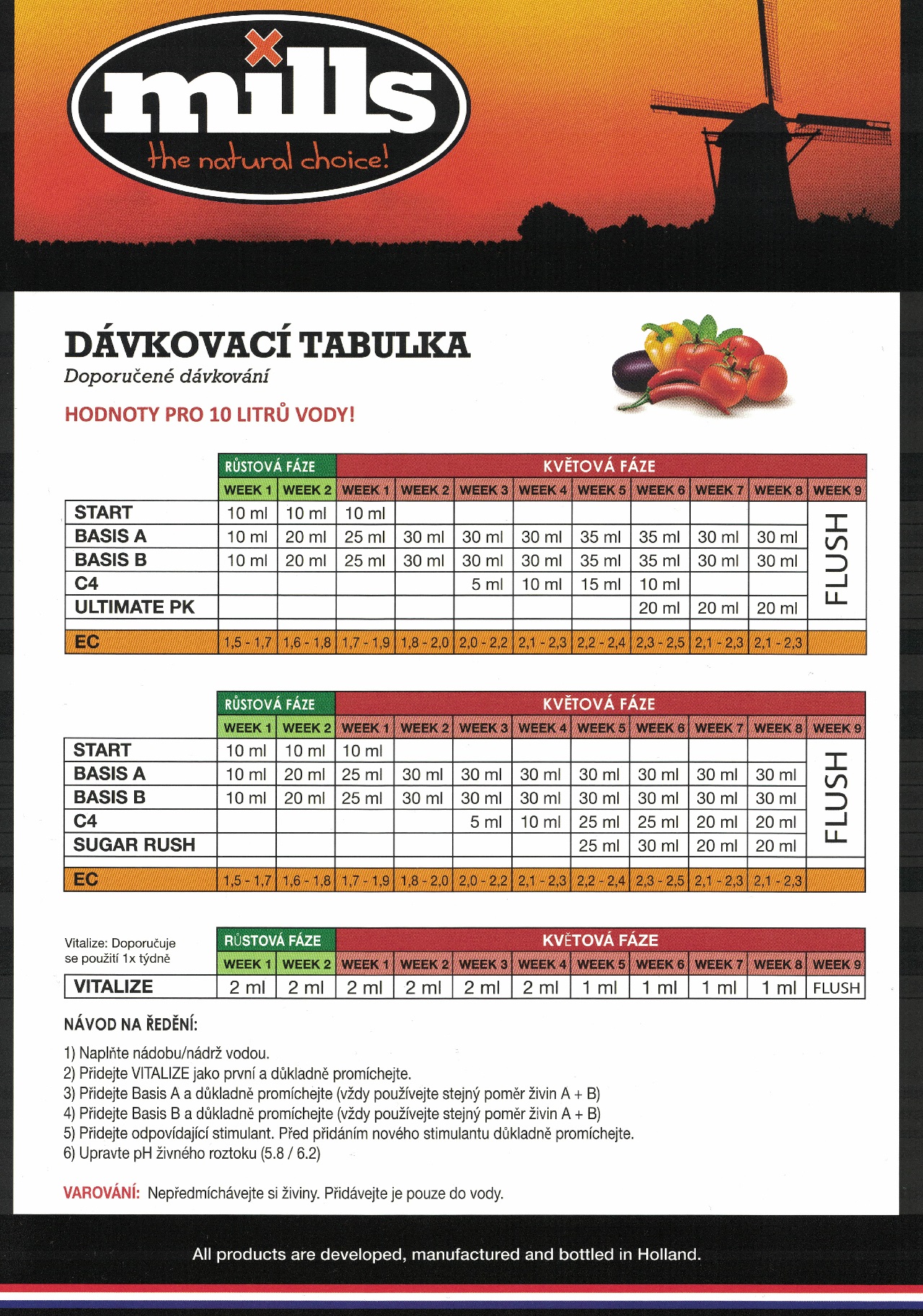
- The dosage of this bio-mineral nutrition is the same for all plant species and applies to all growing methods and substrates.
- It is best to combine Mills fertilisers with substrates of the same brand.
- Mills fertilisers should be dosed according to the table, taking into account the developmental stage the plant is in.
- The growth phase in the manufacturer’s dosage table is divided into two weeks, and the flowering phase lasts nine weeks, with the watering solution (water + nutrients) applied only until the end of week 8. In the final week of the growing cycle, it is important to carry out the so-called flush, or flushing. At this stage, do not add any of the standard fertilisers to the water, so that you achieve exceptionally healthy fruits with excellent flavour, as no residues of salts or other undesirable substances will remain in the harvest.
- An important role in dosing is also played by the electrical conductivity of the solution (EC), which needs to be measured. The last line of the dosage table, marked in orange, is dedicated to EC.
- The Dutch company Mills also gives growers unique supplementary fertilisers for higher yields and better-quality harvests.
- Mills START fantastically kick-starts young plants already during the early developmental stage.
- Towards the end of the growing cycle, definitely use Ultimate PK Booster for beautiful, colourful, fragrant flowers and juicy fruits full of flavour.
- Silicon is essential for plant development. With Vitalise, plants absorb it more easily than with any other product on the market. Therefore, do not forget to add it to the watering solution according to the dosage table.
- Mills C4 is a nutritional bomb for plants of all kinds. With the recommended dosage, you can also expect significantly higher yields!
- Dosing fertiliser according to the table and the manufacturer’s instructions minimises the risk of over-fertilisation. Nevertheless, we recommend continuously checking how the plants are doing during the growing cycle, as each of them has its own individual needs.
- Our TIP: For better watering and improved nutrient management, it is worth using filters and reverse osmosis units Growmax.
When should you add more and when should you reduce it?
- You may reduce the intensity of fertilisation for a while if you notice typical symptoms associated with an excess of nutrients. These are most often signalled by yellowing leaves, spots on their edges, or a white surface on the substrate.
- If you notice that, on the contrary, the plant has a nutrient deficiency, it is advisable to start fertilising a little more. If the plant is growing unhealthily slowly and its leaves are smaller than is usual for the given species, it is probably undernourished. In such a case, you can try increasing the intensity of fertilisation and monitor whether this has a positive effect on the plant and it begins to do better.
Mills info: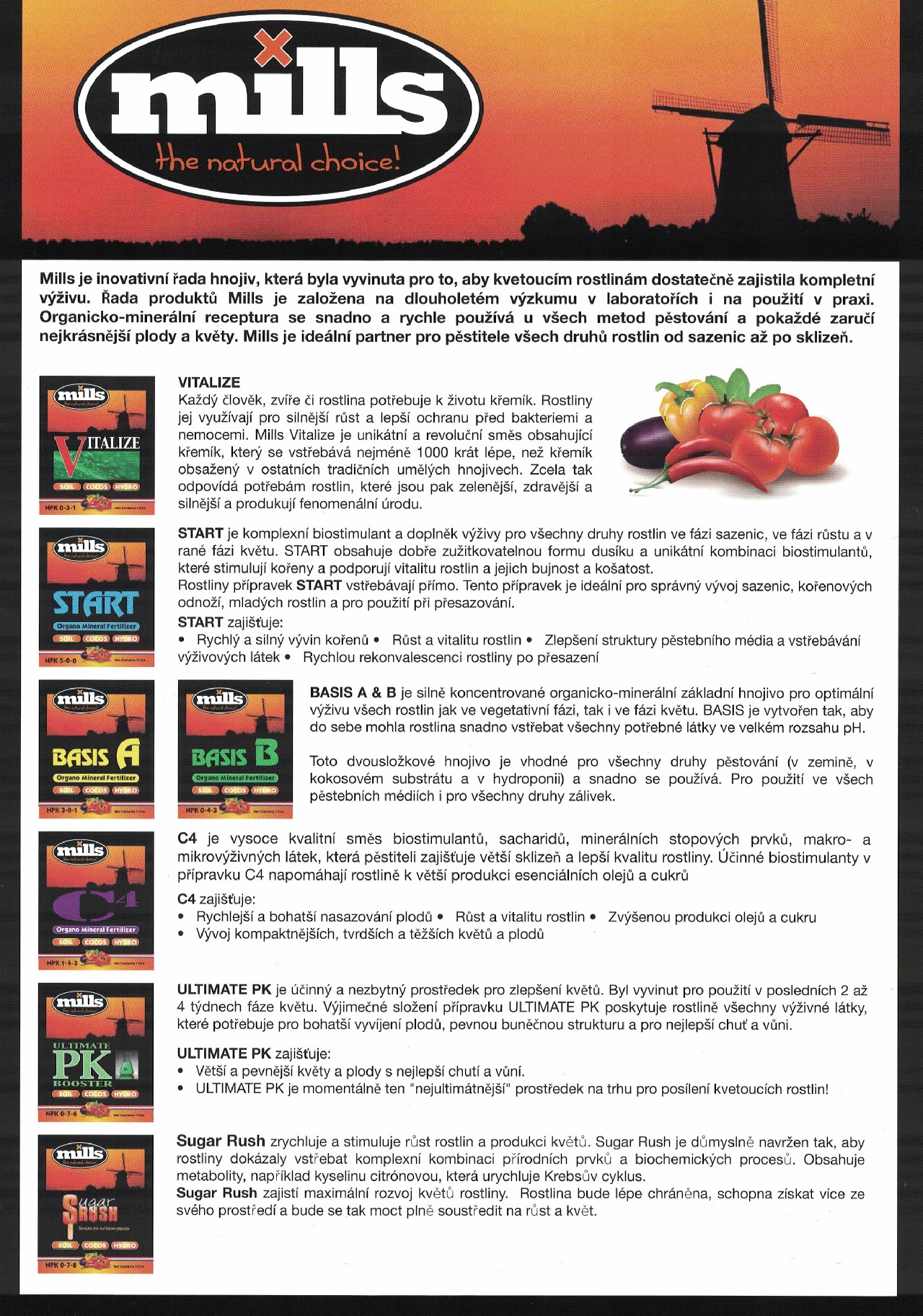
Products Mills here.
We will also be happy to answer any questions about fertiliser dosing at info@higarden.eu.