
Far-red spectrum: Effects on plants and its use in indoor growing
You may have come across sales articles highlighting the benefits of the far-red part of the light spectrum. Higher yields and a shorter flowering period are mentioned most often. Is this just marketing, or is there really something to far-red? We explain how the far-red spectrum affects plants, how to make use of it in indoor growing, and recommend the best far-red lights for your grow room.
Just as the human eye cannot see light with wavelengths that are too short or too long, plants cannot use the entire light spectrum for photosynthesis either. Light with wavelengths of 400–700 nanometres is photosynthetically active and is known as the PAR spectrum. Far-red refers to light with wavelengths of 700–800 nanometres. Although far-red has only a minimal effect on photosynthesis, it influences plant growth, flowering and daily rhythms.
The effect of far-red radiation on plants
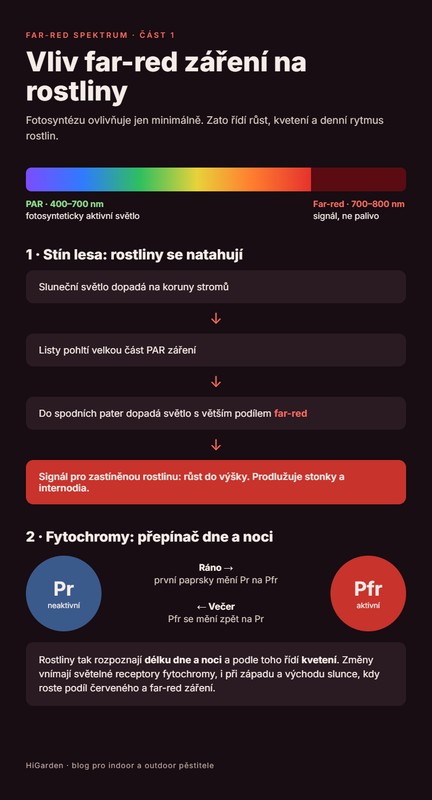 In nature, the light reaching plants changes according to the time of day and the surrounding environment. A forest is one example: sunlight has to pass through the tree canopy before reaching the plants growing beneath it. Tree leaves absorb a large proportion of PAR radiation, so the light reaching the lower levels contains a greater proportion of far-red.
A higher proportion of far-red light signals to shaded plants that they need to grow taller to reach photosynthetically active light. This is why plants respond to far-red radiation by elongating their stems and internodes.
The light spectrum also changes at sunrise and sunset, when the proportion of red and far-red radiation increases. Plants perceive these changes through light receptors called phytochromes. These exist in two interconvertible forms: Pr and Pfr.
In the morning, most phytochromes in a plant are in the inactive Pr form. The first rays of sunlight begin to convert Pr into the active Pfr form. In the evening, Pfr starts converting back into Pr. This balancing system enables plants to recognise the length of day and night and regulate flowering, as well as perform other functions.
Using far-red in indoor growing
Supplementary far-red lighting can be used in indoor growing to support photosynthesis, influence plant structure and regulate the light cycle.
Improving photosynthetic efficiency: Although far-red radiation is outside the PAR spectrum, this does not mean that it has no effect on photosynthesis. Far-red has been found to increase the overall photosynthetic efficiency of red and blue light. This phenomenon is related to what is known as the Emerson effect. In practice, this means that the right far-red supplementation can increase the amount of light energy a plant is able to use, thereby supporting faster biomass production.
Influencing plant growth and morphology: The most pronounced effect of far-red on plants is increased growth in length. Far-red supplementation can therefore stimulate plants to elongate their stems and internodes. This can be beneficial, for example, when growing compact cultivars with closely spaced nodes that are prone to low yields and moulds. Far-red can also be used when growing autoflowering varieties, which have only a limited growth period.
Far-red at the end of the light cycle: End-of-Day Far-Red (EOD-FR) is a technique in which plants receive far-red lighting for a short time at the end of the light cycle, just before the main lights are switched off. This mimics natural conditions at sunset and should cause phytochromes to convert more quickly into the inactive Pr form. Put simply, far-red light can help plants settle down to sleep more quickly.
Far-red lighting buying guide
If you want to experiment with far-red lighting in indoor growing, you can choose between individual LED bars, additional far-red lights and advanced systems with an independent far-red channel. Your choice will depend primarily on whether you simply want to extend the spectrum of your existing lighting or use far-red deliberately at different stages of the light cycle.
 SunPro LED Bars UV+FAR RED ADD-ON, 2x25W – The pair of SunPro supplementary LED bars, with a total input power of 50 W, offers a simple way to extend the spectrum of your existing lighting with UV-A and far-red radiation. Each bar has a power consumption of 25 W and is 115 cm long. Their sliding brackets make them easy to install alongside the main LED panel. They are an interesting option for growers who want to try the effects of supplementary spectrum without investing in new main lighting.
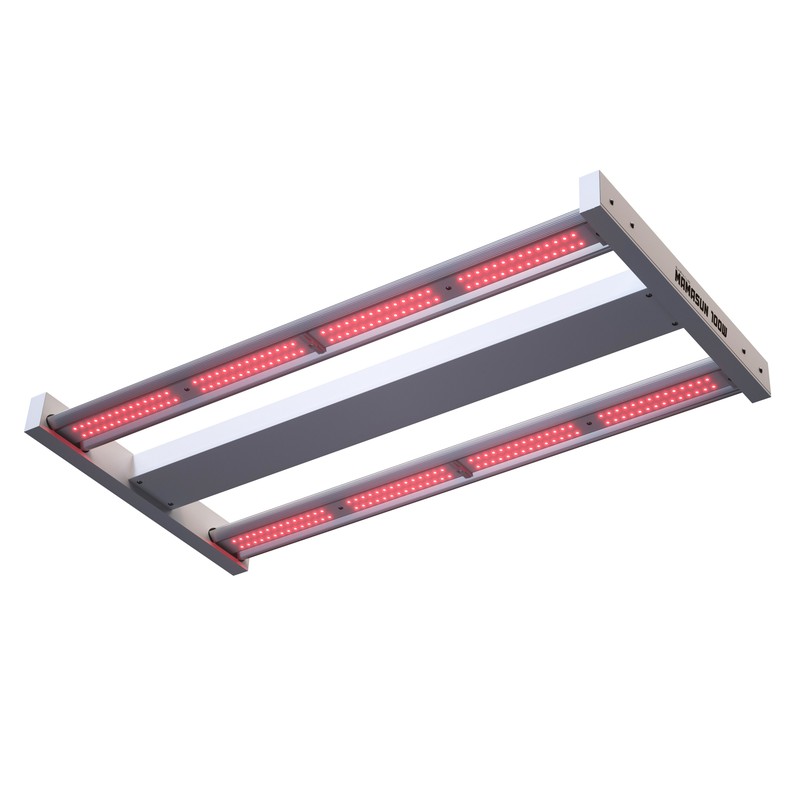 SunPro MAMASUN 100W LED - FAR RED – The standalone SunPro MAMASUN far-red light has a power consumption of 100 W and is designed to supplement the main lighting. The manufacturer designed it primarily as an addition to HPS and CMH discharge lamps, but it can also be combined with other lighting systems. It is suitable for growers who want a separate source of far-red radiation and to experiment with its use during the light cycle.
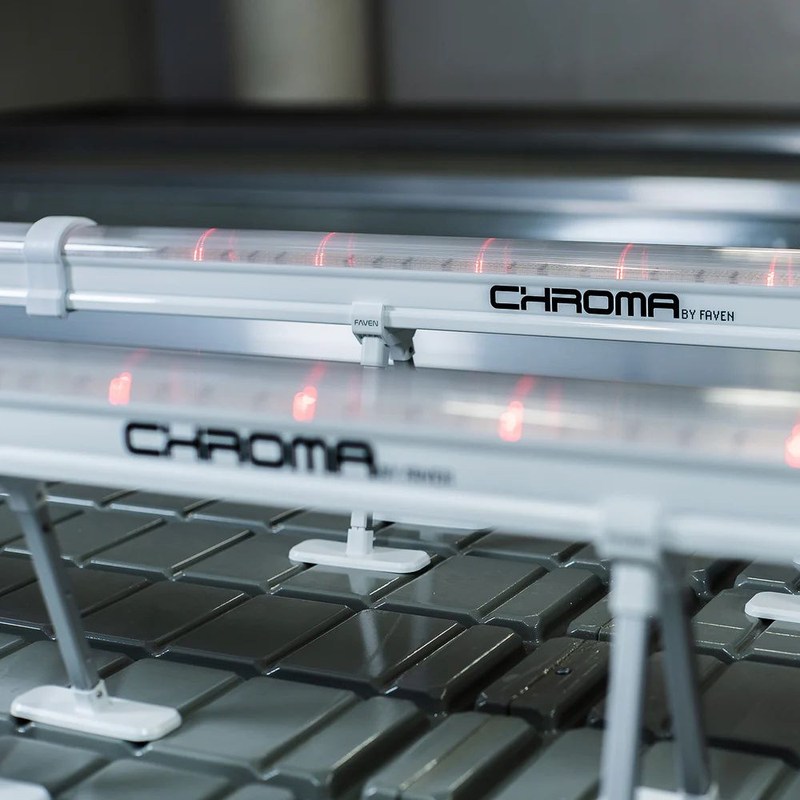 Faven Chroma LED 120W Under Canopy Light 3.0 – An advanced far-red supplementation solution that can perform a range of functions. Faven Chroma 3.0 can be used for under-canopy lighting and is equipped with an independent 15 W far-red channel. To make full use of its control functions, you will need to purchase the Faven CX2 Controller, which allows you to control individual light channels independently and programme lighting schedules.
Lumatek LED Bar Far-Red 50W – A supplementary bar for LED lights in the ZEUS range from Lumatek. The 50 W LED bar adds light with a wavelength of 730 nm to the spectrum.
 SANlight EVO 5-100 and EVO 6-120 – If you are still choosing your main grow lighting, full-spectrum LED modules from SANlight are also an interesting alternative. Their spectrum includes red and far-red OSRAM LED chips and extends up to 780 nm. Far-red is a natural part of the overall light spectrum in these lights, rather than an independently controllable channel. These lights therefore make sense primarily for growers who want high-quality main lighting with a broad spectrum, rather than those who need to time far-red lighting separately.
Our recommendation: If you want to use far-red only as a supplement to a standard LED panel, one of the additional SunPro or Lumatek bars will be sufficient. If you want to experiment with different lighting schedules, including separate lighting at the end of the day, look for a system with independent far-red channel control, such as Faven Chroma 3.0 with the CX2 unit.
For more advice and guides for indoor and outdoor growers, visit the HiGarden blog.