
Grow three plants indoors – Part 1: Introduction
Are you among those who are already impatiently waiting to legally plant three pots of green happiness at home? At Higarden we are also looking forward to this year’s New Year’s Eve celebrations a little more than in previous years, and our team is engaged in passionate debates about the best ways to grow. Three plants may not sound like much, but believe us, you can still produce a surprisingly decent yield from them. We have prepared a simple guide on how to legally grow and harvest three plants at home.
Indoor cultivation of plants takes many forms. What they all have in common, and what distinguishes them from simply growing houseplants or herbs on a windowsill, is the controlled environment of an indoor grow. This is a closed space where plants are grown under artificial lighting. Most home growers use for this purpose a growbox – grow tent made of fabric, where they hide the plants and all equipment such as grow lights and a ventilation system.
What size growbox should you get and where to place it?
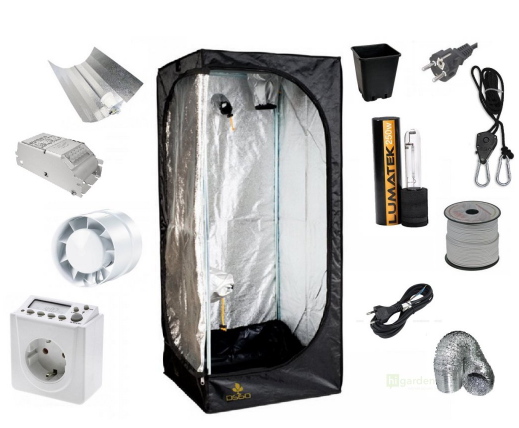 It is clear that the larger the growbox you get, the more you will be able to cultivate in it. We must emphasize, however, that in our case we are limited by law to no more than three plants and a maximum of 100 grams of harvested dry yield. For such purposes you can easily manage with a small to medium growbox with a growing area of 60x60 to 120x120 centimeters. A suitable place to put a grow tent is a well-ventilated room with a stable room temperature. Of course you need a power source and safe water suitable for watering.
You may be interested in: Choosing your first growbox
The beating heart of every growbox is the grow lighting. Its power and quality will be the main factors determining the yield from your indoor grow. As a rough estimate, most growers achieve yields of approximately half to one gram of dry yield per watt of fixture power. This, however, assumes that you are using quality LED grow lights and are taking good care of the plants.
You may be interested in: The most important criteria for choosing grow lights
An indispensable part of every indoor grow is the ventilation system. It consists of an exhaust fan placed at the top of the growbox, which removes the “used” air from the growing space. Connected to the exhaust fan is a carbon filter that neutralizes odors. Inside the growbox there should also be a circulation fan that simulates natural gusts of wind and prevents pockets of hot air from forming in the grow space.
You may be interested in: How strong a fan do you need
If you are starting with indoor cultivation, building and selecting the equipment for a growbox can seem complicated. Don’t despair! At Higarden we offer complete grow kits and ventilation kits. On the Higarden blog you will find useful guides and tips for growers, and our experienced salespeople will advise you on choosing all accessories.
Seeds vs. clones
As with most other plants, you can easily grow plants grown in controlled environments from seeds, which are legally available in brick-and-mortar seed shops as well as online. This applies to both industrial and highly potent varieties, because seeds themselves do not contain active substances and can be legally traded.
The other option is to grow plants grown in controlled environments from clones taken from plants that were selected for their unique traits. Plants grown from clones are identical copies of the mother plant, so the grower knows exactly what to expect. By contrast, growing from seeds is always somewhat of a genetic lottery, because each plant inherits a unique set of genes from its parents. The main argument for growing from seed is the current legislation, which limits growers to three plants.
You may be interested in: Plant cloning step by step
Advantages of growing from seeds
Safety: From a cleanliness perspective, seeds are safer than clones because they are unlikely to transmit pathogens or pests. In addition, seeds are easy to disinfect before germination.
Genetic diversity: When growing from seeds each plant is unique. On the other hand, clones are identical copies of the mother plant. Uniformity of plants can be advantageous, for example, for commercial large-scale growers of medicinal plants grown in controlled environments, however home hobby growers often appreciate diversity.
More developed root system: Plants grown from seeds have a deeper root system compared to clones, thanks to the main taproot that grows vertically directly from the stem.
Easy storage: Seeds are easy to store and remain viable for a long time.
Disadvantages of growing from seeds
Males: These plants are dioecious and have both male and female individuals. If you want to grow plants for flower without seeds, it is important to prevent female plants from being pollinated by male pollen. You can either grow from feminized seed or remove males from the grow space in time.
Longer growth cycle: Compared to seeds, clones are taken from already mature plants and once transplanted into a large pot they grow very quickly. Plants grown from seeds have an approximately 15–20 day longer growth cycle.
Lack of uniformity: The genetic uniqueness of each plant can be an unwanted factor for some growers. For those, it is better to grow from clones or opt for stabilized F1 varieties.
You may be interested in: How to choose seeds
In the next part our blog series we will choose the right substrate and look at how to germinate seeds of plants grown in controlled environments and care for seedlings during their first days of life.