
What are the ideal conditions for indoor growing?
Providing plants with a perfect environment should be the goal of every indoor grower. Only then will you efficiently use the electricity and other resources you invested in cultivation and achieve high yields. In the following lines you will learn how to create the perfect climate in your grow room.
The basic climatic factors affecting plant growth are temperature, humidity, VPD, light and air circulation. Your aim should be to keep all of these variables within optimal ranges throughout the growing cycle. Remember that these factors act like connected vessels: they influence each other and affect how plants take up water and nutrients. Therefore, if you change any climatic factor, you should also adjust plant watering and feeding.
Vapor Pressure Deficit (VPD)
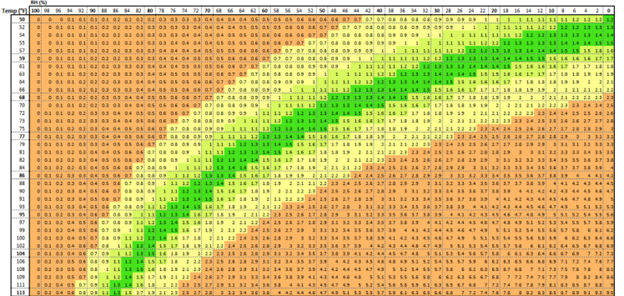 Water continuously moves through plants: roots absorb it and leaves release it as water vapor in a process called transpiration. This allows them to take up nutrients, cool themselves and drive metabolic processes and photosynthesis. The rate at which water evaporates from leaves depends on temperature and the humidity of the surrounding air. The difference between how much moisture the air can hold and how much it currently contains is called VPD (Vapor Pressure Deficit). At low VPD the air is saturated with moisture, transpiration slows and the risk of mold increases, while at high VPD transpiration speeds up, leading to higher water and nutrient uptake but also to a risk of overfeeding. An optimal VPD helps maintain a balance between water and nutrient uptake and healthy plant growth.
- The simplest way to achieve optimal VPD is to maintain a stable temperature in the grow space and adjust humidity according to the plants' age.
- How to manage VPD and advanced climate control.
Temperature
 Temperature affects the rate at which plants take up and process nutrients. Most plants perform best at temperatures between 20 and 30 °C. As temperatures fall, plants transpire more slowly, their metabolism slows, and growth stops completely at around 16 °C. With increasing temperatures plants can photosynthesize more efficiently, using more of the light energy and growing faster, with maximum growth reported at 30 °C and 1500 PPFD (Chandra et al. 2009). If temperatures rise above 30 °C, plants may not be able to cool themselves fast enough and growth can cease entirely at 32–35 °C.
- Measure the temperature in the grow space using a digital thermometer with an external probe, hung near new shoots, which are the most sensitive.
- Prepare your growbox for winter.
- High temperatures in indoor cultivation and how to avoid them.
Humidity
Ideal humidity for indoor cultivation depends on plant age, temperature and VPD. Keeping relative humidity low in the grow space is especially important during flowering and ripening, when plants are more susceptible to mold and botrytis. Generally, humidity should be around 70% during germination and rooting, 55–65% during the vegetative phase, and about 50% during flowering. Remember that overly low humidity speeds up transpiration, which will show on the plants as high water use, slow growth and lower yields.
- To increase humidity in the grow space use humidifiers, to reduce it use dehumidifiers.
- You can't do indoor cultivation without a digital humidity meter with a thermometer.
Light
