
What is vermiculite and how to use it?
On the market for products for indoor and outdoor gardening there are a wide variety of soil enhancers available, so it makes sense to introduce a proven helper for easier orientation that growers of all categories commonly use as an additive to substrates.
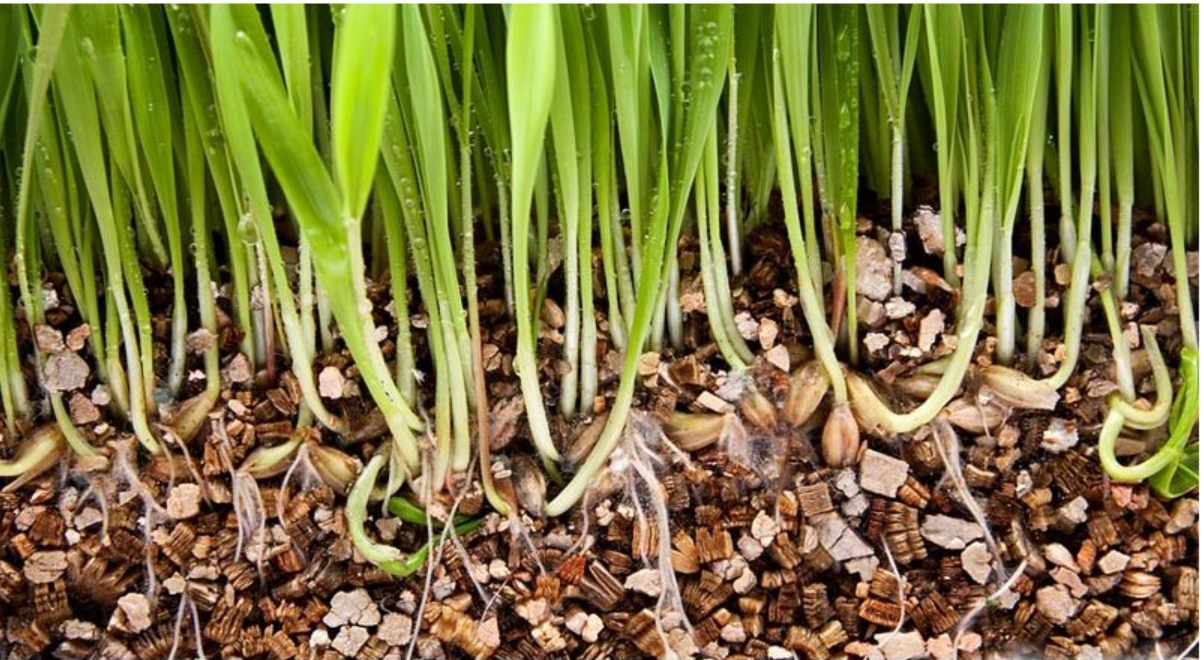
- First, let's answer the basic question from the title of this article: under the term vermiculite there is a natural mineral — a rock of mineral character that is mined worldwide.
- Traditional Czech product from Grena is made of vermiculite originating from southern Africa.
- Vermiculite has no scent. It neither smells nor emits odors. It is a pure mineral, intended for universal use and effective enrichment of soil, much like other common additives such as perlite, of which it is also a full substitute.
- The basic property of vermiculite is its considerable absorption of water, which it then gradually releases to plant roots. For this property, gardeners especially appreciate this sterile mineral during hot summer days.
- Vermiculite not only retains water well but also holds and gradually releases nutrients supplied to the soil through fertilizers.
- So when you add vermiculite to the soil, you ensure better fertilizer management and lower water consumption costs!
- Another advantage of vermiculite is its high resistance to mold growth.
- Another property vermiculite excels at is the ability to multiply its volume depending on temperature. In other words, it expands when heated. This property is used in the production process, when vermiculite undergoes an exfoliation process, making it sterile.
- Unlike similar mineral substances, vermiculite contains no asbestos.
- This rock is very popular in the world of gardening because in practice it replaces perlite, sand and peat at the same time. Among other things it enriches plants with magnesium, calcium, and a range of other trace elements.
- As mentioned earlier, vermiculite is especially useful in hot summer months. At that time it's not just dryness and heat that threaten plant root systems, but we must also not forget the intensity of sunlight. The same applies to indoor growing, for example in a growbox, where the growing space is filled with light generated by a high-intensity artificial lighting source. Because vermiculite acts as a natural insulator, adding it to the soil also helps prevent plant scorching, specifically protecting their roots.
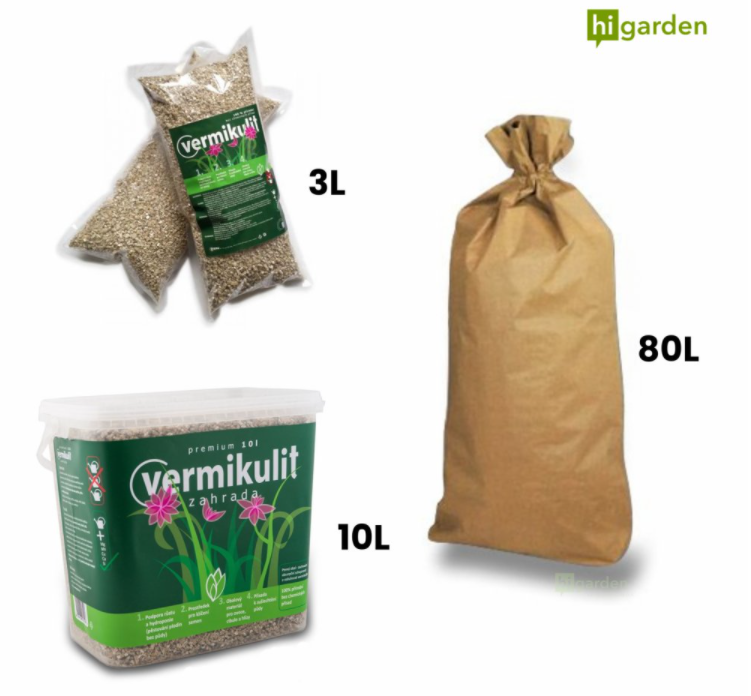
Practical uses of vermiculite:
- Additive to substrates for houseplants. If you grow houseplants, mix 30% vermiculite and 70% substrate.
- Seed germination. For germination, vermiculite can be used entirely on its own.
- Cuttings. Vermiculite can be used alone or as an additive to substrate intended for cuttings in a 1:1 ratio.
- Hydroponics. Vermiculite can also be used on its own in hydroponics. Alternatively, mix 75% vermiculite and 25% sand or pebbles.
- In greenhouses, planters or beds it is common to mix vermiculite into the appropriate type of soil at a 1:1 ratio.
- Fruit storage. Because vermiculite is natural and sterile, you can spread a 2–5 cm layer of vermiculite under freshly harvested produce.
- Vermiculite is generally divided into 5 particle-size grades. For horticultural use — although vermiculite also has a place in construction — the MEDIUM grade is the most widespread.
- Finally, it won't hurt to summarize the key advantages of mixing vermiculite into substrates:
- Protection of the root system against scorching and disease
- Lower costs for water and fertilizers
- No chemical additives
- Enrichment of soil with important elements (Mg, Ca, trace elements)
If you have any questions about using vermiculite, or if you need advice on choosing a suitable substrate, our experts are available at the well-known address info@higarden.cz.
We also recommend these products:
- Gardening vermiculite from Czech company Grena (from 99 Kč)
- BioNova Bio Soilmix 50L (from 279 Kč)
- Aerated plant pots HERCULES (from 49 Kč)
What to read next?
- SHOGUN: The best British fertilizers with an emphasis on research
- Trichoderma: The natural way to a rich, healthy yield
- WHISPERBLOWER: professional fans with unparalleled efficiency