
Odor Filter - How to Choose?
How to choose a odor filter and what to watch out for when choosing one? This is a common question and I will try to give you a few guiding points in this article to help you orient yourself.
What capacity should the odor filter have? - The capacity of an odor filter is given the same way as for fans and it is its ability to clean a certain volume of air per hour of operation, expressed in m3. That is m3/h. You always need a filter more powerful than the maximum capacity of the fan, otherwise the fan may "blow through" it and the filter will start to let odors pass even if the filter itself is otherwise perfectly fine. 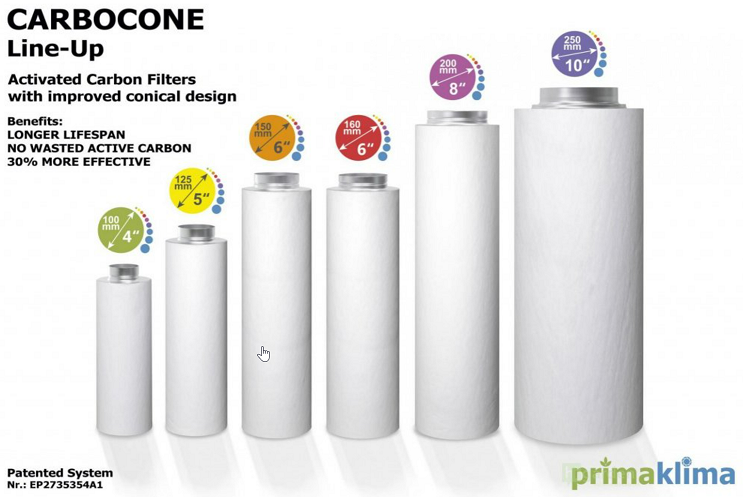
How much more powerful can the odor filter be? - theoretically there is no limit. If you use a filter with a capacity of 4000 m3 on a fan rated 800 m3, the assembly will work, but the filter will be huge and you will likely have space problems. In practice, filters with a capacity 10–50% higher than the maximum output of the fan used are usually used. For our example of a fan with an output of 800 m3 a filter with a capacity from 880 m3 to 1200 m3 is appropriate. The higher maximum capacity you choose, the longer the filter’s service life will be.
How long will my filter last? - This question is very difficult to answer; it is usually given in a range between 6 months and 2 years depending on the chosen filter line and its intended purpose. Overall, the filter’s lifespan is influenced by 3 factors.
- The first is the amount of activated carbon in the filter,
- The second is the quality of the carbon, and the way it is compacted so that the gaps are always the same and no air pockets form—manufacturers use special tools for this.
- The last and very important factor is the "dirtiness" of the air the filter has to clean. If the odor is strong and there is a lot of dust in the air that will clog the filter, you may need to replace the filter every few months; if the odor is mild, the filter can last significantly longer than its stated lifetime.
How to connect the filter? - Always pull air through the filter so that the fan draws in already cleaned air. Filters are also usually made so that on the outside there is a coarse fabric that captures large impurities - (this fabric can be replaced or even shaken out when the air is very dirty) and the air pre-cleaned this way is then filtered by activated carbon. If you connect the filter in the opposite direction, i.e. exhaust air through the filter, large particles in the air will clog the activated carbon and significantly reduce its lifespan, as well as the fan, which prefers to draw clean air.
Is it possible to replace the carbon in the filter and thereby extend its lifespan? - Theoretically yes, but since replacing the carbon is not just about emptying the used carbon and pouring in new carbon, it is also very much about placing the carbon in the filter so that no air pockets form and at the same time so that the carbon is not tamped down too much and the filter’s permeability and thus its real capacity are not reduced. When replacing activated carbon at home, you should therefore expect that the filter may work, but its parameters will be significantly worse than those of a new, originally manufactured filter.
We also recommend:
- You can find a wide selection of odor/carbon filters here.
- Prima Klima Carbocone filters with extended lifespan
- Quiet WHISPERBLOWER fans
What to read next?
- How to choose and assemble tent ventilation
- Prima Klima CARBOCONE: innovative filters with activated carbon
- Design HOMEbox Ambient grow tents combine style with functionality