
Most important criteria for choosing grow lighting
Grow lights are the focal point of every growbox or indoor cultivation room and it's worth paying sufficient attention to their selection. It's far from being only about electricity consumption — parameters such as light spectrum, efficiency and even coverage of the cultivation area are more important. Modern LED technology offers higher efficiency and the ability to tailor light conditions compared to older HPS lamps. In this article you will learn how to choose cultivation LEDs from the wide range to suit your exact needs.
Power draw isn't everything
In the past, growers focused primarily on power consumption expressed in watts (W) when choosing lighting. From this figure you can easily calculate consumption and get a rough estimate of how much light energy plants will have available for photosynthesis. Contrary to common belief, however, the fixture's wattage is not the best measure of how much light from the cultivation lighting actually reaches the plants. The real measure of a fixture's performance is the amount of light energy it delivers to the plants in exchange for the electricity consumed.
PAR (photosynthetically active radiation) is the abbreviation for photosynthetically active radiation, i.e. light of those wavelengths that plants use for photosynthesis. The photosynthetically active light spectrum roughly corresponds to what the human eye perceives as visible light (400–700 nanometers). The most effective fixtures for cultivation are therefore those that most efficiently convert supplied electrical energy in watts (W) into the most photons in the PAR spectrum measured in micromoles (µmol). The most efficient HPS grow lights emit approximately 1.4 to 1.8 µmol/W, the best LED lamps reach almost double the efficiency, up to 2.8 µmol/W. To produce the same amount of PAR photons, the most advanced LEDs require almost half as much electricity as HPS lamps.
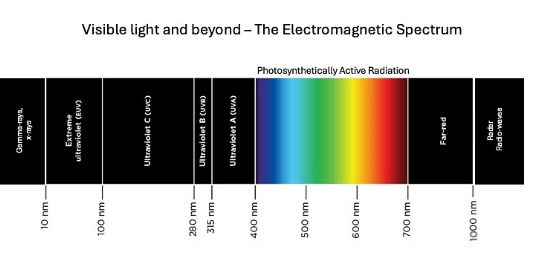
Each wavelength in the PAR spectrum (color of light) has a different effect on plants. Red and blue parts of the spectrum have the most pronounced effects on plant growth. Blue light stimulates plants to grow quickly and produce new leaves and stems, which is important during the vegetative growth phase. Red light supports flowering and ripening and encourages upward growth. However, plants utilize all colors of the light spectrum, including wavelengths outside PAR. For example, exposure to infrared and ultraviolet light can increase resin production and secondary metabolites. Generally, most LED fixtures emit light in the PAR spectrum, but you can also find specific models with UV and infrared wavelengths.
Consider the quality of the LED diodes
Manufacturers of LED cultivation lighting like to talk about the quality of the LED diodes they install in their fixtures. LED diodes are small semiconductor chips that convert electrical energy into light and also determine its wavelength. Quality LED lights use diodes with a power of at least 3 W. The lower the diode power, the lower the intensity of the emitted light. The standard for measuring light efficiency is micromoles per joule (μmol/J).
PPF (photosynthetic photon flux) is the abbreviation for photosynthetic photon flux, i.e. the amount of photosynthetically active photons that a light source emits per joule of electrical energy consumed. Some manufacturers also express PPF in micromoles per second (μmol/s). PPF for cheap LED grow lamps ranges from 0.8 to 1.5 μmol/J, while quality lights achieve up to twice that efficiency.
Besides PPF, the efficiency of a grow light can be expressed by the photon flux density (PPFD). This metric tracks the number of photosynthetically active photons falling on a given surface per second (μmol/m2/s). The older the plants, the more light they can tolerate and use effectively in photosynthesis.
- PPFD for seedlings: 200 to 400 µmol/s/m²
- PPFD for plants in vegetative growth: 400 to 600 µmol/s/m²
- PPFD for flowering stage: 600 to 1000 µmol/s/m²
- If you use CO₂: up to 1 000 µmol/s/m² during growth and up to 1 500 µmol/s/m² during flowering.
What else to remember when choosing LED grow lighting
Besides technical parameters, other factors play a role in choosing the right lighting for your cultivation room. Ideally, the light intensity should be uniform across the entire cultivation area you have available. For example, Maxibright Daylight PRO Full Spectrum LED with a power draw of 300 W will cover a cultivation area of 1x1 meter. The grow light SANlight EVO 3-60 with a power draw of 200 W will cover only an area of 0.6x0.6 meters, and for medium-sized tents it is better to use two models of this type at once.
Another aspect is the angle at which light from the LED diodes hits the plants. The wider the angle, the larger the area the LED diode will illuminate, but intensity and light penetration will decrease. The standard for most grow lights is LEDs with a beam angle of 120°. Additional features such as dimming, external control or spectrum adjustment are not necessary, but they can make the grower's life easier.
Our last tip is that you should always consider the price-to-quality ratio before purchasing grow lights. Although the cheapest equipment may seem like a great saving, it often offers lower durability and outdated technology and is not economical in the long run.
Unsure when choosing equipment for indoor cultivation? At Higarden we've got your back! Visit our cultivation blog or contact our expert retailers.