
How to Use Calibration Solutions and pH Meters?
Quality pH meter is a very useful and at the same time the most accurate available tool for testing pH values, which tell us whether a solution reacts acidic or alkaline. To be able to rely on the accuracy of your pH meter, you need to calibrate it often. For this purpose there are calibration solutions that not only help ensure correct measurement results but also extend the lifespan of meters.
First of all, it is important to emphasize that there is no universal answer to how often a pH meter should be calibrated. Every manufacturer offers a slightly different device and therefore a different procedure. We always recommend reading the manufacturer’s manual carefully. That is the best starting point. How often you calibrate also depends on the required measurement accuracy. Ideally you would calibrate every day, or more precisely, before each measurement.
Preparing the pH meter for calibration
- Turn on the pH meter.
With this first point we again refer to the importance of the user manual for every pH measuring device. Among other things, it will tell you the exact time required for the device to warm up to its optimal operating temperature. After you turn the pH meter on, it usually needs around half an hour to warm up. Only then can you begin calibrating it and subsequently start using it.
- Clean the electrode.
Remove the electrode from the storage solution and rinse it with distilled water over an empty waste beaker. Sometimes the electrode is very dirty; in such cases the manufacturer’s manual should again provide a safe procedure. After rinsing, gently dry the electrode with a lint-free cleaning wipe. Avoid excessive rubbing of the electrode, which has a very sensitive membrane. Remember to use separate containers for rinsing and for calibration of the pH meter (i.e. waste and calibration containers).
- Prepare a pH calibration solution or buffer.
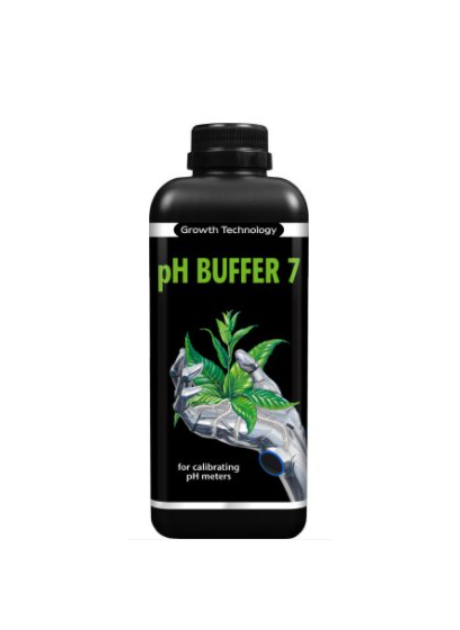
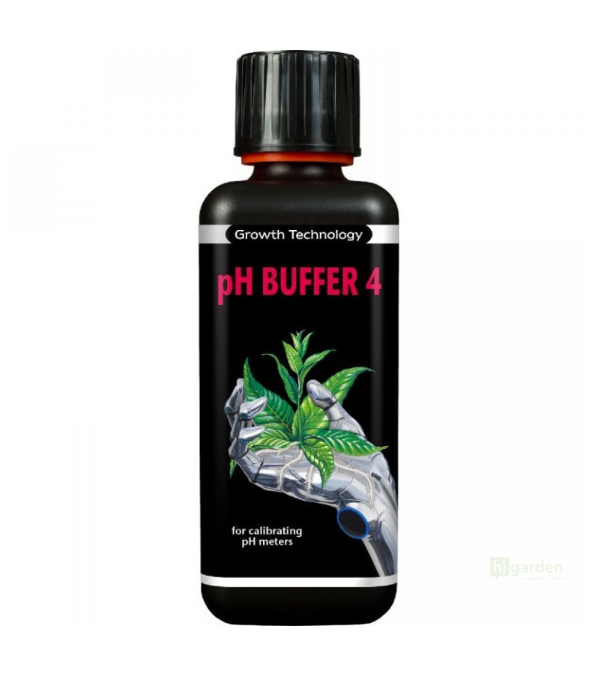
For calibrating a pH meter you will usually need more than one buffer. To ensure the proper functioning of the pH meter, two buffers are typically used because two different concentrations give different results. The first will be the “neutral” buffer at pH 7. The most sold is Growth Technology pH BUFFER 7. The pH of the second calibration solution should be close to the expected pH of your sample — that is either pH 4 or pH 9.21. Buffers with higher pH (9.21) are best for measuring alkaline samples, while buffers with low pH (4) are best for acidic samples. Considering that the correct substrate pH is between 6.5–7.0 and in hydroponic systems the optimal value is usually lower (between 5.5 and 6.5), growers will typically be interested in the first of the two variants, for example again the popular one from Growth Technology. Using two calibration solutions for pH 7 and pH 4 is called two-point calibration, which is more accurate than one-point calibration (only at pH 7).
pH values depend on temperature. Make sure the buffers reach the same temperature as the pH meter. Then pour the buffers into separate calibration beakers. Buffers should be kept in a calibration beaker for a maximum of two hours.
Calibrating the pH meter
- Place the electrode into the pH 7 buffer and start reading.
Press the “measure” or “calibrate” button and begin reading the pH once the electrode is immersed in the calibration solution. First wait for the pH value to stabilize (1–2 minutes).
- Set the pH.
When you reach a stable reading, set the pH meter to the buffer’s pH value by pressing the measurement button a second time. Setting the pH meter after the reading stabilizes allows for more accurate and fine-tuned readings. Stirring the buffer before measuring is not necessary, but if you do stir, remember to stir all other buffers and samples the same way.
- Rinse the electrode.
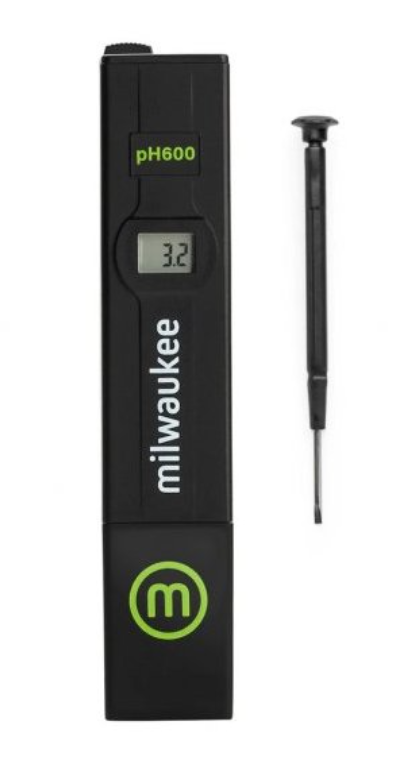
Proper use of the pH meter
- Place the electrode into the sample and start the measurement process.
Once the electrode is placed into the sample, press the measurement button and leave the electrode in the sample for approximately 1–2 minutes.
- Record the pH value.
When the reading stabilizes, press the measurement button. This is the pH value of your sample!
- Clean the electrode after use.
Rinse the electrode with distilled or deionized water. You can also carefully dry it with a lint-free cleaning wipe, but in practice it is recommended to simply blot excess droplets with the wipe. Using an ordinary tissue may create static electricity, which can interfere with the electrode’s reading.
What are other best practices for measuring pH?
- Regular electrode cleaning: Use quality cleaning solutions for pH electrodes to prevent incorrect calibration and measurement, because deposits gradually form on the measuring glass during pH measurements.
- Check the electrode from time to time: Inspect it for damage, because the glass sensitivity decreases over time. Even the smallest damage to the electrode will cause incorrect measurements, so pay proper attention to its condition.
- Full electrolyte level: Electrolyte flows out through ceramic junctions continuously. Low electrolyte level can cause inaccurate measurements, although this does not apply to non-fillable electrodes. It is recommended that the electrolyte level is at most 1 cm below the tip of the electrode.
- Proper electrode immersion: Always ensure that not only the sensing glass but also the reference junction of the electrode are properly immersed in the electrolyte. If not, simply add an adequate amount of sample to the beaker so that the electrode is fully submerged.
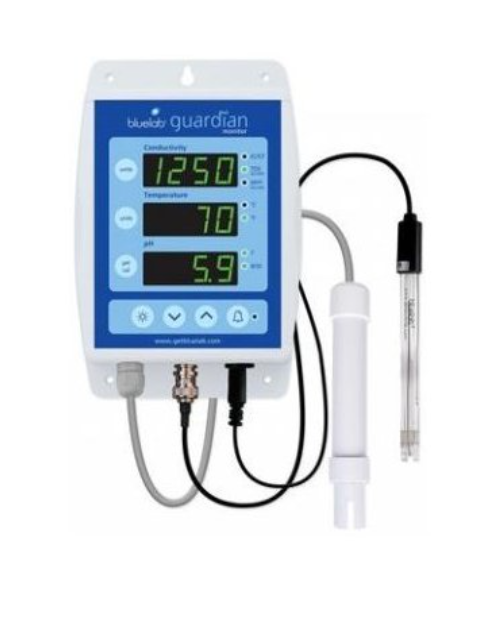
In most cases, the more sophisticated the pH measuring device, the more convenient and easier its calibration. An example is the combined pH/EC Bluelab Guardian Monitor, which features a handy pH calibration button.
In addition to pH calibration solutions, EC calibration solutions are also used. Customers typically prefer CONDUCTIVITY STANDARD from the brand Growth Technology or solutions from the traditional company Milwaukee. It should be noted, however, that while some pH meters need to be calibrated practically daily, the consumption of EC calibration solutions is significantly lower, because EC meters, unlike pH meters, last relatively long without calibration and some advanced EC monitors do not need calibration at all.
If you need any further information regarding calibration solutions and pH meters, we will gladly provide it, for example via the well-known email address info@higarden.cz. We look forward to your questions!
We also recommend these products:
- Aqua Master Tools P110 PRO, pH and EC meter and thermometer
- Milwaukee KIT - Martini pH55 + EC60
- Torus Hydro perfectpH capsules
What to read next:
- Which pH of nutrient solution to choose?
- Torus Hydro perfectpH: revolutionary pH stabilizer
- Do you know what VPD is? Discover the key to perfect conditions for plant development