
How to flush?
Flushing, also called a flush, is performed at the end of each cultivation cycle with the goal of harvesting high-quality plants free of fertilizer residues and other unwanted substances.
There are a significant number of plant flushing methods, so in today’s article we will focus on the absolute basics that every grower who cares about the final quality of their harvest should definitely know.
- The presence of salts or other residual substances in the substrate can negatively affect the development and taste of plants and crops.
- Besides the mentioned “cleansing” of plants or crops, important especially for future consumption and processing, flushing has another key purpose: stimulating plants to make maximal use of fertilizers.
- By skipping all nutrition during the last week of the cultivation cycle and flushing the plants with water only, preferably from reverse osmosis (see the separate article link below), the plant processes nutrients and any non-assimilated salts in its tissues. Simply put, the plant begins to “draw on its reserves.” This process can be compared to the human body, where energy that cannot be immediately processed is stored in fat tissue. Once food intake is limited, the body uses energy reserves from fat tissue.
- Use lukewarm water with a temperature around 24 °C for flushing. And as we mentioned above, it’s best to make use of the options offered to growers by reverse osmosis units.
- Water intended for flushing should have an adjusted pH in the range 5.8 – 6. These two boundary values characterize the pH range in which all nutrients dissolve as needed. If the pH is higher or lower, the nutrients precipitate out of the solution.
- The basic rule of flushing is simple. The more you flush a plant, the more nutrients are washed out of its root system.
- The nutrient concentration in the solution gradually decreases during flushing and this process can be stopped at any time. An example is leaving just a “pinch” of nitrogen, which is no longer sufficient for vegetative growth but is ideal and necessary for the further development of a flowering plant. Regularly check nutrient saturation using measurements of both soil and water.
- Timing plays a very important role in flushing. It is important to estimate nutrient reduction appropriately according to the current stage of flower ripening. If you restrict nutrients too early, it will negatively affect the final yield.
What you need for flushing:
- pH meter for measuring acidity or alkalinity of the solution.
- EC meter for measuring the electrical conductivity of the solution.
- TDS meter for measuring the efficiency of reverse osmosis (RO).
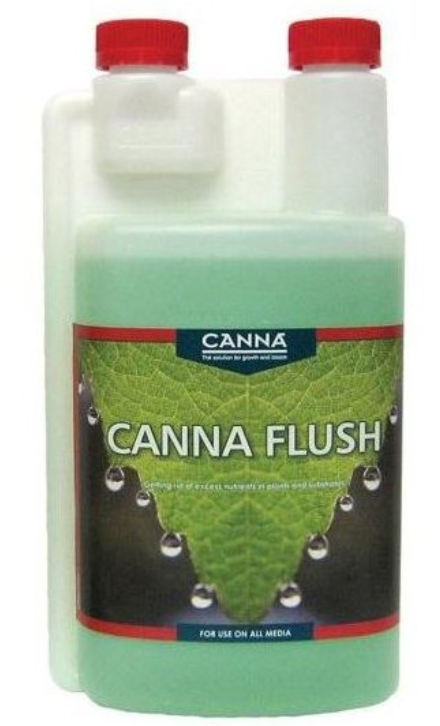
CANNA FLUSH
The well-known fertilizer manufacturer and substrates created a special additive focused specifically on flushing, thanks to which you can significantly increase the value and improve the taste of the harvested produce for a small cost. You will more easily remove unwanted salts from plants and their fruits, while beneficial bacteria or fungi remain unaffected. We recommend it!
3 basic flushing methods:
- Passive flushing: Nutrients from the soil are naturally removed by nature itself, helping the plant to ripen.
- Active flushing: The grower helps the plant ripen by removing nutrients (primarily nitrogen) from the soil.
- Flushing using flush agents: These agents contain various macro- and micronutrients, hormones, enzymes, sugars, etc. Plants respond promptly to the sudden change in the composition of the feed, in a way desirable to growers: they quickly concentrate all their energy on ripening the flowers instead of producing additional new flowers.
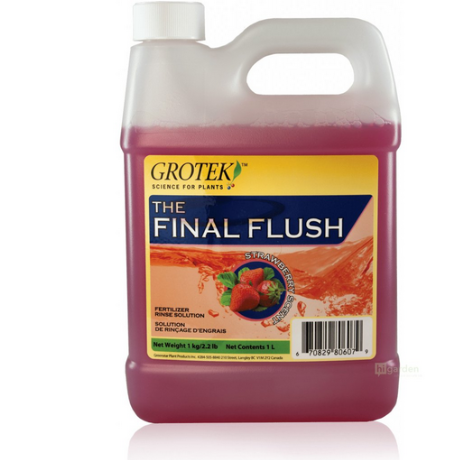
Whether you want to let plants ripen in pots in an indoor or outdoor environment, you can use the flushing product Final Flush from the brand Grotek about a week before the planned harvest. It is produced in several variants that allow the grower to influence the final taste and aroma of the harvested fruits according to personal preference.
If you have any questions about flushing, feel free to contact us at the usual address info@higarden.cz.
We recommend these products:
- Canna Flush (from 119 Kč)
- Milwaukee KIT - Martini meter pH/EC/TDS/Tem (2 819 Kč)
- Final Flush - various scent and flavor types (from 349 Kč)
What to read next?
- Reverse osmosis (RO)
- Which pH to choose for the nutrient solution?
- Electrical conductivity of the solution (EC)