
Choosing lighting for growing microgreens
Microgreens are an excellent source of vitamins, minerals and antioxidants, and growing them is not difficult. The quality of microgreens, however, largely depends on the type of lighting you use during cultivation. In today’s article we will advise you how to choose an LED grow light for microgreens and recommend a few proven items from our selection.
The basic prerequisite for healthy plant growth and development is sufficient light. Light drives photosynthesis, during which plants convert light into energy. While outdoors we can rely on sunlight, indoor cultivation often requires supplemental lighting. This applies both to larger fruiting species such as tomatoes or chili peppers and to microgreens, which have somewhat different lighting requirements than other plants.
Microgreens go through several growth stages during the cultivation cycle, and their light requirements change accordingly. It all starts with the germination phase, when seeds absorb water and begin to grow. During germination seeds do not require light, only a moist and warm environment. Once the seeds have germinated, microgreens enter the growth phase, during which they require bright light. Requirements for the amount and intensity of light vary, but in general we can say that microgreens need light in the PAR (photosynthetically active) spectrum at wavelengths of 400–700 nanometers. After a few days to weeks microgreens are ready for harvest and require no further light and can be stored in the dark, where their growth stops.
You may be interested in: Light spectrum and its effect on plant growth: Outdoor vs. greenhouse vs. indoor
Choosing suitable lighting for microgreens
Inappropriate or insufficient lighting can easily ruin your plans for juicy and healthy sprouts. Insufficient light intensity will cause plants to have elongated thin stems and stunted leaves. An unsuitable light spectrum will result in deformed growth, yellowing leaves or even a poor taste of the microgreens.
Light spectrum
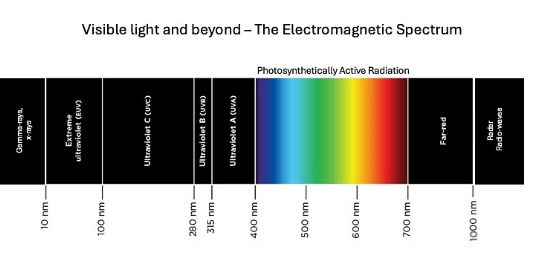
The light spectrum is the range of electromagnetic radiation that is visible to the human eye and is composed of light of different wavelengths. The visible spectrum consists of the colors observed in a rainbow: red, orange, yellow, green, blue, indigo and violet. Light with different wavelengths has different energy — red light has a longer wavelength and lower energy, while violet light has a shorter wavelength and higher energy. In addition to visible light there are also invisible parts of the spectrum, such as infrared radiation (with longer wavelengths) and ultraviolet radiation (with shorter wavelengths).
The light spectrum emitted by modern grow lights generally corresponds approximately to PAR wavelengths, but the proportion of individual colors in the spectrum will vary according to chromaticity, which is measured in kelvins (K). Based on the “temperature” of the light a grow light emits, we distinguish which type of plants and growth stage it is suitable for.
- 9000–11000 K (cool white) for germination and rooting cuttings.
- 5600–6500 K (blue) for growth and the vegetative phase.
- 2000–3000 K (red) for flowering, fruit set and maturation.
The ideal spectrum for microgreens is a light dominated by blue corresponding to 5600–6500 K, which promotes rapid growth while also containing enough red light that is important even for young plants.
Light intensity
Another metric that will influence your choice of lighting for growing microgreens is light intensity. The PPFD (photosynthetic photon flux density) value indicates how many photosynthetically active photons (in the PAR spectrum) from the fixture fall onto the plants. Together with the photoperiod, intensity is the variable that allows us to estimate how much energy the plants receive from light. The optimal light intensity for growing microgreens ranges between 200 and 400 µmol/m²/s, with a recommended photoperiod of 12–16 hours per day.
In a study conducted by researchers at the University of Florida, microgreens grown under low light intensity (around 50 µmol/m²/s) had lower yield and lower antioxidant activity compared to microgreens grown under high light intensity (200 µmol/m²/s). At the same time, microgreens grown under blue light showed higher antioxidant activity than those grown under light dominated by red wavelengths.
Higarden tips for lights for growing microgreens
GENT G-LED grow lights are energy-efficient LED fixtures specially designed for indoor microgreens cultivation. They offer a spectrum optimized for plant growth, especially in the vegetative phase. GENT G-LED fixtures emit a white-blue spectrum with a chromaticity of 6500 K, which is ideal for growing microgreens or other plants in early growth stages.
| Fixture / model name | Power | Chromaticity | PPF | Dimensions (LxWxH) | Description |
|---|---|---|---|---|---|
| GENT G-LED 42W | 42 W | 6500 K | 135-210 µmol/s | 95x4x3 cm | Fixture suitable for beginners or for growing a small amount of microgreens. |
| GENT G-LED 42W Linkable | 42 W | 6500 K | 135-210 µmol/s | 95x4x3 cm | Fixture for microgreens including a power cable for mains connection. Multiple fixtures of this type can be connected on one circuit. |
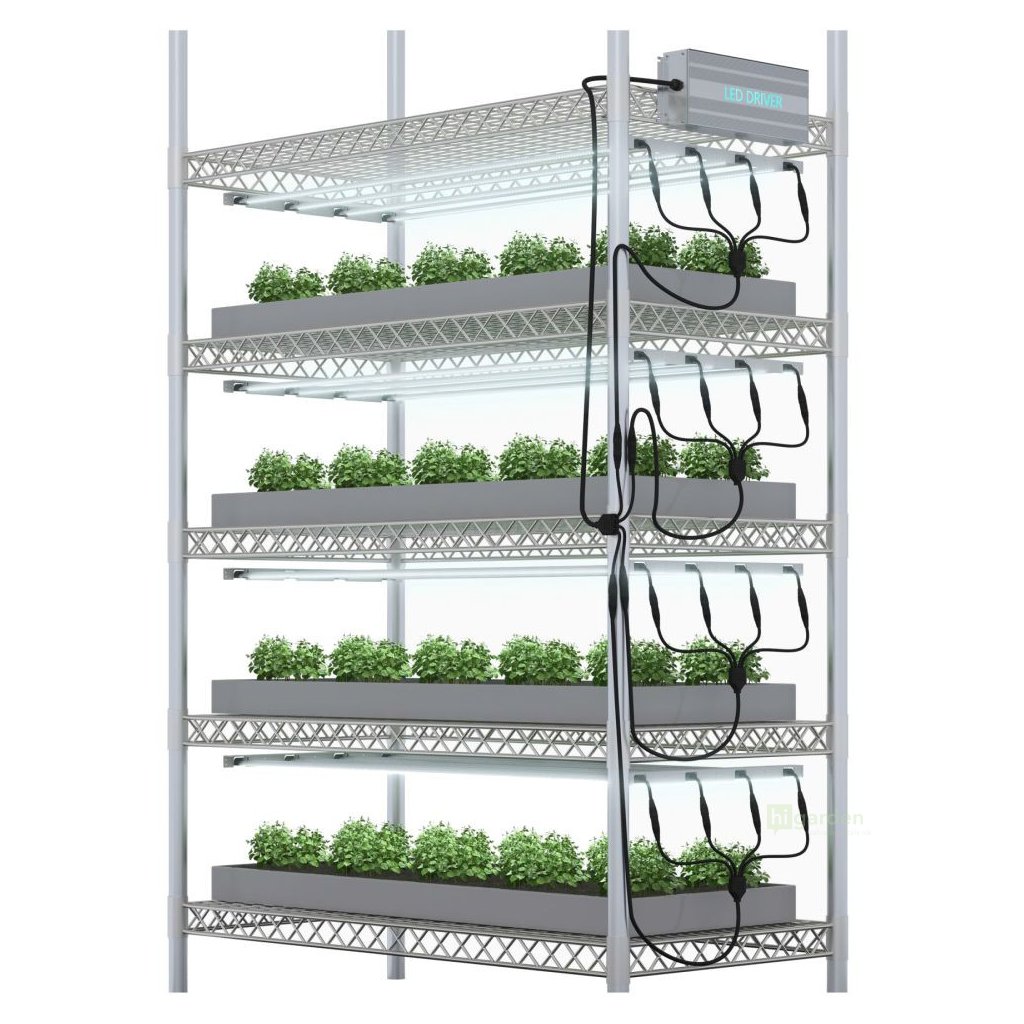
| GENT G-LED Microgreens Dimmer Rack Komplet | 100 W | 6500 K | 210 µmol/s | 120x60 cm | Complete set with a dimmer and wiring with 4 GENT LED segments and accessories for easy connection and installation. Ideal lighting for growing microgreens on a single shelf. |
| GENT G-LED Microgreens Dimmer Rack Komplet 400W na 4 patra | 400 W | 6500 K | 210 µmol/s | 4x(120x60) | 400W LED kit is mainly suitable for home microgreens cultivation on four tiers. |
Want to learn more about indoor microgreens cultivation and other modern gardening techniques? Visit our Higarden blog!