
Advanced climate control – VPD and transpiration
VPD (Vapor Pressure Deficit – difference in water vapor pressure) is an important factor for indoor growers that is closely related to air temperature and relative humidity; it affects plants' transpiration processes and their ability to take up water and nutrients. Proper climate and VPD management is essential for healthy growth and development of plants at every stage of their life. In today’s article you will learn why monitoring VPD is important for indoor cultivation.
Even small changes in climate can have far-reaching consequences for plant development during indoor cultivation, and VPD is a good example of that. Maintaining correct VPD values requires proper regulation of temperature and humidity and adjusting the grow-room climate to the age and type of plants. In the following paragraphs we will look at how VPD works, why it is important to monitor it, and how to achieve ideal conditions at each stage of plant development.
What is VPD
VPD is closely related to the parameters commonly monitored in indoor cultivation, specifically air temperature and relative humidity (RH) in the grow space. Air temperature affects its ability to hold water as vapor. Warmer air can hold more water than cooler air. Relative humidity indicates what portion of the maximum possible water vapor the air is currently holding. VPD expresses the difference between the amount of water vapor actually in the air and the amount it could hold at full saturation (i.e., at 100% relative humidity).
VPD is an important concept for understanding how the surrounding air affects plants' transpiration processes. The unit for VPD is pressure given in kilopascals (kPa). The lower the VPD value, the more saturated the air is with water, which limits plants' ability to evaporate water and slows transpiration. This leads to reduced water and nutrient uptake and creates a humid environment where molds, bacteria and other pathogens can easily spread. On the other hand, a high VPD value means the air in the grow space is very dry and can hold more water. In such an environment transpiration accelerates and plant roots take up more water and nutrients. However, too rapid transpiration forces plants to close their stomata, which are the pores on leaves used for gas exchange (primarily CO₂ and O₂) with the surroundings. Too high VPD can lead to nutrient burn and problems with water uptake.
Managing VPD
The exact VPD range can vary slightly depending on the species being grown, but the decisive factor is primarily the age of the plants. Generally, the younger the plants, the lower the VPD that is suitable for their optimal development.
- Optimal VPD range for seedlings and clones – 0.45 - 0.8 kPa Clones, seedlings and young plants do not have enough leaf area for rapid transpiration and require a humid environment. In the first weeks of plant life keep VPD at the lower end.
- Optimal VPD for vegetative growth 0.75 – 1.25 kPa During vegetative growth plants have enough leaves to transpire large amounts of water and thus take up more nutrients. The goal is to raise VPD as high as possible without causing stomatal closure and reduced CO₂ intake, which would slow growth.
- Optimal VPD for the flowering phase 1.2 – 1.5 kPa During flowering and ripening plants are robust and able to transpire large amounts of water, but flowers and fruits are sensitive to humid conditions. Increase VPD during the flowering phase to prevent water condensation.
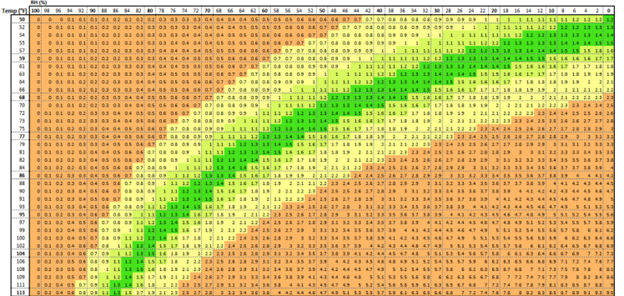
If you want exact VPD values for a specific temperature and RH, look for online VPD calculators (VPD Calculator).
Steps to control VPD
Because VPD depends on the current temperature and humidity in the grow space, the key to correct values is controlling these two variables. For example, when air temperature drops after lights-off, relative humidity usually rises and VPD falls, which limits transpiration rates. In practice this also means more condensation in the grow area. If you want to maintain the current VPD in such a situation, it is necessary to increase the air temperature in the grow room. Essential tools for controlling VPD include greenhouse heaters, dehumidifiers or humidifiers, and additional exhaust fans.
- Measuring temperature and humidity: Place a sufficient number of thermometers with hygrometers in the grow space. Make sure you measure not only at the tops but also in the lower parts of the plants.
- Temperature control: If the temperature in the grow space rises too high, increase the power of the exhaust fans, or consider installing air conditioning. In cooler conditions you can use greenhouse heaters. Use a sufficient number of circulation fans to prevent pockets of cold or hot air.
- Humidity regulation: If the relative humidity in the grow space is too low, use humidifiers. They are especially useful in summer and at the start of the growth cycle. Excessive humidity can be resolved with a dehumidifier, which is important particularly after lights-off or during flowering when the risk of mold is higher.
- Climate control automation: Climate control units (grow room controllers) automatically adjust temperature, humidity, ventilation and lighting based on set parameters. Some modern devices can also calculate and monitor VPD.
Looking for complete guides on indoor and outdoor cultivation or the latest gadgets for growers? Feel free to visit the Higarden blog!