
Lighting, Page 2
List of articles
Growing under artificial lighting: HPS vs. LED
In today’s article, we will look at the main differences between the most commonly used lighting fixtures, namely sodium discharge lamps (HPS) and the increasingly popular LED lighting. If you are serious about cultivation, it pays to keep up with the times!
A grow tent or any enclosed growing area requires a quality light source. Which is more suitable for you? Here are a few facts which should make it easier for you to decide how to light your plants in your grow box. And perhaps it is time for a change!
- LED diodes emit significantly less heat than classic HPS discharge lamps. As a result, even a smaller grow tent does not overheat inside.
- Another advantage of the lower heat output of LED diodes is that you can place these lights closer to the tops of the plants without concern, so you can grow, for example, taller plants than when using discharge lamps.
- Less heat can also be undesirable in the winter months, so the plants need a little extra heating. In practice, however, it is usually enough simply to reduce the intensity of air exchange, so you need a smaller fan and odour, or carbon filter. Lower air exchange also increases the efficiency of CO2 supplementation, if needed.
- LED diodes also stand out for their lower energy use, so if you are not trying to grow a one-off crop, but would like to harvest several times a year, over the longer term your investment in this technology will easily pay for itself.
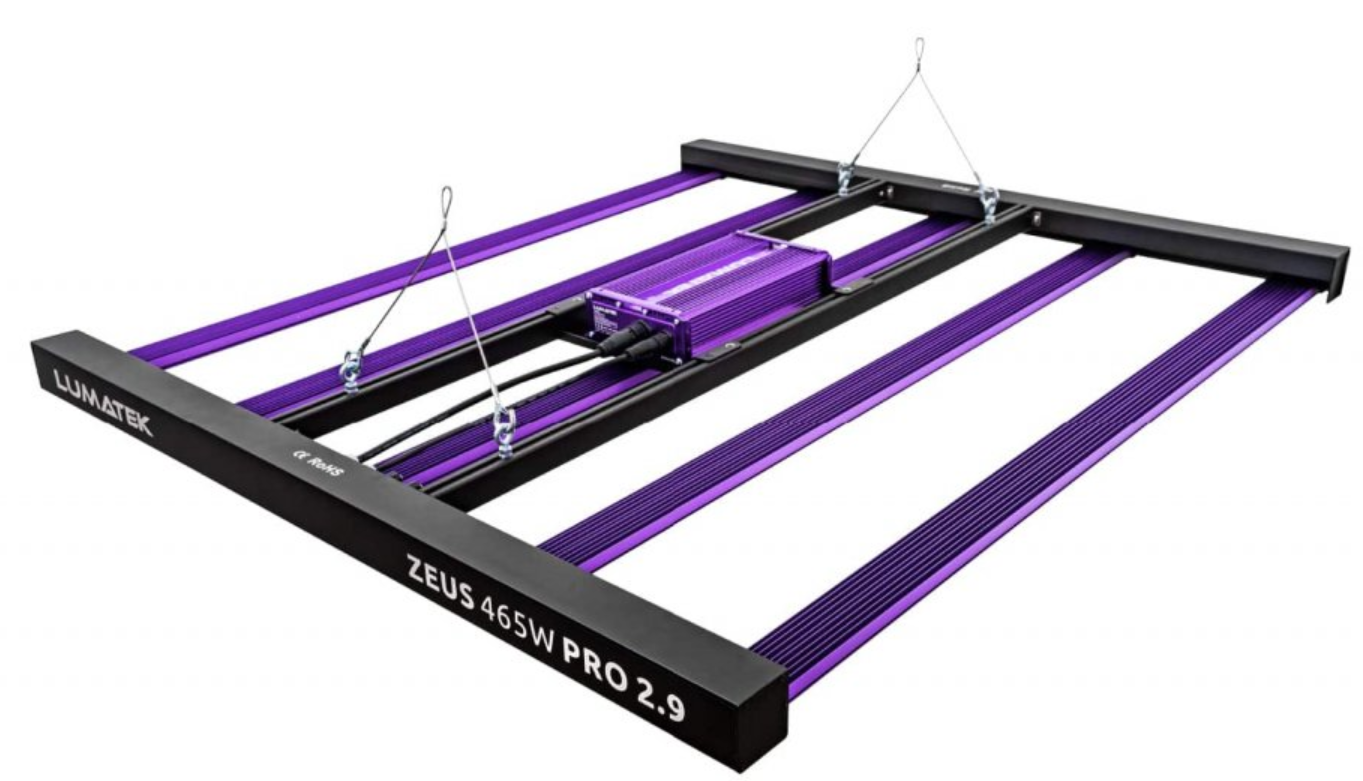
- A wider and more even spread of light is another benefit of LED lighting. For example, the renowned “LEDs” in the ZEUS and ATTIS series from Lumatek are a typical example. This still unbeaten pioneer in the field of LED lighting for indoor growers shines on plants from several angles at once. Not only is the light radiation used more efficiently, but the “LEDs” naturally prevent the formation of so-called “hot spots”, or areas with undesirable intensity of light reflected by the reflector. A reflector, an indispensable accessory for discharge lamps, is practically unnecessary with LED lighting. In reality, the need for a reflector is zero thanks to the excellent light spread directly from the source.
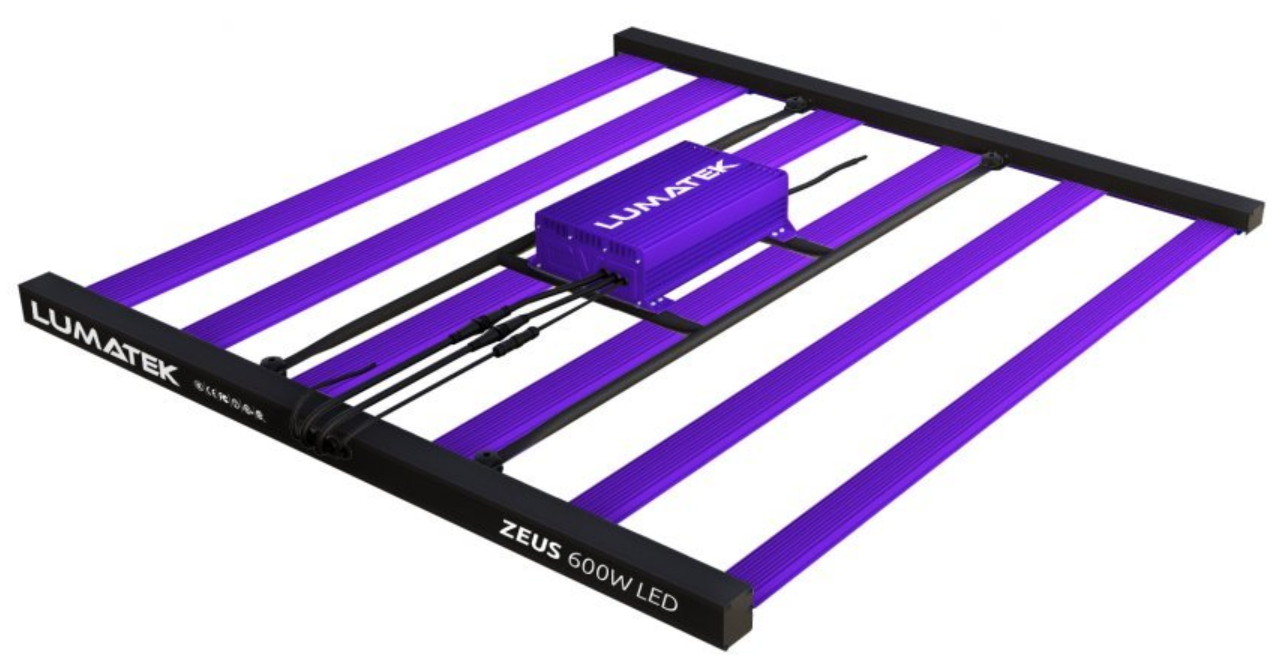
The unbeatable ZEUS 600W LED from Lumatek
- When using discharge lamps, if you try to regulate their output, cultivation practice leads to reduced lighting efficiency and also undesirable changes in the light spectrum. In addition, you need a ballast and a reflector. This does not happen with LED technology. As for the spectrum, “growing LEDs” perfectly imitate natural sunlight for all plants, which is of course soon visible in the harvest, whether you grow herbs, vegetables or fruit.
- For example, using a control unit, you can simulate morning and evening for the plants. This allows you to extend the time devoted to the formation of abundant flowers or juicy fruits. Especially if you are one of those playful types who like to experiment, LED lighting is the clear favourite for you, so that, as the saying goes, there are no tears from toys... With modern technology that is gentle on plants, you simply cannot go wrong, and you gain far greater scope for the individual needs that each plant has.
- LED lights are also a better choice for anyone who is just starting with indoor growing. You simply connect them and switch them on. LED diodes can therefore be used effectively even without experience. As your experience grows, new possibilities will gradually open up for making maximum use of all their additional features to increase yields without needing to change equipment!
- The difficulty in choosing LED lighting, unlike discharge lamps, is that manufacturers commonly measure the stated values in a highly incomparable way. The values are often very misleading. With discharge lamps, you simply choose according to wattage, which is fixed and that is that. With LED lights, you can no longer rely 100% on the “paper” values. We therefore recommend basing your decision mainly on experience with the given light. You can find this out from other growers, on the internet, or you can always ask us directly (info@higarden.eu).
- LED lights have always represented the best option for the vegetative stage of plants. However, in recent times modern full-spectrum lights have also surpassed HPS discharge lamps during the flowering stage.
We recommend these products:
- Lumatek ZEUS - unbeatable LED lighting for demanding users.
- Lumatek ATTIS - top-quality LED lighting offers excellent options at a favourable price, appreciated even by experienced growers.
- Viparspectra PRO Series P600 - quality LED basics, perfect for beginners!
- TLED VF - fluorescent tubes for supplementary lighting of plants in their immediate vicinity, suitable for example for the corners of a tent, where they light areas that the top light cannot reach.
- Discounted complete LED sets, from which everyone looking for a comprehensive solution for growing in a grow box using modern technology will choose.
What to read next:
100W Full-Spectrum Supplementary Light Lumatek BAR 2.9
The high-tech innovation in grow lights in the form of individual supplementary LED bars with a full light spectrum from the British brand Lumatek is described by the manufacturer in just two words – perfection and versatility. Through this article, discover the roots of these ambitious descriptions, which are certainly not exaggerated.
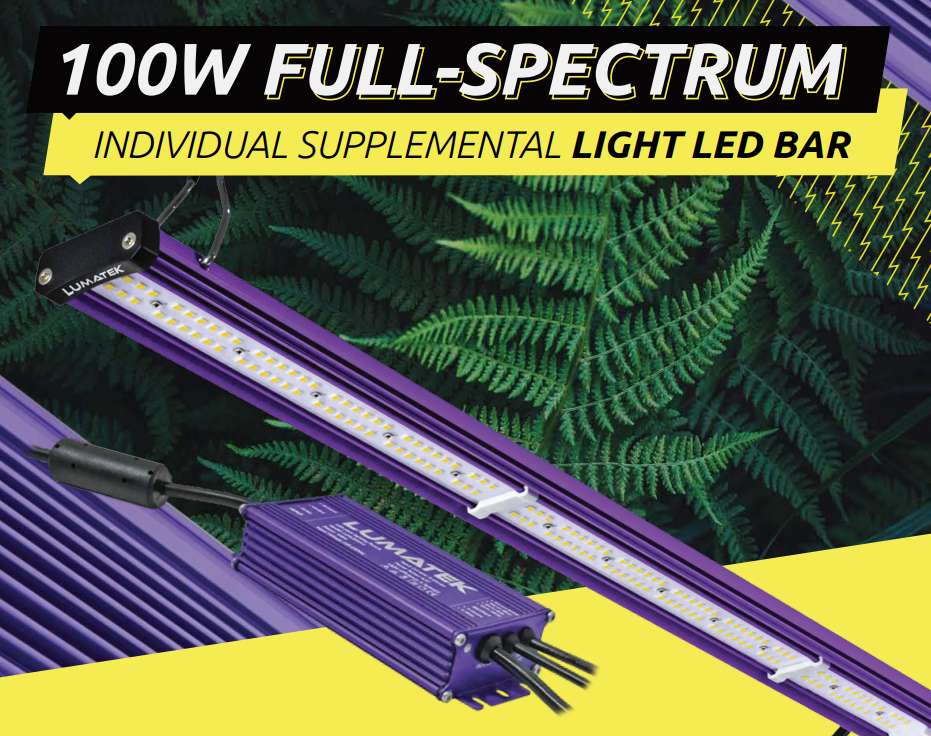
A very practical full-spectrum LED bar, made by pioneers in the field of LED grow lights, was developed for a wide range of applications within indoor plant cultivation and thus greatly simplifies the process of optimising herb growth for growers like no supplementary lamp before it. What practical uses does it therefore have?
- The main light source for clones and seedlings, or for seed germination in a propagator.
- Supplementary lighting for shaded areas in a grow tent or room.
- Support lighting on the top, bottom or side wall of the growing space.
You may already know that Lumatek is among the manufacturers that publish truly relevant data on the performance of their products, and the following parameters will certainly appeal to you as well:
- Very high ppF output for high intensity of 295 µmol/s.
- Very high efficiency of up to 2.9 µmol/J has no competition on the market in relation to the purchase price. The efficiency of this fixture will vary depending on the input voltage used.
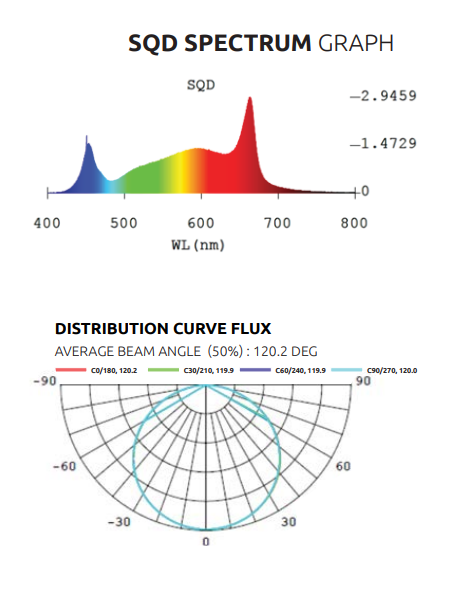
The following factors significantly contribute to the stated values:
- The latest generation of LED diodes from the upper bin (Osram, lumileds). These top-quality diodes not only produce a balanced light spectrum, but are also fully dimmable with 1% increments in light intensity without loss of efficiency for different cultivars or plant development stages.
- Another advantage of these supplementary fixtures is excellent passive cooling that reduces the temperature of the LED diodes.
- New Clear Glue housing technology on the LED bar. Together with the IP65 rating, this results in:
- 99% higher light transmission
- Prevention of light losses
- Extended LED diode lifespan
- Extra resistance to corrosion
- Water resistance
- Dust resistance

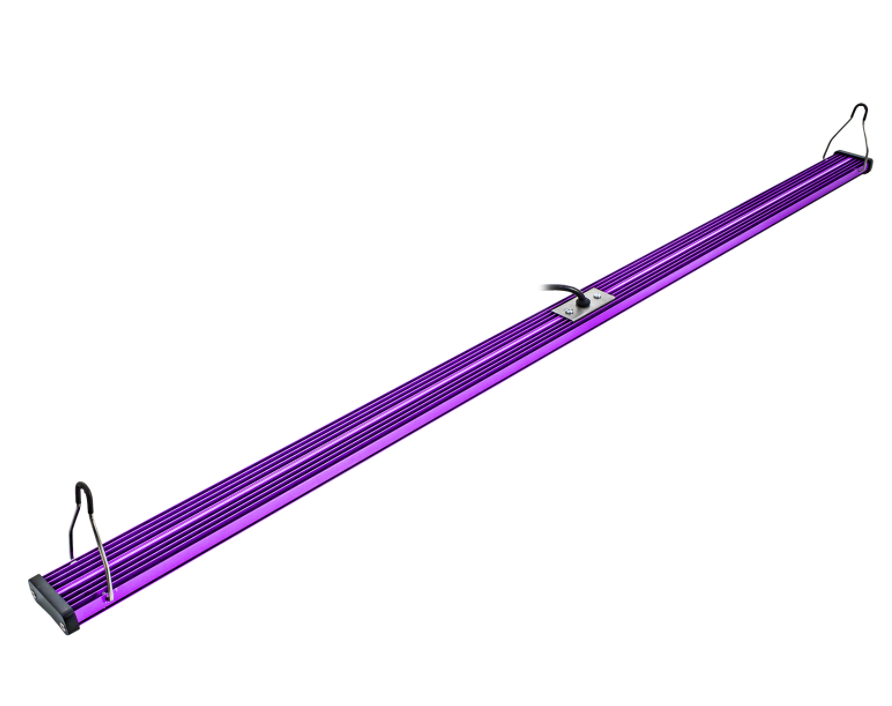
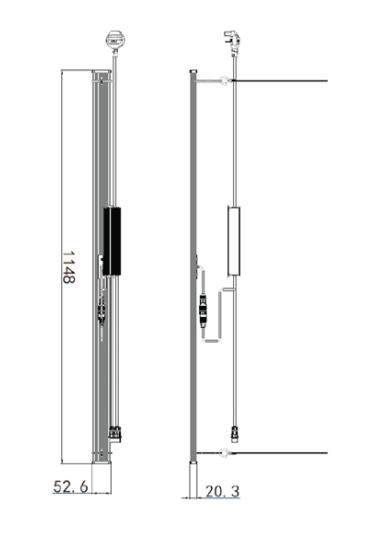
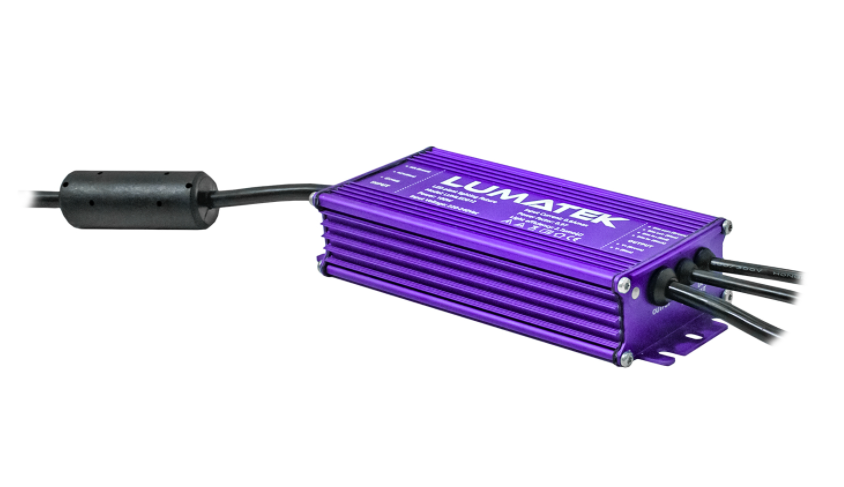
This individual supplementary LED bar therefore represents an exceptionally powerful standalone unit for growth and flowering and provides the same output of full-spectrum light radiation, which perfectly imitates natural sunlight for plants, as every bar from the latest fixtures in the ZEUS 2.9 series, but with the difference that it is a completely independent device with its own 100-watt remote driver included in the price. By driver here we mean the ballast for LED panels and bars. (You can also read a separate article Comparing TOP LED lights... about the ZEUS 2.9 series in comparison with the original ZEUS series.) The reliable 100W original Lumatek driver makes the full-spectrum bar a flexible and dynamic LED solution for higher yields.
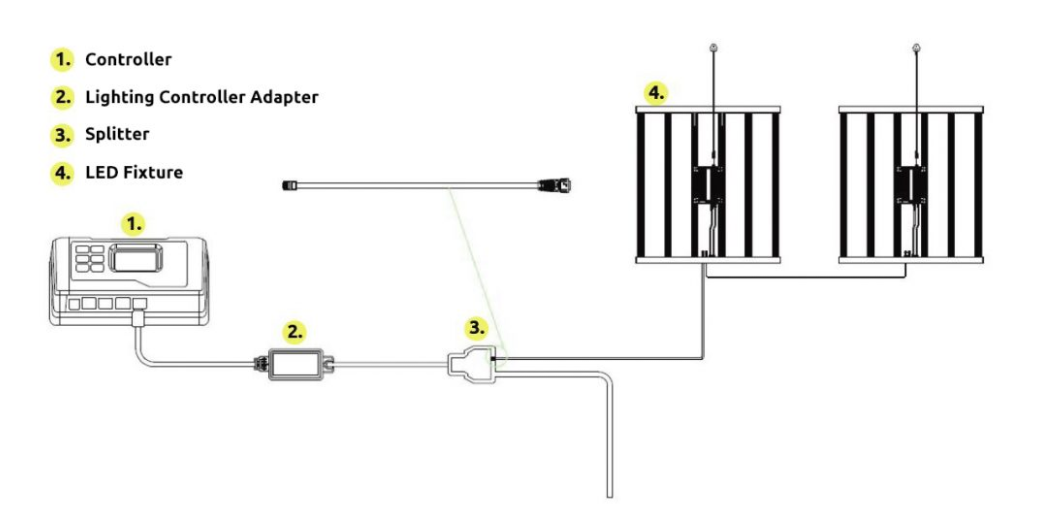
External control and compatibility with universal control systems
Lumatek LED Full-Spectrum 100W BAR 2.9 can be conveniently controlled only externally using universal 0–10 V controllers or the compatible DIGITAL PANEL PLUS 2.0 controller, which you may already have been using for some time to control the new fixtures in the ZEUS or ATTIS series, and which allows control of up to one hundred devices:
- Light timing
- Automatic dimming
- Safety temperature control
- Memory backup
- Popular SUNRISE and SUNSET modes

The British manufacturer provides a 5-year warranty on these fixtures 5 years. Naturally, exceptionally economical, cost-effective operation is a given. Simply put, and as we have come to expect from Lumatek, high performance with low consumption and long service life. Do not hesitate to ask us anything you would like to know about this new product at the well-known e-mail address info@higarden.eu.
We also recommend these products:
What to read next?
How powerful a discharge lamp should you choose?
The following lines will reveal the answer to one of the most common questions asked by beginner growers who use grow tents as a source of artificial lighting for plant cultivation and choose discharge lamps. Do you already know how many watts will be just right for you?
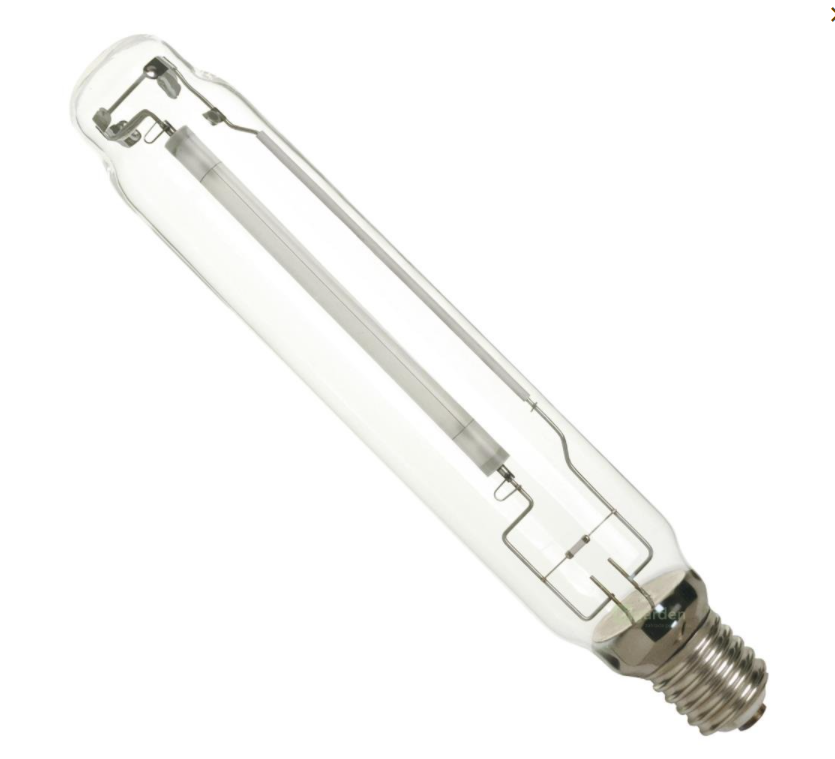
When it comes to the parameters of high-pressure discharge lamps (HID), the wattage of artificial lighting for your plants that will be adequate in relation to your growing space and plans can be estimated as follows:
- 70W discharge lamps are intended to illuminate a growing area of 35 x 35 cm with an effective reach of 25 cm.
- 150W discharge lamps are intended to illuminate a growing area of 45 x 45 cm with an effective reach of 35 cm.
- 250W discharge lamps are intended to illuminate a growing area of 60 x 60 cm with an effective reach of 50 cm.
- 400W discharge lamps already allow reliable coverage of 1 square metre of growing area with an effective reach of 80 cm.
- 600W discharge lamps are intended to illuminate a growing area of 120 x 120 cm with an effective reach of 1 metre.
- 1000W discharge lamps can easily cover a growing area measuring 150 x 150 cm with sufficient light intensity.
However, we must not forget that an important prerequisite for the above values is the use of a high-quality reflector in combination with a high-quality reflective material inside the growing space.
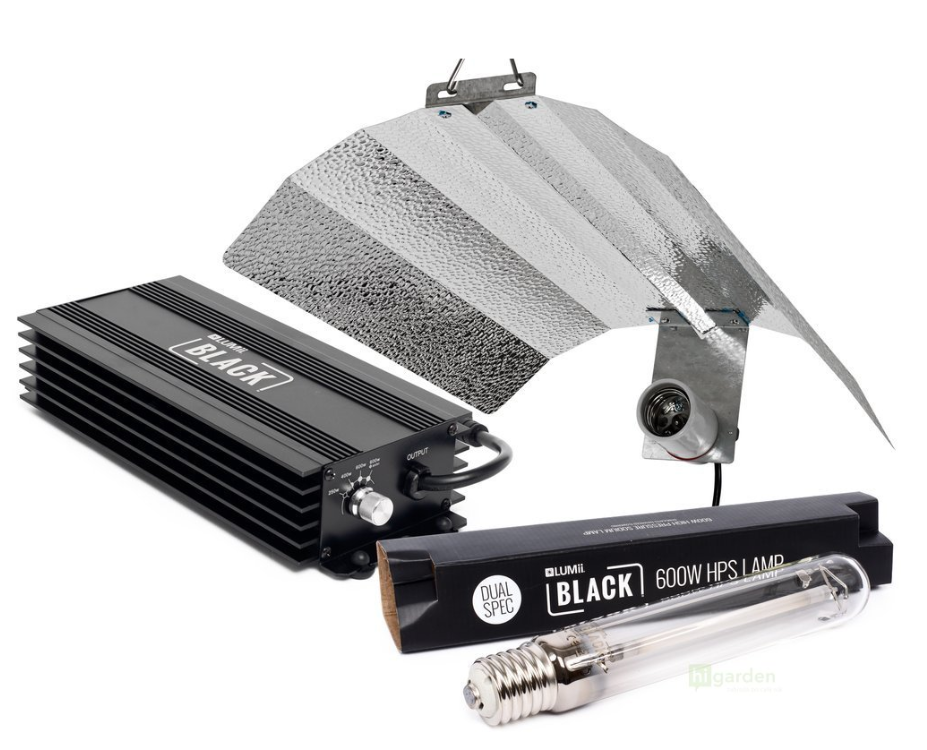
Our TIP: Take advantage of the exceptionally favourable price-performance ratio offered by the LUMii Black Digital Complete 600W KIT. Not only is it one of the bestsellers, but in addition to the lamp and ballast, the price also includes a high-quality reflector!
When it comes to wattage, there are also certain generally accepted rules among growers:
- Mother plants and cuttings (clones) require at least 20 watts (W) per square area. A square foot is equivalent to an area measuring 30 x 30 cm.
- During the flowering phase, stronger lighting is needed, namely 25 to 40 W.
- The greater the output of the grow lamp, the lower the wattage you need in relation to the growing area.
- Many growers solve the situation in an elegant way, namely by replacing one large lamp with several smaller ones whose wattage is the same in total. However, the difference between the two options, and at the same time the advantage of the second variant, lies in the even distribution of light. This is, of course, especially true for discharge lamps, because modern LED lighting takes care of even light distribution on its own.
- Keep in mind that the intensity of light radiation reaching the plants decreases rapidly as their distance from the discharge lamp increases. In practice, you will find that each discharge lamp has a certain reach that is sufficient for the formation of flowers and fruits as you would wish. And again, unlike LED technology, you must subtract a safe distance from this reach from the tops of the plants to prevent them from being scorched by the lamp! Here, the quality and power of the grow tent ventilation system plays an important role, in other words, how and how effectively heat is removed from the tops of the plants.
- The reach (see above) is also related to the height to which the planted plants will grow. It is necessary to bear this in mind. A perfect solution even for taller varieties, so that you can grow them without the risk of scorching their tops, is grow tents with an increased frame height, such as the Dutch Mammoth grow boxes HC or HOMEbox Ambient, marked with a plus sign.
If you need advice on choosing one or more discharge lamps, do not hesitate to ask us anything via the well-known e-mail address info@higarden.eu.
We also recommend these products:
- Spectromaster 250W HPS discharge lamp (449 Kč)
- Spectromaster 400W MH discharge lamp growth (649 Kč)
- Lumatek 1000W 400V DE Growth and Flowering HPS (2 599 Kč)
What to read next?
Which Light to Choose for a Grow Tent - Discharge Lamps, Part 1.
Are you planning to get started and do not know which light is suitable for which tent? Is just one enough for growth and flowering? And what about so-called dual lights? We will answer this and many other questions in the following articles.
The first criterion according to which you should choose the power of the discharge lamp is the size of the space, often the grow tent, which you plan to use for cultivation.
- 250W discharge lamps are suitable for a tent with dimensions of around 60x60 cm. You can take 50x50 cm as the minimum, and in a tent larger than 80x80 cm, 250W is too little and you are "wasting space".
- 400W discharge lamp is ideal in a tent of around 80x80 cm - in a tent under 70x70 cm, you will already not know what to do with the heat. There will be too few plants to make use of so much light. On the other hand, in a 100x100 cm tent you will already be looking at a 600W discharge lamp, and from 120x120 cm a 400W one is unnecessarily weak.
- 600W is a discharge lamp with the best price-performance ratio not only in terms of its own price/Watt output, but also because the necessary accessories such as the ballast are not much more expensive than the weaker variants. This light is ideal for space dimensions of around 100x100 cm - 120x120 cm. The size is already sufficient for proper extraction, and the plants can make use of all the light from the discharge lamps. Also, all accessories are usually limited for use with discharge lamps up to 600W.
- 750W professional discharge lamps usually used for special sets from manufacturers in the USA. The tent size is similar to that for 600W discharge lamps. They are usually supplied as a set with a ballast and reflector, and the recommended tent dimensions range between 100x100-130x130 cm, and I would definitely not recommend putting them into smaller spaces.
- 1000W are already professional discharge lamps and are suitable for experienced growers; the equipment is usually more expensive (but given the efficiency, it can easily pay off in the long term, as for example you only need one reflector, one cable, one timer socket, etc.), as most common active components are manufactured with a limit of approx. 690W (3A at 230V for those familiar with electricity). It is necessary to pay attention to which components you use so that they are sufficiently powerful. As for the tent, we recommend them for tents from 140x140 cm to approx. 160x160 cm.
- 1200W - this is a set of 2x600W, with which you illuminate twice the area as with a 600W discharge lamp, i.e. 200x100 cm - 240x120 cm.
- 2000W+ these are sets with multiple light sources, usually multiples of 600W or 1000W, and the area they can illuminate is always multiplied by the number of sets used. ;-)
In the next part, we will look at the differences between MH and HPS discharge lamps, and you will also find a tip on how to use the energy from discharge lamps to the maximum!
What Is Reflective Film and Which One Should You Choose?
Light in the growing area should certainly not fall anywhere other than on the plants, so that they can grow and flower intensively thanks to it. Reflective films are therefore one of the most important tools for growers engaged in indoor plant cultivation to achieve a massive harvest in the shortest possible time. Which film is best? You will learn everything in the following article.

You may think that a good reflector is enough for perfect light reflection in the growing area. Yes, a reflector will help you direct the light flow as needed, so you cannot do without a quality shade, but in addition to the direction of the light, it is also necessary to deal with the intensity with which it falls on your plants.
Walls, floor and ceiling – light in the growing room is reflected there through the reflector. Each time it hits these surfaces, losses in light intensity are inevitably associated with it. And that is, of course, something we do not want. That is precisely why these surfaces are lined with reflective film.
Let us summarise what reflective film is good for:
- You make maximum use of the light source in the growing area.
- Thanks to reflective film, more light falls on the plants and its rays also reach shaded areas, where larger or smaller parts of the plants usually suffer from a lack of it, which is why supplementary lighting is also used for their supplementary lamps.
- Reflective film also protects plants from top burn.
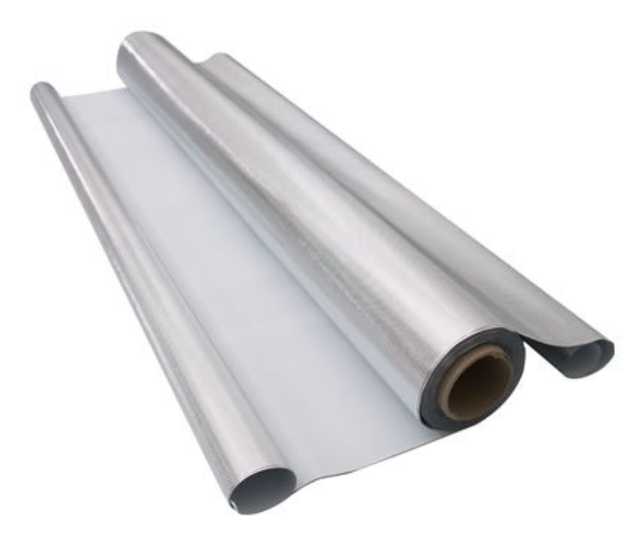
Diamond reflective film ECO is available in our range at an unbeatable price.
We will now look at how the individual reflective films differ from one another based on the production materials and their properties:
- Black-and-white PE film is the basic type of reflective film and, as the name suggests, consists of two layers, with the white one reflecting light (reflectivity approx. 90%) to harder-to-reach places and the black one absorbing it. This also clearly determines its placement on the wall of the grow room, with the white side facing inwards and the black side facing outwards. The advantage of this type of film is its low price and decent light reflection. The disadvantage is its lower ability to diffuse light evenly, as more advanced types of film can do.
- Silver films reflect light more than half as well again as the black-and-white film above, so your plants make use of 50% more light. Silver film is easy to work with, but again it is characterised by a lower ability to diffuse light evenly. It is a durable material resistant to creasing and wear, easy to maintain and also completely non-toxic, whether you choose the REFLECT-A-GRO, MYLAR or ECO version.
- Diamond films are available in our range in two versions. The A-GRO version will of course do a better job, but you will not go wrong with the cheaper version either, which is the diamond film ECO. What is the difference compared with silver films? It is the ability to diffuse light evenly. By using diamond film, you will therefore not only ensure that your plants make use of more of the light radiation from the discharge lamp, but the lighting will also be even, which is an added value that will certainly be reflected in the final yield. The disadvantage may be maintenance, as the film needs to be washed and polished with a dry cloth.
- ORCA are Canadian-made films with a unique surface topography formed by fibres of high-density specialised reflective plastic. The white colour of the film ensures a high standard in both factors mentioned above, namely reflectivity and even light diffusion. ORCA film is also much easier to clean than diamond film. Simply wipe it with a damp cloth and that is it. The main advantage is the Canadian manufacturer’s promise that by using ORCA film you will significantly reduce growing costs, as you can afford to use a discharge lamp with lower output for the designated growing area.
We recommend these products:
- ORCA Grow Film ™ - reflective film - TOP film on the market, nothing more needs to be said.
- Diamond film REFLECT-A-GRO - unbeatable price-performance ratio and at the same time the best-selling reflective film in our range. A great choice for everyone!
- Diamond reflective film ECO - once again an excellent price-performance ratio. The cheaper version of diamond film still offers 99.9% light reflection and is easy to wash. It is also available in our e-shop at an exclusive price!
- Silver film REFLECT-A-GRO - a luxury non-flammable film offers 50% better light reflection than ordinary black-and-white film and also approximately 22% better reflection than MYLAR film.
Now you know why reflective film is important and perhaps also which film to choose. Also consider whether it is more worthwhile for you to buy at the price per metre, or to buy an entire roll. If you are still unsure, we will be happy to advise you on light reflection at the well-known address info@higarden.eu.
What to read next:
What do I need a ballast for?
Many people ask us about the differences between magnetic and digital ballasts. Sometimes they also ask what they are for at all. We have therefore tried to answer the most common questions:
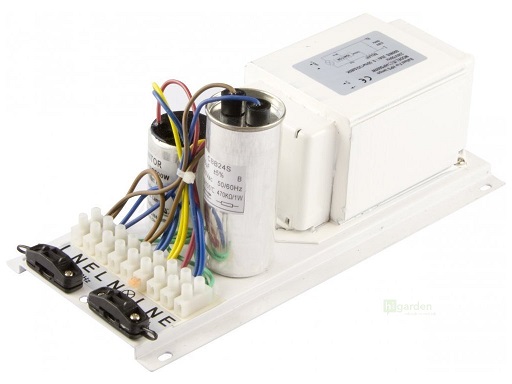
1) Do I need a ballast for all discharge lamps? - Yes, there is no HPS, MH or CMH discharge lamp on the market that does not need a ballast, regardless of whether its power is 70 W or 1000 W. An exception may be the CFL energy-saving lamp, which, however, contains the ballast in its base.
2) Why do I need a ballast then? Because a discharge lamp needs much higher voltage for its "ignition" than 230 V, which is initially supplied by the starter (magnetic ballasts) or voltage converter (electronic ballasts) to provide the necessary voltage at the start.
3) So does the ballast do nothing after that? No, during normal operation it again limits the voltage below 230 V, because the discharge lamp requires a lower voltage than the usual 230 V to run
4) What is the difference between a magnetic and an electronic (digital) ballast?
a) Magnetic - The original technology based on a starter and choke. Low efficiency caused by the very low light frequency (50 Hz), individual components degrade over time, thereby reducing the efficiency of the ballast, and due to its principle it also reacts with a delay to fluctuations in the electrical grid, which reduces the lifespan of the discharge lamp. The ballast cannot be adjusted either and works only at a preset power. Due to the ferrite core of the transformer, buzzing may occur.
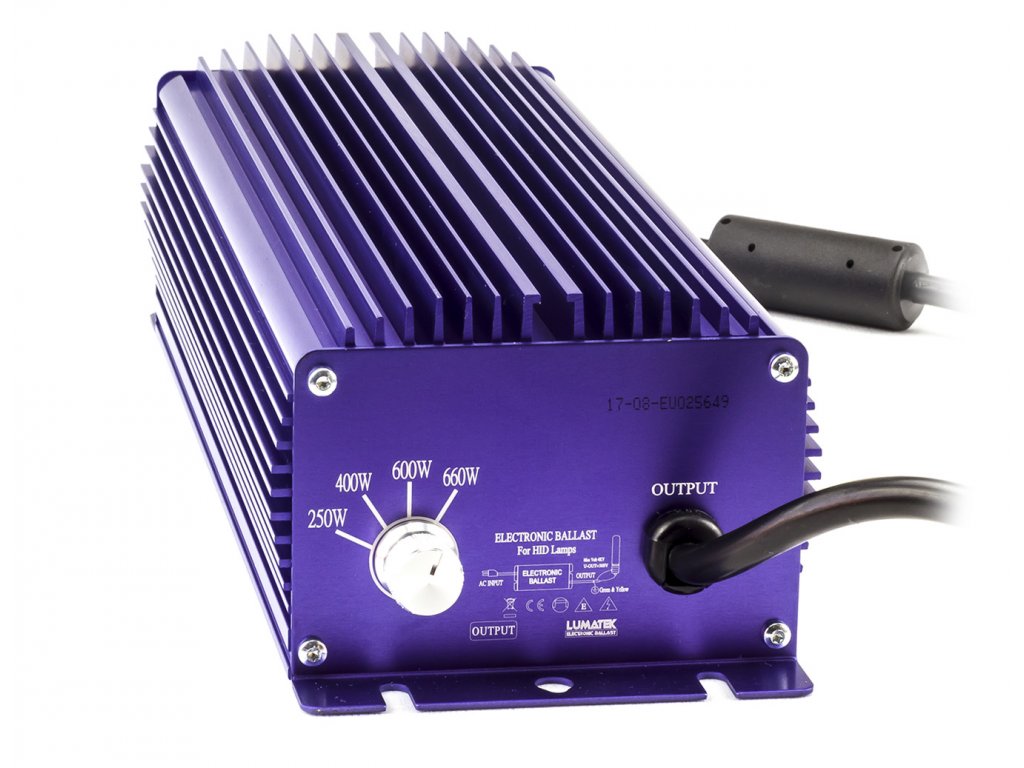
b) Electronic (Digital) - Modern ballasts based on a frequency voltage converter. They operate at a frequency of 30 - 50 kHz (approximately 1,000 times higher frequency). Thanks to the electronics, they react immediately to fluctuations in the grid and always deliver the optimal voltage and current. Most digital ballasts allow power switching, so they can be used with discharge lamps of different wattages (a popular setup is a 400 W growth discharge lamp and a 600 W flowering discharge lamp). Efficiency is also significantly higher, as the power consumption of the ballast itself is approximately one third of that of the magnetic variant. It contains no transformer and is therefore completely silent. The components do not change their properties over time, so their efficiency remains the same throughout their service life. The mean service life, that is, the average lifespan, of digital ballasts is also significantly longer than that of their magnetic predecessors, and they are therefore better in practically every respect. However, these advantages come at a higher purchase price, which is nevertheless returned several times over through the savings during the life of the electronic ballast.
¨
5) What is the difference between the individual ballast brands? - Whether magnetic or electronic ballasts, it always depends on the components used, that is, their quality as well as their price, which allows the manufacturer to significantly influence both the lifespan and the efficiency of the ballast.
6) Which ballasts do you recommend then? - Generally, those that we have tested ourselves and those that are popular among our customers. Mainly:
- Among magnetic ballasts, we recommend the time-tested LUMii Black ballasts. They have a protective casing and IEC connectors, thanks to which they have a lower surface temperature and also work on a Plug & Play principle. So there is no cable wiring.
- For digital ballasts, we recommend Lumatek ballasts, which offer maximum quality for their price, a 5-year warranty and excellent warranty service. In terms of price-performance ratio, we then recommend LUMii Black ballasts (not to be confused with their magnetic variant of the same name), which are very reliable.
- A separate category is 400V Lumatek ballasts, which deliver up to 15% more light at the same power consumption, but we will talk about those another time.
Which Light to Choose for a Grow Tent - Discharge Lamps, Part 2.
In the previous article we looked at which lamp wattage is suitable for tents of different sizes. But which type of lamp should you choose?
The basic types of lamps include MH (metal halide) and HPS (High Pressure Sodium). The basic difference between these two lamps is the composition of the light spectrum they emit. 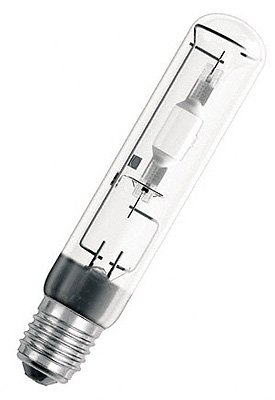

MH lamp on the left and HPS lamp on the right
MH (Growth) - For growth, a light source with a higher proportion of blue light is suitable, which plants in the growth stage can use better - in this way the lamp imitates the light emitted in spring, when the plant is growing and there is still plenty of time before "winter". This light is best imitated by an MH lamp and is therefore always labelled as a growth lamp. Although it cannot emit the same amount of visible light as an HPS lamp (the figure given in lumens), it can still produce more suitable light for growth at the same power consumption than an HPS lamp with a higher proportion of visible spectrum and thus a higher lumen value. MH lamps are also characterised by a higher colour temperature, ranging between 4000K and 6000K, with values close to the 4000K limit being used more often for cultivation.
HPS (Flowering) - The plant can make much better use of the yellow-red part of the spectrum, which imitates summer weather and, together with the shortening of daylight, causes the plant to flower in order to ensure the survival of its species into the next growing season. HPS lamps best imitate this period and have a light spectrum composition adapted to it. An HPS lamp usually has a colour temperature (chromaticity) between 2000K and 3000K.
For comparison, an illustrative graph of the light spectrum of MH and HPS lamps 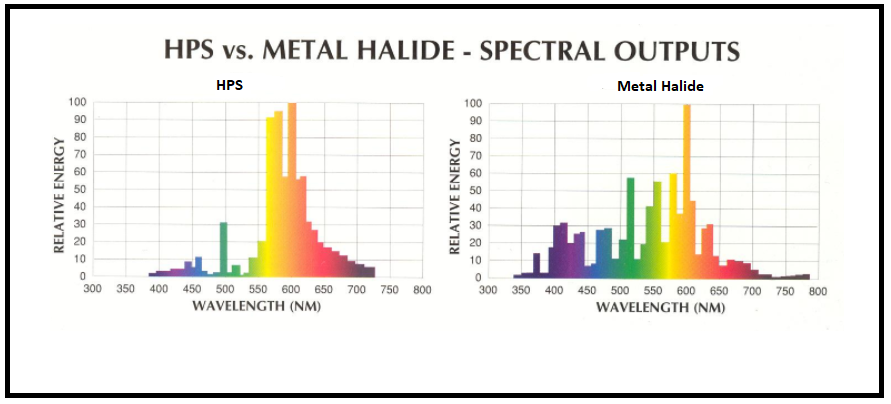
In the previous article, I also promised you a tip on how to use the energy from the lamp to the maximum. The principle is very simple. If you use the most common 600W lamp, buy a 600W HPS lamp and a 400W MH lamp. Your plants are still small during growth and do not need as much light as they do during flowering. Save money and buy a weaker lamp, and save further on energy.
If you use a setup with a 400W HPS lamp, you can use a 250W MH lamp for growth, or conversely, with a 1000W HPS lamp you can use a 600MH lamp for growth.
DO NOT FORGET that you will need a switchable ballast, which will allow you to use 2 different lamps so that you do not burn out the weaker lamp before you even start. More about ballasts can be found in our article what do I need a ballast for?
Prima Klima Azerwing vs Adjust-a-Wings
For several years now, Prima Klima, best known for its reliable fans and filters, has also been manufacturing reflectors for discharge lamps. Prima Klima calls its reflector range Azerwing and is trying to compete with the better-known manufacturer that introduced this reflector design at Adjust-a-Wings. Just like Adjust-a-Wings, Prima Klima Azerwing reflectors are made in 2 sizes, M and L, which match their better-known competitor in dimensions and recommended use, and also in 2 quality levels. Prima Klima Azerwing reflectors without a suffix are a direct competitor to the cheaper Adjust-a-Wings Defender range, while Azerwing Vegagreen reflectors compete with the very best from Adjust-a-Wings, namely the Avenger range.
Adjust a Wings Avenger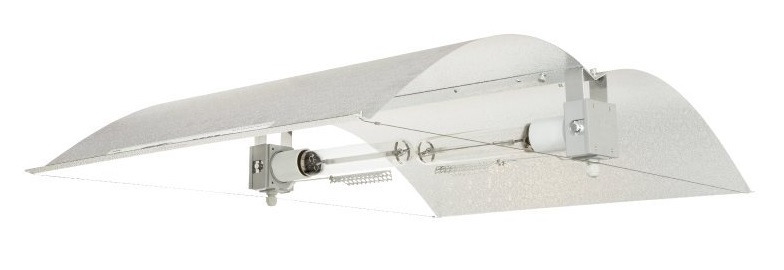
In practice, the reflectors use different but very similar materials, which in tests achieve very similar results in the percentage of reflected light. In the cheaper Adjust-a-Wings Defender and Prima Klima Azerwing ranges, this is around 86%, and compared with their cheaper competitors with a different construction they have the advantage mainly of distributing light evenly across the entire growing area, without pronounced so-called heat spots, that is, places where reflected light concentrates and can therefore burn the plant locally, while elsewhere the plant lacks light.
The more expensive variants, namely Adjust-a-Wings Avenger and Prima Klima Azerwing Vegagreen, are top-quality reflectors with reflection between 95-98% depending on the testing methodology, and you will not find anything better on the market unless you look at systems that are an order of magnitude more expensive.
Prima Klima Azerwing Vegagreen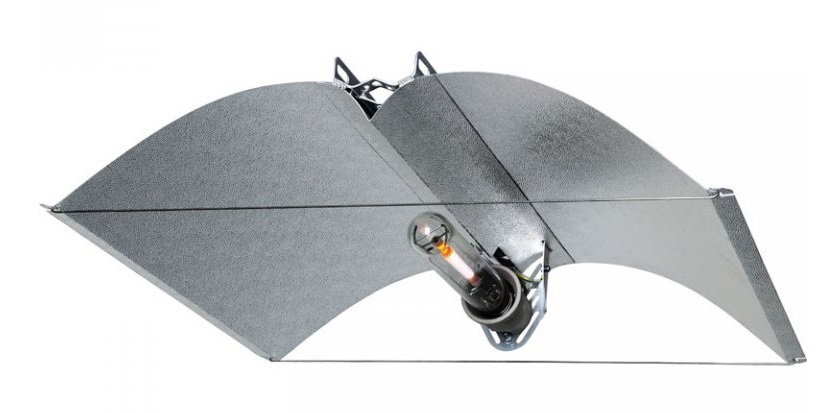
So far, we have said that Adjust-a-Wings and Prima klima Azerwing reflectors are almost the same and, according to growers' experience, differ only in details. So what is the difference?
The first and probably most important difference when choosing will be the price. Adjust-a-Wings reflectors are approximately 30-50% more expensive than their younger competitors from Prima Klima Azerwing. The second major difference is the complexity of installation. Prima Klima Azerwing reflectors cover the centre of the reflector with a special part for better light distribution, which makes assembly more complicated and does not show any demonstrable advantage in tests. It should be said, however, that this is not a disadvantage either and, if nothing else, in my subjective view it looks more "professional". However, because of this, putting together an Adjust-a-Wings reflector is quicker and easier.
It is therefore up to you whether you choose a well-known, time-tested brand with simple installation, or a newer, cheaper brand with more demanding installation. In neither case will you make a mistake, and you will have a quality home for your discharge lamps for many years!
Videos clearly showing how each reflector is assembled:
Prima Klima Azerwing:
How High Should You Hang the Light Above the Tops of the Plants?
A simple question, a simple answer. Yet for anyone who is starting to grow plants indoor in a grow tent, it is so fundamental that we have decided to explain it in more detail in this article. Read on to find out what the advantages of LED lamps are and why, unlike discharge lamps, you can place them safely very close to the tops of your plants.
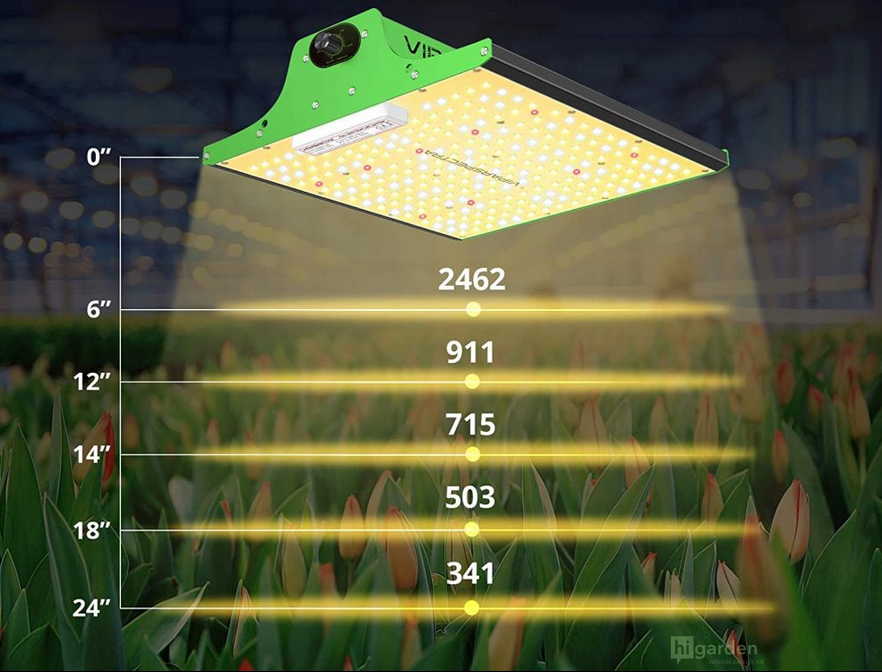
The answer to the question posed in the title is, of course, always the same: as close as possible.
- However, if you use, as most growers still do, classic high-pressure grow box discharge lamps (HPS, MH, etc.) as a powerful source of artificial lighting in a grow box, there is one significant catch. Discharge lamps are powerful, but together with the light radiation they release a considerable amount of heat into the enclosed growing space, and thus also into the immediate surroundings of the plants, which can harm them.
- It is therefore necessary to be very careful to ensure that you illuminate the plants sufficiently intensely, but at the same time do not burn them! This is not at all an easy task, especially at the beginning, and even more so if you only have a limited growing space and, like every grower in the world, your aim is the richest possible harvest made up of plants with lush flowers.
- When you move young seedlings under a powerful discharge lamp, we recommend hanging the lamp initially somewhat higher than is strictly necessary, with a certain margin, so that the plant can first get used to the intense light in the early stage of development. Depending on its growth, we raise the lamp to an appropriate height so that we use the light to the full.
- How can you tell that it is neither unnecessarily high nor too low? When using discharge lamps, the simplest way to find out whether the heat will not harm the plants is to hold your hand above their tops for one minute.
- Once the minute has passed and you still feel only pleasant warmth on your hand, similar to what the sun can create on your skin during a summer day, everything is fine.
- However, if you can barely keep your hand under the lamp after a minute and it is no longer particularly pleasant, then it is certainly not right for the plants either, and you need to address how to cool the air in the growing space effectively.
- If you cannot use the very simplest solution, which is to hang the discharge lamp higher above the tops of the plants to eliminate the risk of burning them, the following options are available:
- For example, the popular Mammoth Pro+ HC grow tents have a structure that is 25 cm taller precisely so that the enclosed growing space provides enough room for plant growth and for placing all accessories, including the lighting source, and in the case of a discharge lamp, at a safe distance from the tops of the plants.
- Cooltube
- More powerful ventilation
- The above options, however, are also associated with additional costs, and if you enjoy indoor growing, you should definitely start considering the advantages that full-spectrum LED lamps bring to growers, such as those made by Lumatek or Viparspectra.
- Because HPS discharge lamps need to be hung much higher above the plants, the plants naturally tend to stretch towards the light.
- Grow tents with an increased structure are a good solution, but if you have recently bought a grow box, the clearly best investment is a modern LED lamp, with which you will never again have to deal with the question, “How high above the tops should the lamp be hung?” You can dismiss it and look forward to a great harvest. So no more waving your hand under a discharge lamp.
The point, then, is that “LEDs” allow you to use the growing space to the maximum, and unlike discharge lamps, where you must constantly watch out for the risk of burning the plants, you can place them very close to the tops. If you are looking around for a new grow tent, then raised grow boxes are a practical choice, whether you grow with a discharge lamp or prefer LED lighting.
If you have any questions on the topic of MICROGREENS, we will be happy to answer them at the well-known address info@higarden.eu.
We also recommend these products:
- Viparspectra PRO Series P600 (2,990 Kč)
- Lumatek ZEUS 600W PRO 2.9 (24,990 Kč)
- Mammoth Pro+ HC grow tents (from 5,990 Kč)
What to read next?
How to Use UV Radiation in Indoor Growing?
Ultraviolet radiation, whose natural source is the Sun, can also be provided to plants we grow in the comfort of our homes, supporting them during both the growth and flowering phases. Broaden your horizons in indoor gardening and read this article for all the essential information about UV radiation and its influence on plant development.
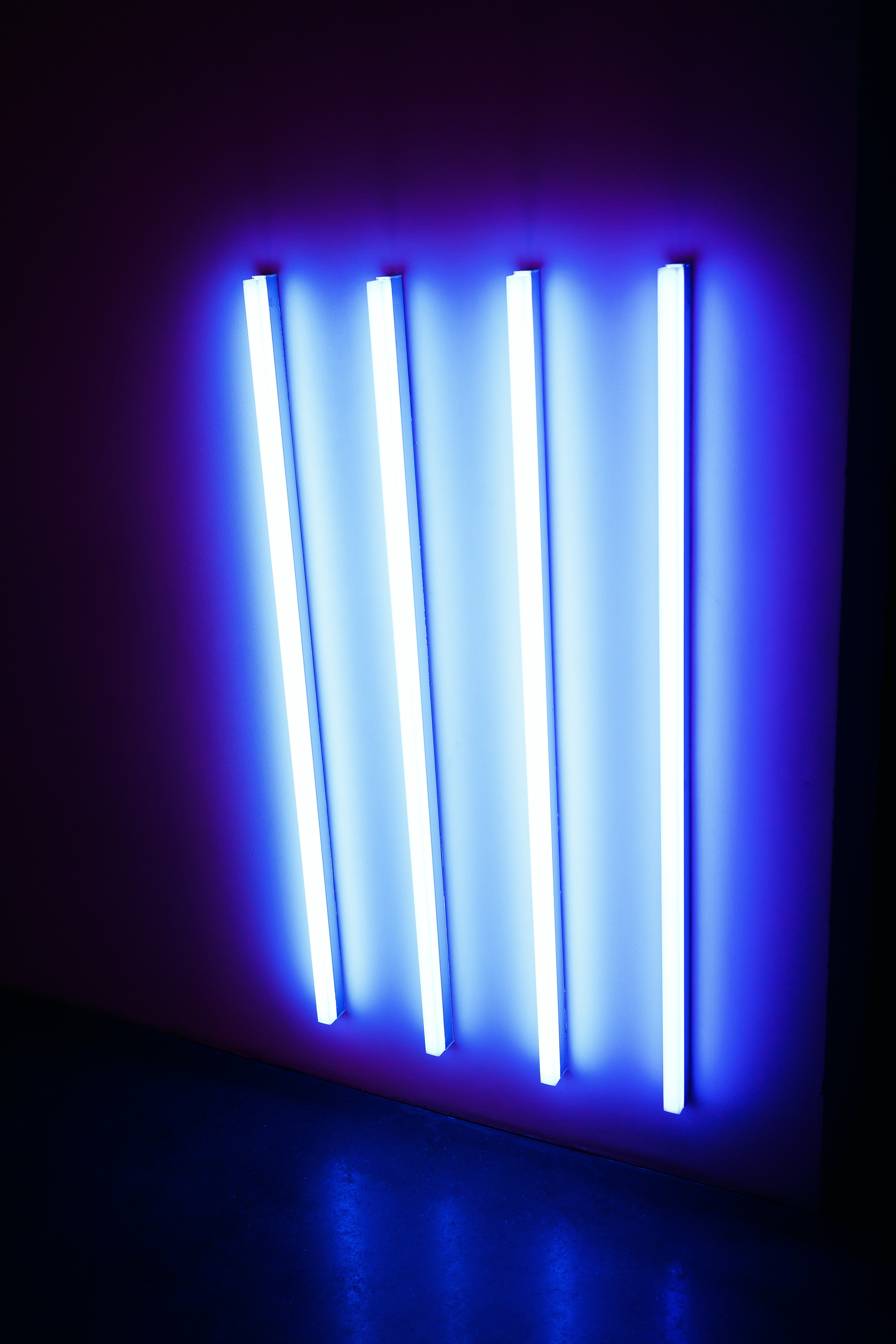
- What is UV, or ultraviolet radiation? You may still remember the answer to this question from physics lessons. It is electromagnetic radiation with a wavelength shorter than visible light, but at the same time longer than X-ray radiation. As a result, UV radiation is invisible to the human eye. For growers, however, the important fact is that a short wavelength means high light energy. And if, as a grower, you decide to use a UV lamp during cultivation processes, wavelength plays a crucial role in its selection.
- Did you know that there are several types of UV radiation? Yes, that is correct, and each type of UV radiation affects plants completely differently. It will probably not surprise you that the individual types of ultraviolet radiation are distinguished precisely by wavelength as follows:
- UVA: 315–400 nm
- A harmless light spectrum present in ordinary daylight, to which our skin is accustomed thanks to the sun.
- For plants grown in indoor environments, it is useful blue light that simulates natural sunlight, especially in those parts of the growing area where the primary source (výbojka, LED light) of artificial lighting does not reach sufficiently.
- This radiation is especially useful during the vegetative phase of plants.
- UVB: 280–315 nm
- This type of UV radiation is captured by the ozone layer.
- It is harmful to people in larger amounts.
- It has a negative effect on the photosynthetic activity of plants, which, however, may be desirable during the flowering phase, and therefore growers use it in reasonable amounts for higher yields and also to make the most of the genetic potential of herbs, for example with regard to beneficial active compounds.
- It also affects the intensity of the taste and scent of flowers or fruits.
- UVC: less than 280 nm
- The strongest form of UV radiation.
- The radiation penetrates cellular structures.
- It destroys viruses, bacteria, mould spores and microorganisms.
- It is used for water disinfection and sterilisation of spaces, including growing areas.
- Reliable sterilisation of your grow box is ensured by high-quality germicidal lamps.
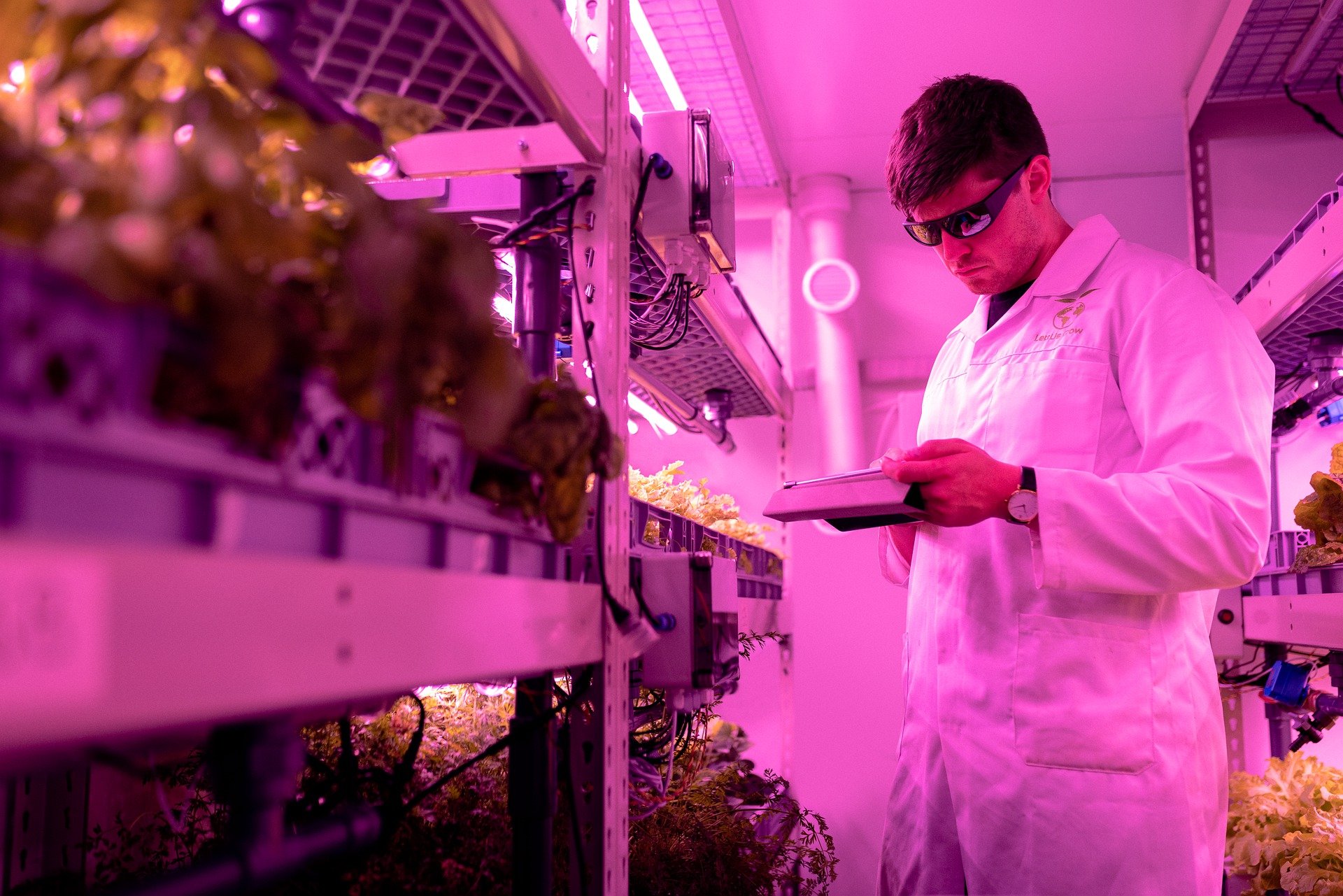
- Using all the above-mentioned types of UV radiation when growing indoor requires a certain discipline; otherwise, you could quite easily burn your precious little plants.
- We therefore recommend starting with a shorter lighting period, and if you consider it appropriate, you can gradually extend it. However, an ideal lighting time practically does not exist in the case of UV lamps, and it depends greatly on the individual characteristics and needs of each plant.
- Another way to prevent burning is to place the lamp emitting ultraviolet radiation at a sufficient distance from the plants. These are the recommended minimum distances:
- Discharge lamps: 40–60 cm
- LED lights: 30–40 cm
- Fluorescent tubes, energy-saving lamps, or less powerful LED lights, etc.: 10–15 cm
Are you looking for suitable lighting with UV radiation? Our specialists are available to you at the well-known address info@higarden.eu. We look forward to your questions!
We also recommend these products:
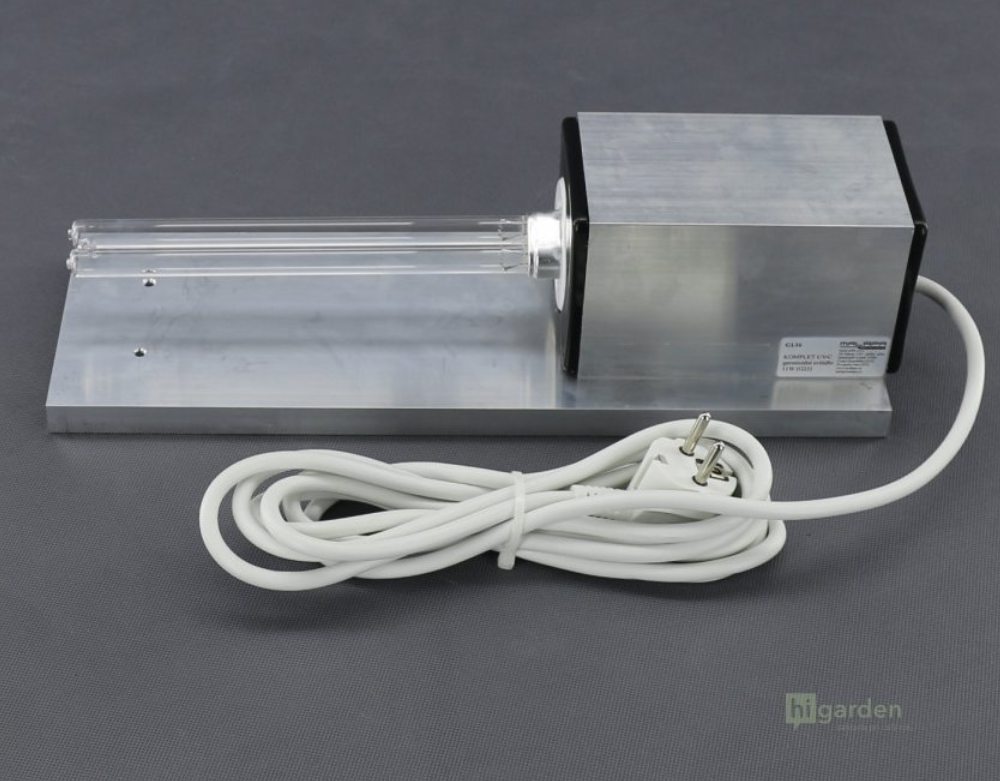
- GL16 – COMPLETE UV-C germicidal light 11 W (G23) (1,790 Kč)
- LUMii Black Digital complete 600 W KIT (2,990 Kč)
- Aerated HERCULES pots (from 49 Kč)
What should you read next?
- SHOGUN: The best British fertilisers with an emphasis on research
- How powerful a discharge lamp should you choose?
- succulents?